

The Enduring Enigma: Exploring the Concept of the Soul in Ancient Philosophy
The concept of the soul stands as one of the most persistent and perplexing subjects in the history of philosophy. From the earliest musings of the Pre-Socratics to the intricate metaphysics of Neoplatonism, ancient thinkers grappled with its nature, its connection to the body, its immortality, and its role in defining human being. This pillar page delves into the foundational ideas that shaped Western thought on the soul, drawing extensively from the intellectual treasures housed within the Great Books of the Western World. We shall trace a journey from rudimentary notions of life-force to sophisticated arguments for a rational, immortal essence, revealing how the understanding of the soul was inextricably linked to broader theories of reality, knowledge, and ethics.
Pre-Socratic Foundations: The Soul as Life-Force
Before the grand systems of Plato and Aristotle, early Greek philosophers – often termed the Pre-Socratics – began to move beyond purely mythical explanations for life and consciousness. Their inquiries, though varied, often linked the soul (psyche) to fundamental cosmic elements or principles, marking the nascent stages of metaphysical thought.
-
Early Materialist Views:
- Thales: Though not directly addressing the soul, his assertion that "all things are full of gods" and that magnets possess a psyche suggests an animating principle inherent in matter.
- Anaximenes: Proposed that air, when rarefied or condensed, constitutes all things, including the soul. Our soul, being air, holds us together, and breath (air) is life itself.
- Heraclitus: Famously declared that "the soul is a vapor which is dry and warm," and that a dry soul is the wisest and best. He saw the soul as fundamentally fiery, reflecting his emphasis on flux and change.
- Empedocles: Advocated for the transmigration of souls, suggesting a cycle of rebirth for those who fall from a state of bliss. He saw the soul as composed of the four roots (elements) and driven by Love and Strife.
-
Pythagorean Mysticism: The Pythagoreans offered a profound departure from materialist views, introducing the idea of the soul as an immortal entity capable of transmigration (metempsychosis). For them, the soul was distinct from the body, trapped within it as a punishment, and destined to purify itself through a cycle of reincarnations. This concept profoundly influenced later thinkers, particularly Plato. Their philosophy began to separate the soul from mere biological function, hinting at its potential for higher knowledge and moral being.
Plato's Metaphysical Soul: Reason, Immortality, and Forms
With Socrates and his student Plato, the soul moved from being a principle of life to the very core of human identity, morality, and knowledge. Plato's philosophy established a profound dualism between the immortal soul and the mortal body, a distinction that would reverberate through centuries of Western thought.
Socratic Precursors: The Care of the Soul
Socrates, as depicted in Plato's dialogues, shifted the focus of philosophy from cosmology to ethics and the human condition. His famous dictum, "the unexamined life is not worth living," underscores his belief that the ultimate purpose of human existence is the care of the soul. For Socrates, the soul was the seat of intelligence and character, the essence of a person, and virtue was its health. He believed that true knowledge was self-knowledge, and that by purifying the soul through rational inquiry, one could achieve a good life. This emphasis laid the groundwork for Plato's more elaborate metaphysical system.
The Tripartite Soul and its Cosmic Journey
Plato's theory of the soul, most notably articulated in the Republic and Phaedo, posits an eternal, non-material entity that pre-exists and survives the body. He argues for the soul's immortality through various proofs, including the argument from recollection (learning is remembering knowledge the soul possessed before birth) and the argument from opposites (life comes from death, and death from life).
Plato further divides the soul into three distinct parts, each with its own function and corresponding virtue:
| Part of the Soul | Function | Location (Metaphorical) | Virtue |
|---|---|---|---|
| Reason (λογιστικόν) | Seeks truth, governs, deliberates | Head | Wisdom |
| Spirit (θυμοειδές) | Seeks honor, courage, indignation | Chest | Courage |
| Appetite (ἐπιθυμητικόν) | Seeks bodily pleasures (food, sex, drink) | Abdomen | Temperance/Self-Control |
The harmonious functioning of these three parts, with Reason guiding the Spirit and controlling the Appetites, constitutes a just and virtuous individual. This internal order mirrors the ideal state (polis) and reflects the soul's connection to the eternal Forms, Plato's ultimate reality. The soul's journey, for Plato, is one of ascent, seeking to return to the realm of pure Forms from which it originated, striving for true knowledge and understanding of Being.
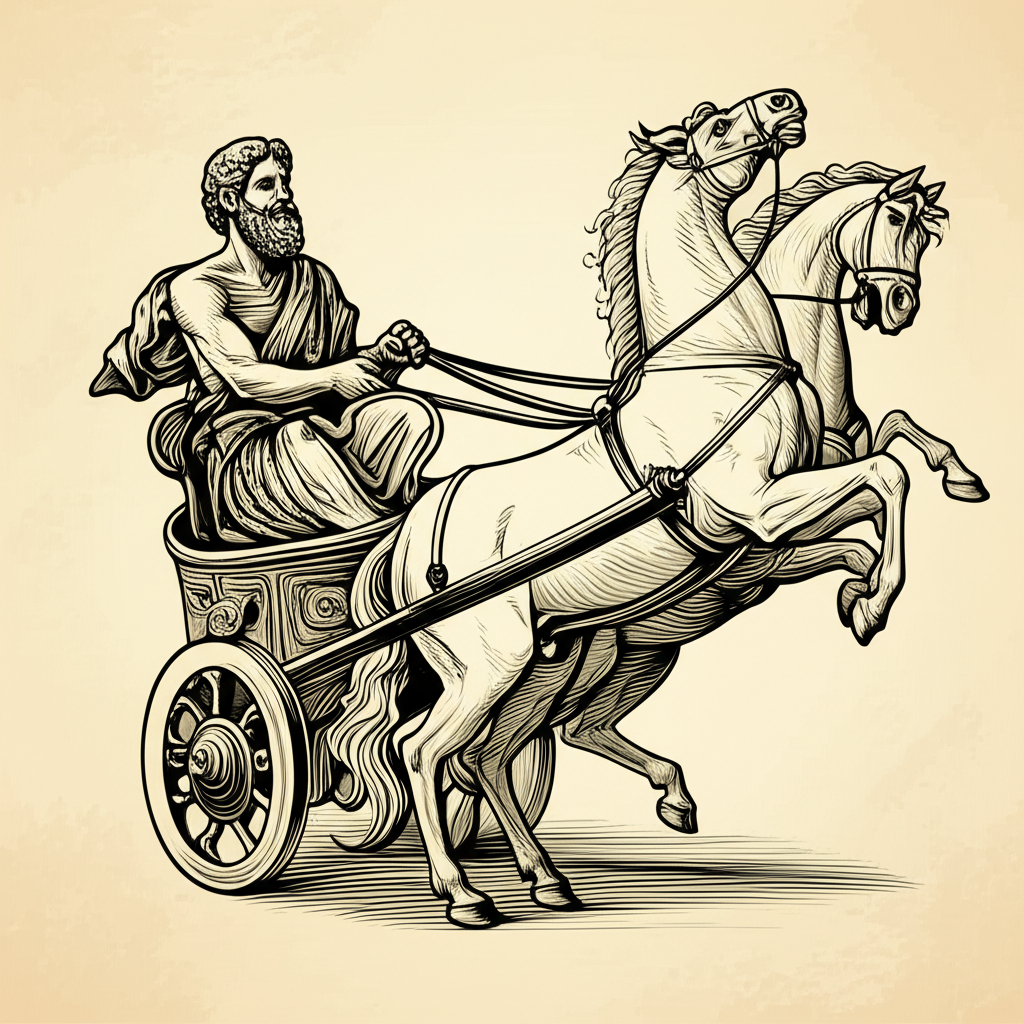 skillfully guiding two winged horses—one noble and white (symbolizing spirit) and the other dark and unruly (representing appetite). The charioteer strains to direct them upwards towards a luminous, abstract realm of perfect geometric shapes and ideas (the Forms), while the turbulent, shadowy physical world lies far below, illustrating the soul's struggle and aspiration.)
Aristotle's Hylomorphic Soul: Form, Function, and Being
Aristotle, Plato's most famous student, offered a radically different, yet equally profound, perspective on the soul. Moving away from Platonic dualism, Aristotle's philosophy presented the soul not as a separate entity trapped in the body, but as the form of the body, its organizing principle and actualizing force. His treatise De Anima (On the Soul) is a foundational text in understanding his views.
The Soul as Entelechy
For Aristotle, the soul is the "first entelechy" of a natural organized body having life potentially. This means the soul is the form (eidos) of the body, just as the shape of an axe is its form, enabling it to cut. It is not a substance separate from the body, but rather the principle that gives the body its specific structure and capacities. The soul is what makes a living thing alive, and it cannot exist without a body, just as a body cannot be alive without a soul. This concept is known as hylomorphism (matter + form).
Hierarchy of Living Beings
Aristotle identified a hierarchy of souls, each possessing specific faculties:
- Vegetative Soul: Possessed by plants. Its primary functions are nutrition, growth, and reproduction. It is the most basic principle of life.
- Sensitive Soul: Possessed by animals. It includes all the functions of the vegetative soul, plus sensation (perception), desire, locomotion, and imagination.
- Rational Soul: Possessed by humans. It includes all the functions of the sensitive soul, plus the unique capacity for thought, reason, and deliberation. This is the highest form of soul.
For Aristotle, the rational soul is what defines human being. While he did not believe in the immortality of the individual soul in the Platonic sense, he did ponder the nature of the "active intellect" (nous poietikos), a part of the rational soul that might be separable and immortal, though this remains a complex and debated aspect of his philosophy. His empirical approach grounded the discussion of the soul in observable biological processes, yet still engaged with deep metaphysical questions about the essence of life and consciousness.
Hellenistic Divergences: Materialism, Ethics, and Transcendence
Following the classical period, Hellenistic philosophy continued to explore the soul, often within the context of ethical systems aimed at achieving tranquility and a good life. These schools offered diverse perspectives, some embracing materialism, others reaching for transcendence.
Stoic Breath and Cosmic Reason
The Stoics viewed the soul as a material substance, specifically a refined form of pneuma (a fiery breath or air). This pneuma was considered a fragment of the divine logos (universal reason) that pervades the cosmos. While material, the Stoic soul possessed rational faculties that allowed humans to live in accordance with nature and reason. They believed the soul survived the body for a period after death, eventually rejoining the cosmic logos. Their philosophy emphasized virtue, duty, and emotional resilience, all rooted in the rational faculty of the soul.
Epicurean Atoms and Mortal Tranquility
Epicurus and his followers held a decidedly materialist view of the soul. They believed the soul was composed of fine, smooth atoms dispersed throughout the body. These atoms were responsible for sensation and thought. Crucially, the Epicureans argued that upon death, the soul's atoms disperse, meaning the soul is mortal and ceases to exist with the body. This mortalist view was central to their ethical philosophy, which aimed to free individuals from the fear of death and the afterlife, allowing them to pursue pleasure (understood as the absence of pain and mental disturbance) in this life.
Neoplatonic Ascent: The Soul's Divine Origin
Centuries later, Neoplatonism, particularly through the philosophy of Plotinus, revitalized and transformed Plato's ideas. For Plotinus, the soul was a divine emanation from "The One," the ultimate, ineffable source of all being. The individual soul is part of the "World-Soul," which in turn emanates from the Intellect (Nous), which emanates from The One. The human soul descends into the material world, becoming entangled with the body, but retains the capacity to ascend back to its divine source through contemplation and mystical union. This highly metaphysical system emphasized the soul's transcendent nature, its potential for purification, and its journey towards ultimate unity with the divine.
The Enduring Legacy of Ancient Soul Concepts
The diverse and profound inquiries into the concept of the soul by ancient philosophers laid the groundwork for millennia of Western thought. From the rudimentary identification of the soul with life-force to Plato's grand dualism and Aristotle's intricate hylomorphism, these thinkers grappled with fundamental questions about consciousness, identity, immortality, and the very nature of being. Their debates illuminated the intrinsic link between the soul and a comprehensive worldview, shaping not only metaphysics but also ethics, psychology, and theology. The questions they posed—what is the soul? Is it immortal? What is its relation to the body? How does it enable us to know and act?—remain central to philosophy to this day, a testament to their enduring intellectual legacy.
📹 Related Video: PLATO ON: The Allegory of the Cave
Video by: The School of Life
💡 Want different videos? Search YouTube for: "Plato's Theory of the Soul Explained"
📹 Related Video: ARISTOTLE ON: The Nicomachean Ethics
Video by: The School of Life
💡 Want different videos? Search YouTube for: "Aristotle's De Anima Summary"