

The Concept of the Soul in Ancient Philosophy: A Journey Through Metaphysics and Being
The concept of the soul stands as one of the most enduring and perplexing subjects within the annals of philosophy. From the earliest musings of the pre-Socratics to the intricate systems of Plato and Aristotle, ancient thinkers grappled with its nature, function, and ultimate destiny. This pillar page delves into the rich tapestry of ancient philosophical thought concerning the soul, exploring how different schools understood its relationship to the body, its role in ethics, its place within metaphysics, and its very essence as a form of being. We will journey through the foundational ideas that shaped Western thought, revealing the profound questions that continue to resonate in contemporary discussions about consciousness, identity, and the human condition.
The Dawn of Inquiry: Pre-Socratic Speculations on the Soul
Before the systematic inquiries of the classical period, early Greek thinkers, often referred to as pre-Socratics, began to probe the nature of existence, and in doing so, touched upon the soul. Their investigations were often intertwined with their cosmologies, seeking a fundamental principle (arche) that governed the universe and, by extension, human life.
- Anaximenes (c. 585–528 BCE): Proposed that air (pneuma) was the arche, and that the soul was a form of air, vitalizing the body. Just as air encompasses the world, so too does the soul hold the body together.
- Heraclitus (c. 535–475 BCE): Believed in an ever-changing cosmos, characterized by fire. For Heraclitus, the soul was also fiery, its quality determining one's wisdom and moral character. A dry, fiery soul was considered wisest, while a wet soul indicated intoxication or foolishness.
- Pythagoras (c. 570–495 BCE): Introduced the concept of the soul's immortality and its transmigration (reincarnation). For Pythagoreans, the soul was distinct from the body, a divine spark trapped within it, destined to purify itself through a cycle of rebirths. This marked a significant shift towards viewing the soul as a separate, enduring entity.
These early explorations laid the groundwork, introducing the idea of the soul as a principle of life, consciousness, and even moral essence, paving the way for more sophisticated analyses.
Socrates and the Ethical Soul
With Socrates (c. 470–399 BCE), the focus of philosophy shifted dramatically from cosmology to ethics and the human condition. For Socrates, the soul (psyche) was not merely a life-giving force but the very core of one's moral and intellectual character.
Socrates famously asserted that "the unexamined life is not worth living," emphasizing the paramount importance of self-knowledge. He believed that caring for one's soul was the highest duty, far surpassing the care of the body or material possessions. The soul, in his view, was the seat of intelligence, virtue, and one's true self.
- Ignorance as the Root of Evil: Socrates argued that all wrongdoing stemmed from ignorance. If one truly knew what was good, they would always choose it. Therefore, virtue was knowledge, and the cultivation of the soul involved purifying it through rigorous self-examination and rational inquiry.
- The Soul's Immortality (Implied): While Socrates did not offer a detailed metaphysical argument for the soul's immortality, his unwavering commitment to its moral integrity and his serene acceptance of death in the Phaedo strongly suggest a belief in its enduring nature, independent of the body. His emphasis on the soul's capacity for reason and virtue positioned it as something transcendent, a crucial step toward Plato's more elaborate theories.
Plato's Tripartite Soul and the Realm of Forms
Plato (c. 428–348 BCE), Socrates' most famous student, developed a comprehensive and influential theory of the soul that integrated ethics, metaphysics, and epistemology. For Plato, the soul was not only immortal but also pre-existent, having resided in the Realm of Forms before incarnating into a body.
The Tripartite Soul
Plato famously divided the soul into three distinct parts, often illustrated by his allegory of the charioteer:
- The Rational Part (Logistikon): Located in the head, this is the divine, immortal part of the soul. It is responsible for reason, thought, and the pursuit of truth. Its virtue is wisdom. The charioteer represents this part, guiding the horses.
- The Spirited Part (Thymoeides): Located in the chest, this part is mortal and the seat of emotions like anger, honor, courage, and ambition. Its virtue is courage. It acts as an ally to reason, helping to control the appetites. One of the horses, noble and obedient, represents this part.
- The Appetitive Part (Epithymetikon): Located in the belly and genitals, this part is also mortal and responsible for basic desires and bodily urges such as hunger, thirst, and sexual desire. Its virtue is temperance. The other horse, unruly and prone to desire, represents this part.
For a well-ordered individual and a just society, the rational part must govern the spirited and appetitive parts, achieving internal harmony. This internal balance is crucial for achieving true virtue and happiness.
The Soul's Immortality and Connection to the Forms
Plato presented several arguments for the soul's immortality, most notably in the Phaedo.
- The Argument from Opposites: Life comes from death, and death from life, suggesting a cycle of existence where the soul must persist.
- The Argument from Recollection (Anamnesis): Our ability to recognize perfect concepts (like equality or beauty) that we never directly experience in the physical world implies that our souls must have encountered these perfect Forms in a prior existence. This is a direct link between the soul and Plato's theory of Forms, a cornerstone of his metaphysics.
- The Argument from Simplicity: The soul, being non-composite and akin to the eternal Forms, cannot be broken down or destroyed, unlike the material body.
Plato's metaphysics posits a hierarchy of being, with the eternal, unchanging Forms as the highest reality. The soul, by its rational nature, has an affinity with these Forms, striving to ascend from the shadows of the material world to the illumination of pure intellectual understanding. The soul's journey, through reincarnation and philosophical contemplation, is an effort to purify itself and return to its divine origin.
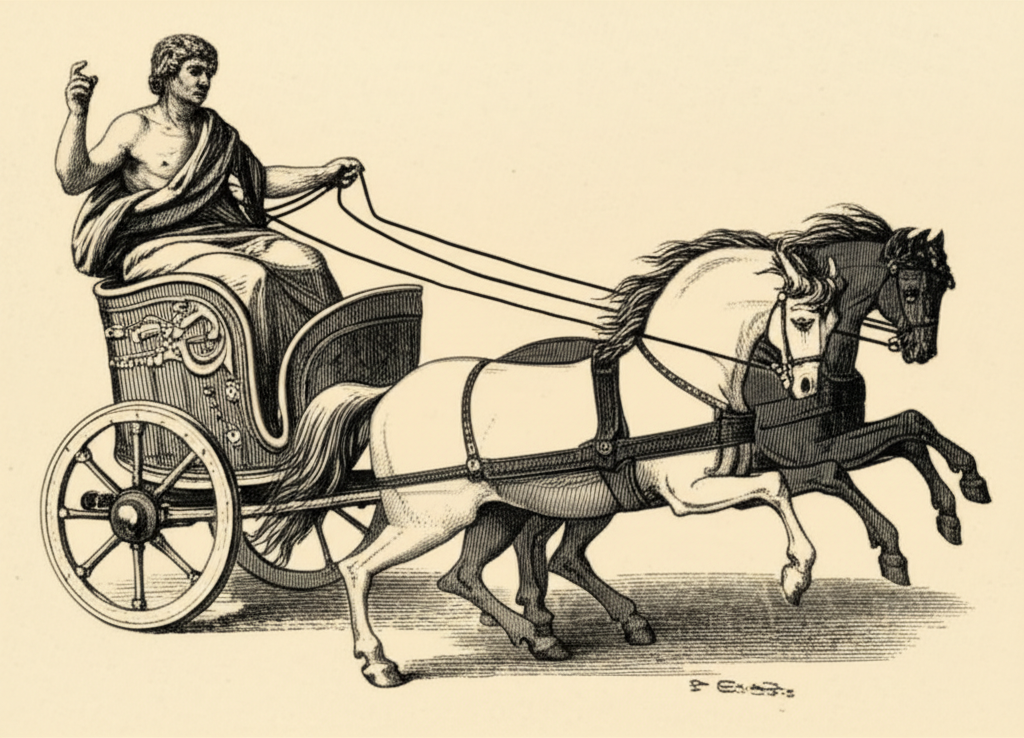 holding reins, guiding two winged horses – one noble and white (Spirit), the other unruly and dark (Appetite) – through a cosmic landscape towards a glimpse of transcendent, luminous Forms in the distance.)
Aristotle's Hylomorphic Soul: Form of the Body
Aristotle (384–322 BCE), Plato's most brilliant student, offered a radically different perspective on the soul, largely rejecting his teacher's dualism. In his seminal work, De Anima (On the Soul), Aristotle proposed a hylomorphic (matter-form) understanding, arguing that the soul is not a separate entity imprisoned in the body, but rather the form or actuality of a natural body that has life potentially.
The Soul as the Entelechy of the Body
For Aristotle, the soul is the first actuality of a natural body possessing organs. It is what makes a living thing alive, giving it its specific nature and capabilities.
- Not a Substance: The soul is not a separate substance (like a ghost in a machine) but rather the organization or principle of organization of the body. Just as the shape of an axe makes it an axe, the soul is the shape or form of the living body.
- Inseparable from the Body: The soul and body are inextricably linked. One cannot exist without the other, much like the impression on a seal cannot exist without the seal itself, or the cutting ability of an axe without the axe. When the body dies, the soul (in most of its aspects) perishes with it.
Types of Souls
Aristotle identified a hierarchy of souls, corresponding to different levels of life and complexity:
- Nutritive Soul (Vegetative Soul): Possessed by all living things (plants, animals, humans). It is responsible for basic life functions: growth, nutrition, and reproduction.
- Sentient Soul (Perceptive Soul): Possessed by animals and humans. It includes the functions of the nutritive soul, plus sensation (the five senses), desire, pleasure, pain, and locomotion.
- Rational Soul (Intellective Soul): Unique to humans. It includes the functions of the nutritive and sentient souls, plus the capacity for thought, reason, and understanding. This is the distinctively human being.
The Question of Immortality
Aristotle's view generally implies the mortality of the soul, as it is the form of a particular body. However, he introduced a complex distinction between passive intellect (which perishes with the body) and active intellect (which is "separable, impassive, and unmixed," potentially immortal and divine). This active intellect is not individual but universal, a pure being that acts upon the individual's passive intellect. This aspect of Aristotle's metaphysics has been a subject of intense debate and interpretation throughout the history of philosophy.
Hellenistic Perspectives: Stoics, Epicureans, and Neoplatonists
Following the classical period, Hellenistic philosophy continued to grapple with the soul, often in response to Plato and Aristotle, but with new emphases on ethics, tranquility, and the individual's place in the cosmos.
Stoicism: The Soul as Pneuma
For the Stoics, the cosmos was a rational, material whole governed by a divine logos or reason, often conceived as a fiery breath (pneuma). The human soul was a fragment of this divine pneuma, an emanation of the universal reason.
- Material and Mortal: The Stoics believed the soul was material, composed of fine air or fire, and therefore mortal. While some Stoics suggested it might persist for a short time after death before rejoining the universal pneuma, it was not considered individually immortal in the Platonic sense.
- Seat of Reason and Virtue: The soul's most important faculty was its ruling part (hegemonikon), which was responsible for reason, judgment, and the control of emotions. The goal of Stoic philosophy was to live in accordance with nature, cultivating virtue and achieving ataraxia (tranquility) by aligning one's reason with the cosmic logos.
Epicureanism: The Soul as Atoms
Epicurus (341–270 BCE) adopted Democritus's atomistic theory, applying it to the soul.
- Material and Mortal: The soul was composed of fine, smooth, rapidly moving atoms dispersed throughout the body. These soul atoms were responsible for sensation and thought.
- Perishes with the Body: When the body dies, the soul atoms disperse, and the soul ceases to exist. This mortality was not something to be feared, as Epicurus argued that "death is nothing to us; for that which has been dissolved into atoms has no sensation, and that which has no sensation is nothing to us." This understanding of the soul underpinned Epicurean ethics, which focused on achieving pleasure (absence of pain) in this life.
Neoplatonism: The Soul's Ascent to the One
Plotinus (c. 204–270 CE), the founder of Neoplatonism, revitalized and reinterpreted Plato's ideas, creating a complex metaphysical system centered on the concept of "The One," the ultimate, ineffable source of all being.
- Emanation and Hierarchy: Reality emanates from The One in a series of hypostases: Intellect (Nous), and then Soul (Psyche). The universal Soul then gives rise to individual souls.
- Individual Soul's Journey: The individual soul is immortal and retains its connection to the higher hypostases. It has fallen into the material world but yearns to return to its divine source. This journey involves philosophical contemplation, purification, and an ecstatic ascent back to The One, transcending the physical and even intellectual realms. For Plotinus, the soul is a bridge between the intelligible and sensible worlds, a crucial aspect of being that seeks ultimate unity.
Enduring Questions and Legacy
The ancient Greek engagement with the concept of the soul laid the indelible foundations for millennia of philosophical and theological inquiry. From the pre-Socratics' initial attempts to identify a life-principle, through Socrates' ethical reorientation, Plato's grand metaphysical synthesis of an immortal, tripartite soul linked to eternal Forms, and Aristotle's rigorous biological and functional analysis of the soul as the form of the body, these thinkers explored virtually every facet of this profound concept.
The Hellenistic schools, in turn, refined these ideas, sometimes reducing the soul to material elements, at other times elevating it to a conduit for divine unity. The questions they posed—What is the soul? Is it immortal? What is its relationship to the body? Is it the seat of identity, consciousness, or morality? How does it relate to being itself?—continue to animate contemporary philosophy and science. Their debates on substance dualism versus monism, the nature of consciousness, and the possibility of life after death are direct descendants of these ancient inquiries. The "Great Books of the Western World" stand as a testament to the enduring power and relevance of these foundational explorations into the innermost core of human existence.
📹 Related Video: PLATO ON: The Allegory of the Cave
Video by: The School of Life
💡 Want different videos? Search YouTube for: ""Plato's Theory of the Soul Explained" or "Aristotle on the Soul - De Anima Summary""
Conclusion
The ancient Greek philosophers bequeathed to us an unparalleled legacy regarding the concept of the soul. Their diverse and often conflicting theories underscore the complexity and profundity of this inquiry. Whether viewed as an immortal spark of divine reason, the animating form of a living body, or a fleeting arrangement of atoms, the soul remained central to their understanding of human being, ethics, and the very structure of reality. Their intellectual courage in confronting these ultimate questions continues to inspire and challenge us, demonstrating that the quest to understand the soul is, at its heart, the quest to understand ourselves.