

The Enduring Enigma: Unpacking the Concept of the Soul in Ancient Philosophy
The human fascination with the soul is as old as philosophy itself. From the earliest murmurs of self-awareness to the intricate systems of thought developed by the likes of Plato and Aristotle, ancient thinkers grappled with questions fundamental to our understanding of Being: What is the animating principle within us? Does it survive death? What is its nature, its purpose, its relationship to the body? This exploration of the soul, deeply intertwined with metaphysics and ethics, laid the foundational groundwork for millennia of Western thought. This pillar page delves into the diverse and profound ways ancient philosophy conceived of the soul, tracing its evolution from a mere life-force to a complex entity embodying reason, morality, and even divinity.
The Genesis of Inquiry: Early Greek Musings on the Soul
Before the systematic treatises of classical Athens, the concept of the soul, or psyche (ψυχή), began as a more nebulous idea, often associated with breath, life, and the shadow-like existence after death. Early Greek thought saw the soul as that which distinguishes the living from the dead, a vital essence that animated the body.
From Breath to Being: The Pre-Socratic Perspective
The first philosophers, the Pre-Socratics, began to move beyond purely mythic explanations, seeking naturalistic accounts for the Being of the soul.
- Anaximenes (c. 585–528 BCE): Proposed that the soul was made of air, just as the cosmos was. Breath (pneuma) was the soul, and when it left the body, life ceased.
- Heraclitus (c. 535–475 BCE): Believed the soul was a spark of divine fire, subject to flux and change, yet capable of profound depth. A dry soul, he argued, was the wisest and best.
- Pythagoras (c. 570–495 BCE): Introduced the radical idea of metempsychosis, or the transmigration of souls. For Pythagoras, the soul was immortal and divine, trapped in the cycle of rebirth through different bodies, striving for purification and liberation. This elevated the soul beyond a mere life-principle to an entity with its own destiny and moral journey.
These early thinkers, though diverse, collectively began the philosophical project of defining the soul, moving it from a simple animating force to a subject of profound metaphysical speculation.
Plato's Tripartite Soul: Reason, Spirit, and Appetite
No ancient philosopher explored the nature of the soul with more depth and influence than Plato (c. 428–348 BCE). For Plato, the soul was not merely a life-principle but the very essence of personhood, an immortal entity distinct from the perishable body. His works, particularly Phaedo, Republic, and Phaedrus, offer a rich tapestry of ideas concerning the soul's origin, structure, and destiny.
The Soul's Immortality and Divine Origin
Plato argued forcefully for the immortality of the soul, using various proofs, including the argument from recollection (learning is remembering knowledge the soul possessed before birth) and the argument from opposites (life comes from death, implying a return to life). The soul, for Plato, was akin to the Forms – eternal, unchanging, and divine – trapped in the material world.
The Chariot Analogy: A Model of Inner Conflict
In Phaedrus, Plato famously describes the soul as a charioteer (reason) guiding two winged horses: one noble and striving for honor (spirit), the other unruly and driven by base desires (appetite). This vivid analogy illustrates the internal struggle within the human psyche.
Table 1: Plato's Tripartite Soul
| Part of the Soul | Function / Role | Location (Metaphorical) | Virtue |
|---|---|---|---|
| Reason (λογιστικόν) | Seeks truth, wisdom, and knowledge; guides the soul. | Head | Wisdom |
| Spirit (θυμοειδές) | Seeks honor, courage, and righteous indignation; ally to reason. | Chest | Courage |
| Appetite (ἐπιθυμητικόν) | Seeks bodily pleasures, desires, and material gratification. | Abdomen | Temperance |
For Plato, a just individual and a just society arise when reason, guided by wisdom, governs the spirit and the appetites, leading to a harmonious and virtuous life. The ultimate goal of the soul, through philosophy, was to ascend back to the realm of the Forms, transcending the limitations of the body.
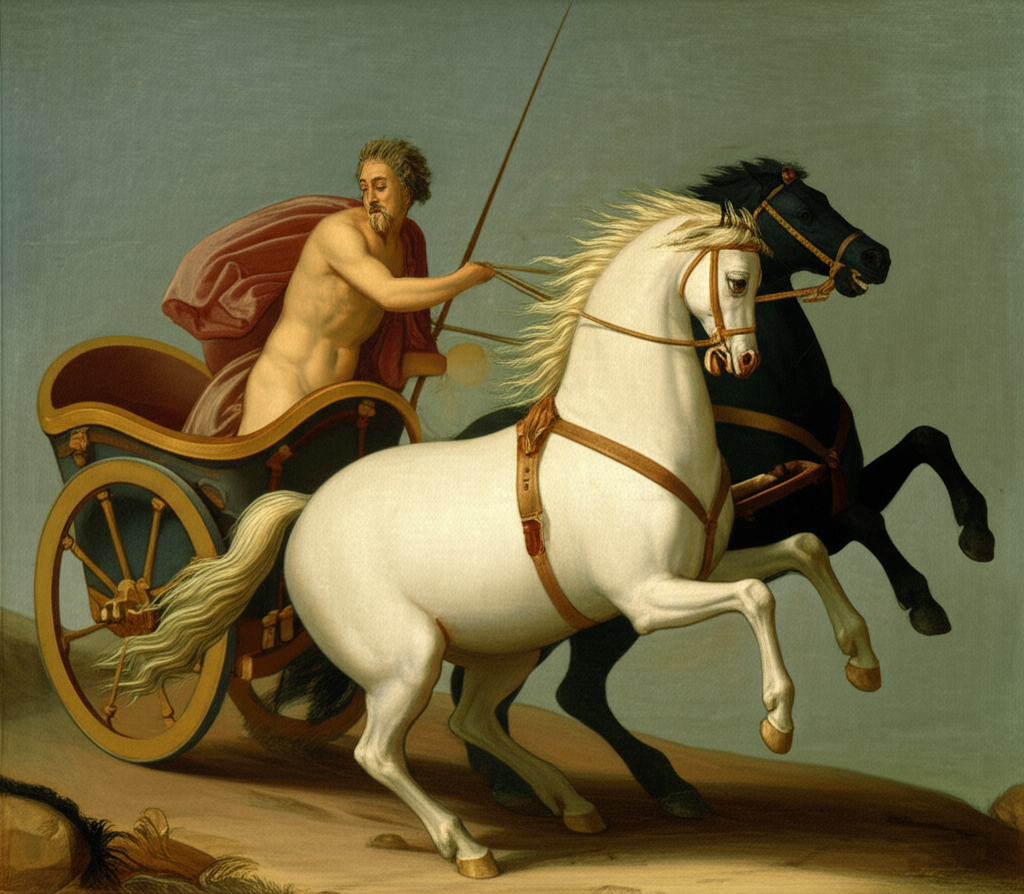 and a wild, dark horse (Appetite) upwards towards a realm of light and abstract forms, with the material world receding below.)
Aristotle's Entelechy: The Soul as Form of the Body
Aristotle (384–322 BCE), Plato's most famous student, offered a profoundly different, yet equally influential, account of the soul. In his seminal work, De Anima (On the Soul), Aristotle rejected Plato's dualistic view of a soul separate from and merely inhabiting the body. Instead, he proposed an intrinsic connection.
The Soul as the Form of a Natural Body Possessing Life Potentially
Aristotle famously defined the soul as the "first actuality of a natural body having life potentially." This means the soul is not a separate entity but the form or essence of a living organism, just as the shape of an axe is its form. It is the organizing principle that gives a body its specific capacities and functions. The soul is to the body as the impression is to the wax; they are inseparable.
Hierarchy of Souls: A Spectrum of Being
Aristotle identified a hierarchy of souls, corresponding to different levels of Being in the natural world:
- Nutritive Soul (Vegetative): Possessed by all living things (plants, animals, humans). Responsible for growth, reproduction, and nourishment.
- Sensitive Soul (Animal): Possessed by animals and humans. Includes the capacities of the nutritive soul, plus sensation, desire, and locomotion.
- Rational Soul (Human): Possessed only by humans. Includes the capacities of the sensitive soul, plus reason, thought, and contemplation. This is the highest form of soul, allowing for philosophy and intellectual pursuits.
For Aristotle, the soul is not immortal in the Platonic sense, as it is intrinsically linked to the body. However, he did suggest a potential for a separable "active intellect" within the rational soul, which has been a subject of extensive philosophical debate. His approach grounded the study of the soul in natural observation and biological function, deeply influencing subsequent scientific and philosophical inquiries into life and Being.
Beyond Greece: Other Ancient Perspectives
While Plato and Aristotle cast long shadows, other ancient schools of thought also contributed to the rich tapestry of ideas concerning the soul, each with its unique metaphysics.
Stoic Materialism and Epicurean Atomism
- Stoicism: Believed the soul was a material entity, a refined breath or pneuma, a fragment of the divine fiery reason (logos) that permeates the cosmos. Though material, it was seen as the seat of rationality and virtue. They typically believed the soul might survive the body for a time but would eventually be reabsorbed into the cosmic fire.
- Epicureanism: Adhered to a strict atomic materialism. The soul, for Epicurus, was a collection of fine, smooth atoms dispersed throughout the body. It was mortal and disintegrated upon death, much like the body itself. This view aimed to free individuals from the fear of death and divine judgment.
Neoplatonic Ascent: The Soul's Return to the One
Later, Neoplatonists like Plotinus (c. 204/5–270 CE) developed Plato's ideas into a complex system of emanation. For Plotinus, the individual soul emanates from the World Soul, which in turn emanates from the ultimate, ineffable "One." The human soul, therefore, retains a longing to return to its divine source through intellectual and spiritual purification, a journey of ascent through various hypostases. This deeply mystical and metaphysical view profoundly influenced early Christian and Islamic philosophy.
The Enduring Legacy: Why the Ancient Soul Still Matters
The ancient philosophical inquiries into the soul were not mere academic exercises; they were urgent attempts to understand human nature, morality, and our place in the cosmos. These foundational discussions laid the groundwork for future philosophy, theology, psychology, and even neuroscience.
The questions posed by the ancients – concerning consciousness, identity, free will, immortality, and the relationship between mind and body – remain central to contemporary thought. Whether viewed as an immortal spark, an organizing principle, or a collection of atoms, the concept of the soul has profoundly shaped our understanding of Being and continues to challenge us to explore the depths of human existence. The "Great Books of the Western World" stand as a testament to this enduring quest, inviting us to join the timeless conversation about what it means to be, and to have, a soul.
📹 Related Video: PLATO ON: The Allegory of the Cave
Video by: The School of Life
💡 Want different videos? Search YouTube for: "Plato's Theory of the Soul Explained | Ancient Philosophy"
📹 Related Video: ARISTOTLE ON: The Nicomachean Ethics
Video by: The School of Life
💡 Want different videos? Search YouTube for: "Aristotle De Anima Summary | Metaphysics of the Soul"