

The Enduring Enigma: Exploring the Concept of the Soul in Ancient Philosophy
The concept of the soul stands as a cornerstone in the edifice of ancient philosophy, a profound inquiry into the very essence of human existence, consciousness, and our place within the cosmos. From the earliest musings of the pre-Socratics to the sophisticated treatises of Plato and Aristotle, the soul was not merely a theological construct but a central subject of metaphysics, ethics, and epistemology. This pillar page delves into the multifaceted interpretations of the soul across various ancient philosophical traditions, tracing its evolution from a vital life force to the seat of reason and moral agency, ultimately shaping our understanding of Being itself. We will explore how different thinkers grappled with its nature, its relationship to the body, its potential immortality, and its role in human flourishing, drawing insights from the foundational texts compiled in the Great Books of the Western World.
The Pre-Socratic Dawn: Early Glimmers of the Soul
Before the systematic inquiries of classical Greek thought, the notion of the soul (or psyche) was already a subject of fascination, albeit in less defined forms. Early thinkers, often referred to as the pre-Socratics, began to move beyond purely mythical explanations, seeking naturalistic principles for the animating force of life.
- Thales: Believed that all things are full of gods, suggesting a kind of animating principle even in seemingly inanimate objects, perhaps a nascent idea of a universal soul or vital force.
- Anaximenes: Proposed that air, when rarefied, becomes fire, and when condensed, becomes wind, cloud, water, earth, and stone. He likened the soul to air, stating that "just as our soul, being air, holds us together, so do breath and air encompass the whole world." Here, the soul is a material, life-giving force.
- Heraclitus: Famously declared that "you could not discover the limits of the soul, even if you traveled every road, so deep is its measure." For Heraclitus, the soul was associated with fire—dynamic, ever-changing, and the seat of reason, though susceptible to becoming "wet" and irrational.
- Pythagoras: Introduced the idea of the soul as immortal and subject to transmigration (reincarnation). For Pythagoreans, the soul was distinct from the body, a divine spark trapped within it, seeking purification through a life of virtue and intellectual pursuit. This marked a significant departure, emphasizing the soul's non-material and enduring nature.
These early explorations laid the groundwork for more profound investigations into the soul's nature, its connection to the physical world, and its implications for human Being.
Socrates and Plato: The Soul as the Seat of Reason and Immortality
The intellectual revolution brought about by Socrates and his student Plato cemented the soul as the central focus of philosophical inquiry, particularly concerning ethics and metaphysics.
Socrates: The Care of the Soul
Socrates, as depicted in Plato's dialogues, shifted philosophy from cosmic speculation to human morality. For him, the soul was not merely a life-giving principle but the core of one's moral and intellectual character. His famous dictum, "Know thyself," was an injunction to understand and care for one's soul.
- Moral Imperative: Socrates argued that the greatest good for a human Being is to seek knowledge and virtue, thereby improving the soul. Neglecting the soul for the pursuit of wealth or power was the gravest error.
- Intellectual Soul: The soul was the seat of reason, capable of discerning good from evil. True happiness stemmed from a virtuous soul.
Plato: The Tripartite Soul and its Eternal Journey
Plato's theory of the soul is perhaps the most influential in ancient philosophy, deeply intertwined with his metaphysics of Forms and his understanding of human nature.
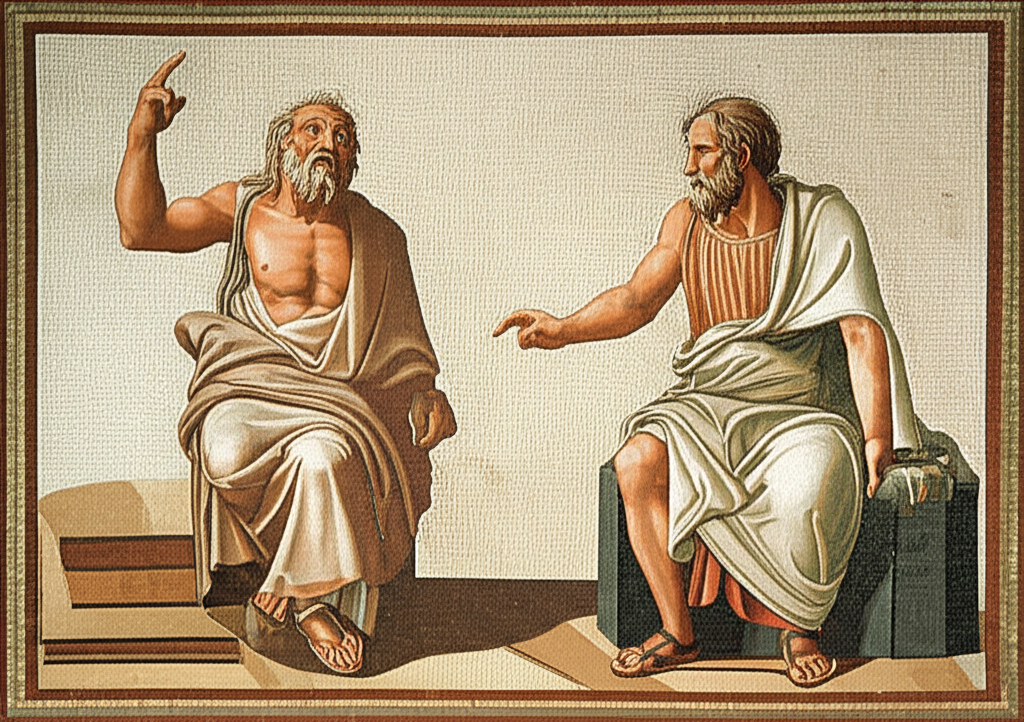
Plato posited a tripartite soul, each part having distinct functions and desires, often illustrated in his Republic through the allegory of the charioteer:
| Part of the Soul | Function | Virtue | Location (Allegorical) |
|---|---|---|---|
| Reason (λογιστικόν) | Seeks truth, governs | Wisdom | Head (Charioteer) |
| Spirit (θυμοειδές) | Seeks honor, courage, emotion | Courage | Chest (Noble Horse) |
| Appetite (ἐπιθυμητικόν) | Seeks bodily pleasures, desires | Moderation/Temperance | Belly (Unruly Horse) |
For Plato, a just and harmonious individual is one where Reason, guided by Wisdom, controls the Spirit and Appetite.
Furthermore, Plato argued vehemently for the soul's immortality, presenting several arguments in dialogues like the Phaedo:
- The Argument from Opposites: Life comes from death, and death from life, suggesting a continuous cycle for the soul.
- The Argument from Recollection (Anamnesis): Our ability to recognize perfect concepts (like equality or beauty) implies pre-existence, where the soul encountered the Forms before birth.
- The Argument from Affinity: The soul is akin to the eternal, unchanging Forms, while the body is like the changing, perishable world. Therefore, the soul is immortal.
- The Argument from Life: The soul is the essence of life; it cannot admit its opposite (death).
Plato's soul is an eternal, divine entity, temporarily imprisoned in the body, striving to return to the realm of pure Forms. Its nature is central to understanding his entire system of metaphysics and ethics.
Aristotle's Empirical Approach: The Soul as the Form of the Body
Aristotle, Plato's most famous student, offered a radically different, more empirically grounded perspective on the soul, primarily articulated in his treatise De Anima (On the Soul). Rejecting Plato's dualism, Aristotle viewed the soul not as a separate entity but as the form of the body.
- The Soul as Entelechy: Aristotle defined the soul as "the first actuality of a natural body having life potentially." This means the soul is the organizing principle, the essence, or the "what it is to be" of a living Being. It is to the body what the shape is to a statue—inseparable for its existence.
- Hierarchy of Souls: Aristotle identified a hierarchy of souls, corresponding to different levels of life:
- Nutritive Soul (Vegetative): Possessed by plants, responsible for growth, reproduction, and nourishment.
- Sensitive Soul (Appetitive): Possessed by animals, encompassing the nutritive functions plus sensation, desire, and locomotion.
- Rational Soul (Intellective): Unique to humans, including all the functions of the lower souls plus reason, thought, and contemplation. This is the part of the soul that allows for abstract thought and understanding.
For Aristotle, the soul is the principle that gives life, movement, and thought to an organism. While the rational soul has an aspect (the intellect or nous) that might be considered separable and immortal, Aristotle's general view emphasizes the soul's intrinsic connection to the body. The soul is what makes a living Being a Being of a particular kind; it is its form and purpose.
Hellenistic Perspectives: Soul in Stoicism and Epicureanism
Following the classical period, Hellenistic philosophy continued to grapple with the soul, often with a greater emphasis on ethics and practical living.
Stoicism: The Soul as Pneuma
The Stoics, known for their emphasis on virtue, reason, and living in harmony with nature, viewed the soul as a material entity, albeit a very refined one.
- Material Soul: The Stoics believed the soul was composed of pneuma (a subtle, fiery breath or spirit), an emanation of the universal divine logos (reason) that permeates all of reality.
- Eight Parts: The soul was divided into eight parts: the ruling faculty (hegemonikon), five senses, and the faculties of speech and reproduction. The hegemonikon was the most crucial, as it was the seat of reason, judgment, and choice.
- Mortality (with caveats): While a part of the divine logos, individual souls were generally considered mortal, dissipating back into the universal pneuma after death, though some Stoics believed they might endure for a period before reabsorption. The focus was on living virtuously in the present, not on post-mortem existence.
Epicureanism: The Soul as Atomic Arrangement
Epicurus and his followers held a thoroughly materialistic view of the soul, consistent with their atomic metaphysics.
- Atomic Composition: The soul was seen as a collection of very fine, smooth atoms, distributed throughout the body. These atoms were similar to those of fire and air, giving the soul its sensitivity and mobility.
- Mortal and Perishable: Since the soul is physical and composed of atoms, it is mortal. Upon death, the body's protective enclosure breaks down, and the soul atoms disperse, ceasing to exist as a cohesive entity.
- Purpose: The Epicurean view of the soul served their ethical goal of achieving ataraxia (tranquility) and aponia (freedom from pain). The knowledge that the soul is mortal and disperses after death was meant to alleviate the fear of death and divine punishment, as there is no conscious Being to experience them.
The Enduring Legacy: Why the Ancient Soul Still Matters
The ancient philosophical inquiries into the soul were not mere academic exercises; they were fundamental attempts to understand what it means to be human, to define our moral responsibilities, and to grasp the ultimate nature of Being.
The diverse conceptions of the soul—from a divine, immortal essence to a material, perishable principle—have profoundly influenced subsequent Western thought:
- Theology: Plato's arguments for the soul's immortality became foundational for Christian theology.
- Psychology: Ancient distinctions between reason, emotion, and appetite continue to resonate in modern psychological theories.
- Ethics: The emphasis on caring for the soul and living a virtuous life remains a central theme in ethical discourse.
- Metaphysics: The debate over the soul's relationship to the body laid the groundwork for the mind-body problem, which continues to challenge philosophers today.
The ancient philosophers, through their rigorous exploration of the soul, provided us with a rich tapestry of ideas that continue to inform our understanding of consciousness, identity, and the very fabric of existence. Their questions remain our questions, inviting us to engage with the profound mystery of the soul.
Further Exploration
📹 Related Video: PLATO ON: The Allegory of the Cave
Video by: The School of Life
💡 Want different videos? Search YouTube for: "Plato's Theory of the Soul Explained"
📹 Related Video: ARISTOTLE ON: The Nicomachean Ethics
Video by: The School of Life
💡 Want different videos? Search YouTube for: "Aristotle De Anima Summary"