

The Concept of Sin and Moral Judgment: A Philosophical Inquiry
From ancient myths to modern dilemmas, the intertwined concepts of sin and moral judgment have profoundly shaped human thought, society, and individual conscience. This pillar page delves into the philosophical underpinnings of these concepts, exploring their evolution from religious doctrines to secular ethical frameworks. We will navigate the multifaceted definitions of sin—from a transgression against divine law to an existential failing—and dissect the mechanisms of moral judgment, examining how humanity has historically distinguished between Good and Evil. Drawing upon the rich tapestry of the Great Books of the Western World, we seek to understand not just what sin is, but why its concept persists, and how our capacity for judgment defines our very humanity.
Unpacking Sin: From Transgression to Existential Burden
The notion of sin is as old as civilization itself, evolving from early taboos and ritual impurities to complex theological and philosophical constructs. At its core, sin represents a deviation—a missing of the mark—that carries significant moral weight.
The Etymology and Evolution of Sin
The word "sin" itself carries a lineage that hints at its profound implications. In its most ancient sense, particularly in Greek philosophy, the term hamartia referred to an error, a mistake, or "missing the mark"—often unintentionally. This concept was central to Greek tragedy, where a hero's downfall might stem from a fatal flaw rather than malicious intent.
However, with the rise of monotheistic Religion, the concept of sin transformed dramatically. It ceased to be merely an error and became an offense—a deliberate or negligent act against a divine will or moral law.
- Pre-Religious Roots:
- Hamartia (Ancient Greek): An error in judgment, a tragic flaw, or a missing of the target. Not necessarily moral failing in the modern sense, but a deviation from an ideal.
- Taboo: Early societal prohibitions often with supernatural or ritualistic implications.
- Religious Codification:
- Hebrew Bible: Hattat (missing the mark), pesha (rebellion), avon (iniquity). Sin is a breach of the covenant with God, requiring atonement.
- Christianity: Derived from the Greek hamartia in the New Testament, but imbued with the profound theological weight of Original Sin (as articulated by Augustine), and later categorized into mortal and venial sins.
- Islam: Dhanb (sin, offense), khati'a (error), ithm (crime). Sin is a conscious act of disobedience against Allah's commands, with an emphasis on repentance.
Sin in Monotheistic Traditions: A Deeper Dive
The Abrahamic religions, in particular, have provided the most enduring frameworks for understanding sin, influencing Western thought for millennia.
| Religious Tradition | Core Understanding of Sin | Key Concepts | Consequences & Atonement |
|---|---|---|---|
| Judaism | Breach of covenant, disobedience to Mitzvot (commandments). | Hattat, Pesha, Avon; collective and individual responsibility. | Repentance (Teshuvah), sacrifice, prayer. |
| Christianity | Transgression against God's law, original sin, separation from God. | Original Sin (Adam's fall), mortal vs. venial sin, Seven Deadly Sins. | Confession, penance, grace, redemption through Christ. |
| Islam | Disobedience to Allah's will and commands. | Dhanb, Khati'a, Ithm; major vs. minor sins. | Repentance (Tawbah), good deeds, Allah's mercy. |
As Daniel Fletcher, one might observe that "the religious concept of sin, especially in its Abrahamic manifestations, imbues human actions with cosmic significance, transforming a mere error into a rupture in the divine-human relationship, demanding not just correction, but often, redemption."
Secularizing Sin: Modern Interpretations
While religious frameworks continue to define sin for many, modern philosophy and psychology have sought to understand the phenomena of moral transgression without recourse to divine law.
- Psychological Perspectives:
- Guilt and Shame: These emotions are the internal experience of having violated one's own moral code or societal norms. Guilt focuses on the action, shame on the self.
- Moral Injury: A concept often used in trauma studies, describing the psychological distress resulting from actions, or lack of them, that violate one's moral beliefs (e.g., in combat situations).
- Sociological Views:
- Deviance: Acts that violate social norms, whether codified into law or not. Sin, in this context, can be seen as a form of moral deviance.
- Anomie (Durkheim): A state of normlessness, where individuals feel disconnected from societal values, potentially leading to increased transgression.
- Existentialist Philosophy:
- Bad Faith (Sartre): A form of self-deception where individuals deny their radical freedom and responsibility, attributing their choices to external forces or predetermined roles. This can be seen as a "sin" against one's own authentic existence.
- Inauthenticity: Living a life not true to oneself or one's values, often driven by societal pressures or fear of freedom.
The Architecture of Moral Judgment: How We Evaluate Good and Evil
If sin is the transgression, then moral judgment is the mechanism by which we identify, categorize, and respond to such transgressions, and indeed, to all actions and character traits. It is the process of evaluating actions, intentions, character, and situations as Good and Evil, right or wrong, virtuous or vicious.
Foundational Theories of Ethics
Philosophers have developed various frameworks to explain how we ought to make moral judgments and what constitutes the basis for Good and Evil.
- Deontology (Duty-Based Ethics):
- Key Thinkers: Immanuel Kant.
- Core Idea: Morality is based on duties and rules, and actions are inherently right or wrong, regardless of their consequences. The moral worth of an action lies in the intention behind it, specifically whether it is done out of duty.
- Example: Kant's Categorical Imperative—act only according to that maxim whereby you can at the same time will that it should become a universal law. Lying, for Kant, is inherently wrong because it cannot be universalized without contradiction.
- Consequentialism (Outcome-Based Ethics):
- Key Thinkers: Jeremy Bentham, John Stuart Mill (Utilitarianism).
- Core Idea: The morality of an action is determined by its outcomes or consequences. The "right" action is the one that produces the greatest Good for the greatest number.
- Example: A utilitarian might argue that lying is acceptable if it prevents greater harm or leads to overall greater happiness.
- Virtue Ethics (Character-Based Ethics):
- Key Thinkers: Aristotle, Plato, Thomas Aquinas.
- Core Idea: Focuses on the character of the moral agent rather than specific actions or consequences. The goal is to cultivate virtuous character traits that lead to human flourishing (eudaimonia).
- Example: An action is good if it is what a virtuous person would do. A virtuous person is honest not because honesty follows a rule or produces good outcomes, but because honesty is a part of their character.
The Role of Reason and Emotion in Judgment
The debate over whether moral judgment is primarily a product of rational deliberation or emotional response is ancient and ongoing.
- Rationalism:
- Plato: Believed moral knowledge was accessible through reason, by apprehending the Forms, especially the Form of the Good. Ignorance was the root of evil.
- Kant: Argued that moral judgments are derived from pure practical reason, leading to universal moral laws. Emotions, for Kant, could even corrupt true moral action.
- Empiricism/Sentiment:
- David Hume: Famously argued that "reason is, and ought only to be, the slave of the passions." Moral judgments, for Hume, stem from moral sentiments—feelings of approval or disapproval—rather than rational deduction. Reason can inform us of facts, but only sentiment moves us to action or moral evaluation.
- Modern Neuroscience:
- Contemporary research suggests that moral judgments involve a complex interplay between both cognitive (reasoning, deliberation) and affective (emotional, intuitive) brain systems. Initial emotional reactions often inform subsequent rationalization.
Sin and Judgment in the Great Books of the Western World
The enduring philosophical quest to understand sin and judgment finds its most profound expressions within the canon of Western literature and philosophy. These works provide not only historical context but also timeless insights into the human condition.
Ancient Greece: The Seeds of Moral Inquiry
The Greeks laid the groundwork for ethical philosophy, grappling with concepts that prefigure later notions of sin and moral culpability.
- Plato (c. 428–348 BCE): In works like The Republic, Plato posits that true Good is found in the Forms, particularly the Form of the Good. Evil, for Plato, is often linked to ignorance or a lack of understanding. To know the Good is to do the Good; therefore, wrongdoing stems from a flawed apprehension of reality. His allegory of the cave illustrates how distorted perceptions can lead individuals away from truth and virtue.
- Aristotle (384–322 BCE): In Nicomachean Ethics, Aristotle defines virtue as a mean between two extremes (vices). Sin, in an Aristotelian sense, would be an excess or deficiency of a virtue—for instance, cowardice (deficiency of courage) or recklessness (excess of courage). His concept of hamartia in tragedy refers to a character's error or flaw that leads to their downfall, often through a lack of knowledge or a misjudgment, rather than pure malice.
Early Christianity and Medieval Scholasticism
With the advent of Christianity, the concept of sin became central to Western theology and philosophy, irrevocably linking human morality to divine law and grace.
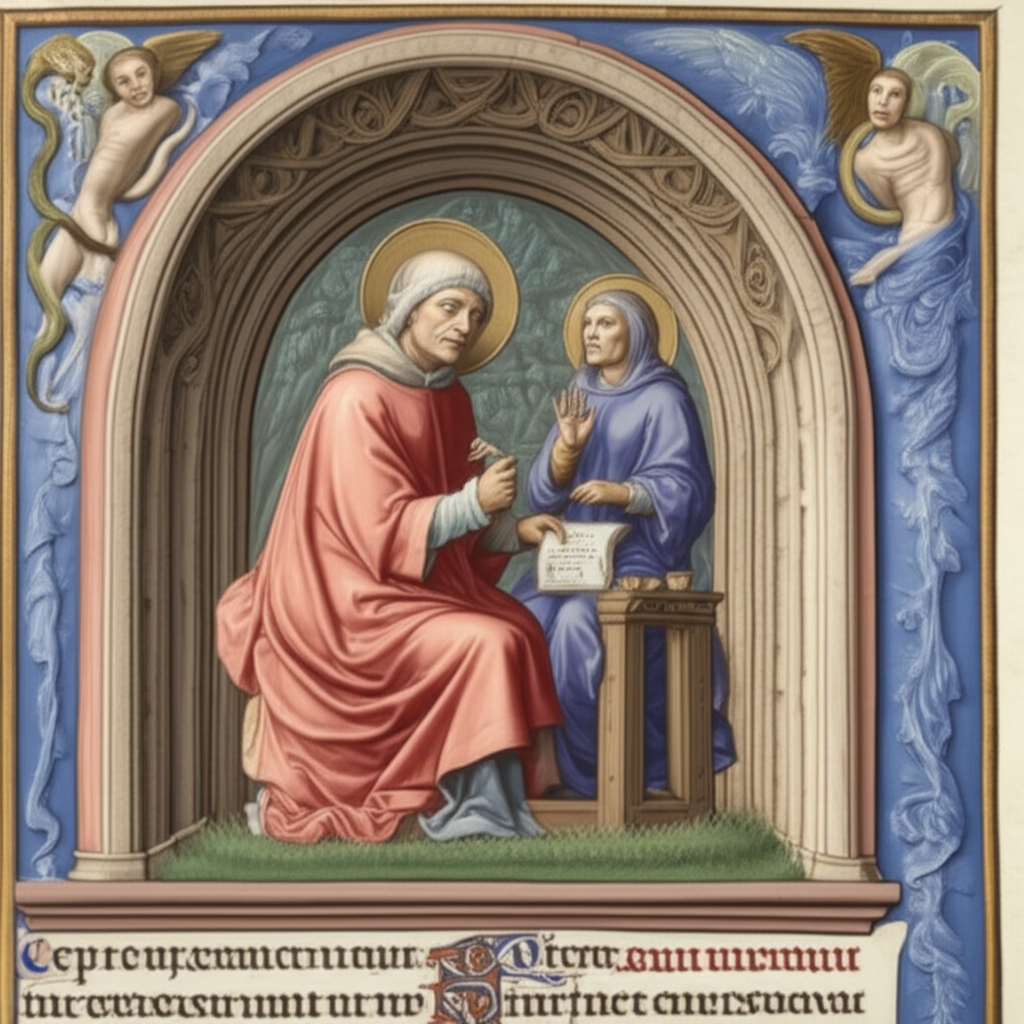
- Augustine of Hippo (354–430 CE): A towering figure, Augustine's writings, particularly Confessions and City of God, established the doctrine of Original Sin as foundational to human nature. He argued that humanity inherited a propensity to sin from Adam's fall, corrupting human will and making true Good impossible without divine grace. His struggle with his own past sins and his eventual conversion offer a powerful narrative of guilt, free will, and redemption.
- Thomas Aquinas (c. 1225–1274 CE): In his Summa Theologica, Aquinas synthesized Aristotelian philosophy with Christian theology. He meticulously categorized sins, distinguishing between mortal (leading to spiritual death) and venial (lesser offenses), and explored the nature of natural law, divine law, and human law. For Aquinas, sin is a deviation from right reason and eternal law, an act against God and against one's own rational nature.
The Enlightenment and Beyond: Challenging Traditional Paradigms
The Enlightenment brought a radical shift, questioning religious authority and placing human reason at the forefront of moral inquiry, leading to new understandings of Good and Evil.
- Immanuel Kant (1724–1804): In works like Groundwork of the Metaphysics of Morals, Kant sought to establish morality on pure reason, independent of Religion or empirical consequences. His categorical imperative posited that moral actions are those that can be universalized, forming a duty that all rational beings must follow. For Kant, to act immorally is to act irrationally, to make an exception for oneself that one would not wish to be a universal law.
- Friedrich Nietzsche (1844–1900): A fierce critic of traditional morality, Nietzsche's On the Genealogy of Morality launched a scathing attack on what he called "slave morality," which he argued arose from the resentment of the weak against the strong. He challenged the very notions of Good and Evil as culturally constructed, advocating for a "revaluation of all values" and the creation of one's own morality by "master morality." For Nietzsche, traditional concepts of sin were life-denying.
- Fyodor Dostoevsky (1821–1881): Dostoevsky's novels, such as Crime and Punishment, delve into the psychological and spiritual torment of sin and judgment. Raskolnikov's murder of the pawnbroker is not merely a legal transgression but a profound moral and existential crisis, exploring themes of guilt, suffering, and the possibility of redemption outside conventional religious frameworks, yet deeply spiritual in its essence.
The Interplay of Sin, Judgment, and Societal Norms
The philosophical exploration of sin and judgment inevitably leads us to consider their relationship with the broader societal structures, legal systems, and cultural values that shape human conduct.
Law vs. Morality
While often overlapping, legal systems and moral codes are distinct. Laws are formal rules enforced by the state, whereas morality refers to informal principles of right and wrong that guide individual and collective behavior.
- Overlap: Many laws codify widely accepted moral principles (e.g., laws against murder, theft).
- Divergence:
- Legal but Immoral: Actions that are legal but widely considered morally objectionable (e.g., some forms of exploitation, tax avoidance loopholes).
- Moral but Illegal: Actions that some consider morally imperative but are illegal (e.g., civil disobedience, certain acts of self-defense that exceed legal limits).
- Justice and Punishment: Legal systems employ formal judgment and punishment to address violations of law. Philosophies of punishment—retributive, deterrent, rehabilitative—reflect different moral justifications for societal responses to wrongdoing.
Cultural Relativism vs. Universal Morality
The vast diversity of moral codes across cultures raises profound questions about the universality of Good and Evil, and the relativity of sin.
- Cultural Relativism: The view that moral judgments are culturally dependent, and there are no universal moral truths. What is considered a sin in one culture might be acceptable or even virtuous in another. This perspective challenges the idea of a fixed, objective moral law.
- Universal Morality: The belief that some moral principles apply to all people, regardless of culture. Philosophers like Kant sought universal moral laws, while many religious traditions posit divinely ordained moral standards. The search for universal human rights is a modern attempt to establish such principles.
Concluding Thoughts: Navigating the Moral Labyrinth
The concepts of sin and moral judgment remain central to the human experience. From the ancient Greek hamartia to the Christian doctrine of Original Sin, and from Kant's categorical imperative to Nietzsche's revaluation of values, philosophers have ceaselessly grappled with why we transgress and how we evaluate such transgressions.
As Daniel Fletcher, I contend that "to ignore the profound philosophical inquiry into sin and judgment is to overlook a fundamental aspect of what it means to be human—a creature capable of both immense Good and Evil, burdened by responsibility, and driven by an innate, if often conflicted, desire for moral order." These concepts force us to confront our freedom, our accountability, and our ceaseless quest for meaning in a world where moral clarity is often elusive. The journey through the Great Books of the Western World demonstrates that while the definitions and interpretations may shift, the underlying human struggle with right and wrong is an eternal constant, inviting continuous introspection and dialogue.
YouTube Video Suggestions:
-
📹 Related Video: ARISTOTLE ON: The Nicomachean Ethics
Video by: The School of Life
💡 Want different videos? Search YouTube for: ""Crash Course Philosophy: Ethics and Morality""
-
📹 Related Video: PLATO ON: The Allegory of the Cave
Video by: The School of Life
💡 Want different videos? Search YouTube for: ""Jordan Peterson: The Psychology of Sin and Responsibility""