

In the grand tapestry of human thought, few threads are as enduringly complex and deeply woven as the concepts of Sin and Moral Judgment. From ancient epics to modern ethical dilemmas, these ideas have shaped our understanding of right and wrong, dictated societal norms, and driven individual conscience. This pillar page delves into the philosophical underpinnings, historical evolution, and contemporary relevance of sin and moral judgment, exploring their multifaceted nature beyond mere religious doctrine. We will navigate the profound questions these concepts pose about human agency, responsibility, and the very definition of Good and Evil, drawing insights from the timeless wisdom preserved in the Great Books of the Western World.
What is Sin? A Philosophical Inquiry
At its core, sin can be understood as a transgression against a moral or divine law, a deviation from what is considered right, good, or virtuous. While often associated with Religion, particularly in Judeo-Christian traditions where it signifies a separation from God or a breach of divine commandments, its philosophical scope is much broader. Philosophically, sin can represent:
- A failure of reason or virtue: As articulated by Aristotle in his Nicomachean Ethics, vice is a deviation from the "golden mean," a failure to act virtuously. Sin, in this sense, is missing the mark of human flourishing.
- A violation of natural law: Thinkers like Thomas Aquinas, building on Aristotle, posited that sin is an act contrary to right reason and the eternal law, which is discoverable through human reason.
- An act against the categorical imperative: Immanuel Kant, in his Groundwork of the Metaphysics of Morals, would view sin as an action that cannot be universalized without contradiction, thus failing the test of moral duty.
- An existential failing: In more modern interpretations, sin can be seen as a form of "bad faith" (Sartre) or a failure to embrace authentic existence, where one denies one's freedom and responsibility.
The concept inherently grapples with the nature of Good and Evil, compelling us to define what constitutes a morally reprehensible act and why. Is it the intent, the consequence, or the inherent nature of the act itself that makes it sinful?
The Nature of Moral Judgment
Moral Judgment is the process by which individuals and societies evaluate actions, intentions, character, and even institutions as morally right or wrong, good or bad. It is inextricably linked to the concept of sin, as judgment often follows the perceived transgression. This process involves:
- Evaluation: Assessing whether an action aligns with or deviates from established moral principles, norms, or laws.
- Attribution of Responsibility: Determining who is accountable for an action, which often hinges on the presence of free will and intent.
- Consequence: The imposition of sanctions, punishment, or condemnation, whether by divine authority, legal systems, or social ostracism.
The source of moral judgment is a subject of intense philosophical debate. Is it rooted in universal moral truths (objective), or is it culturally relative and individually subjective? Do we judge based on emotion, reason, divine revelation, or a combination thereof?
Historical Trajectories: Sin and Judgment Through the Ages
The understanding of sin and moral judgment has evolved dramatically across civilizations and philosophical epochs.
Ancient Roots: Hubris and Cosmic Order
In the ancient Greek world, particularly in Homer's epics like the Iliad, transgression often manifested as hubris—excessive pride or defiance against the gods or the natural order. Such acts inevitably led to divine retribution or tragic downfall, demonstrating a profound sense of cosmic judgment and the inescapable consequences of overstepping one's bounds. Plato, in his Republic, explored justice and injustice, framing the "good" as alignment with the Forms, and injustice (a form of sin) as a distortion of the soul's proper order.
Judeo-Christian Frameworks: Divine Law and The Fall
The Abrahamic Religions, particularly Judaism and Christianity, introduced a robust framework for sin and judgment.
- Original Sin: The narrative of Adam and Eve's disobedience in Genesis establishes "original sin" as a foundational concept in Christian theology, implying a fallen human nature prone to transgression.
- Divine Law: The Ten Commandments and Mosaic Law provided explicit directives, making clear what constituted a sin against God and community.
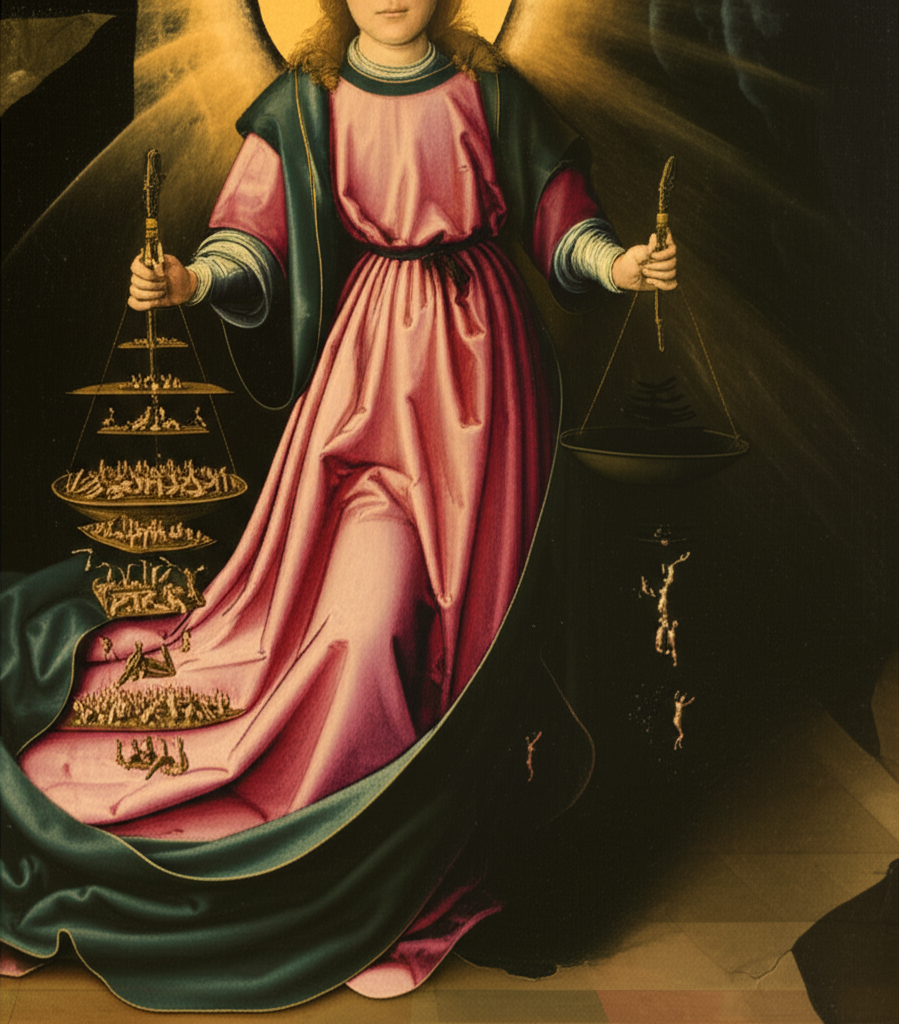
- Ultimate Judgment: Concepts of a final Judgment Day, where souls are held accountable for their earthly deeds, are central to Christian eschatology, vividly depicted in Dante Alighieri's Inferno from The Divine Comedy.
Medieval Scholasticism: Reason and Free Will
Thinkers like St. Augustine and St. Thomas Aquinas deeply probed the nature of sin. Augustine, in Confessions and City of God, grappled with free will, the origin of evil, and the necessity of divine grace to overcome sin. Aquinas, in his Summa Theologica, systematized Christian theology, defining sin as a voluntary act against reason and eternal law, emphasizing the role of human intellect and will in moral culpability.
The Enlightenment and Beyond: From Divine to Human Authority
The Enlightenment brought a shift, moving away from purely divine authority towards human reason as the arbiter of morality.
- Kant's Categorical Imperative: Immanuel Kant sought to establish universal moral laws based purely on reason, independent of religious dogma. Moral transgressions were failures of rational duty.
- Hume's Moral Sentiments: David Hume, conversely, argued that moral distinctions arise from sentiment and feeling, not reason, suggesting a more subjective basis for Good and Evil.
- Nietzsche's Revaluation: Friedrich Nietzsche, in On the Genealogy of Morality, launched a radical critique of traditional Christian morality, arguing that concepts of "good" and "evil" were constructs of a "slave morality" designed to suppress the strong. He called for a revaluation of all values, challenging the very foundation of traditional sin and Judgment.
Table: Shifting Perspectives on Sin and Moral Judgment
| Era/Thinker | Primary View of Sin | Basis of Moral Judgment | Key Concept(s) |
|---|---|---|---|
| Ancient Greece | Hubris, deviation from cosmic/natural order | Divine retribution, societal shame | Cosmic justice, fate, virtue |
| Judeo-Christian | Transgression against divine law, original sin | Divine will, God's commandments, ultimate judgment | Redemption, grace, free will |
| Medieval Scholastic | Voluntary act against reason and eternal law | Natural law, divine revelation | Conscience, culpability, virtue |
| Kant (Enlightenment) | Failure of rational duty, non-universalizable act | Pure reason, categorical imperative | Autonomy, moral law |
| Nietzsche (Modern) | A construct of "slave morality" | Rejection of traditional values, will to power | Master/slave morality, nihilism |
The Interplay of Free Will and Responsibility
A crucial philosophical problem underlying both sin and moral judgment is the question of free will. If individuals are not genuinely free to choose their actions, can they truly be held responsible or sinful?
- Determinism: If all actions are predetermined by prior causes (e.g., genetics, environment, divine plan), then the concept of moral responsibility, and thus sin and judgment, becomes problematic.
- Compatibilism: Many philosophers argue that free will and determinism can coexist, suggesting that freedom lies in acting according to one's desires, even if those desires are determined.
- Libertarianism: This view holds that humans possess genuine freedom to choose, making them truly accountable for their actions and capable of sin.
The entire edifice of moral Judgment, whether human or divine, rests heavily on the assumption that individuals are rational agents capable of making choices for which they can be justly praised or condemned.
Secular Ethics and the Legacy of Sin
Even in increasingly secular societies, the fundamental concerns addressed by the concept of sin persist. While the language may shift from "sin" to "wrongdoing," "harm," "unethical conduct," or "moral failing," the underlying need to define Good and Evil and hold individuals accountable remains.
- Consequentialism: Ethical frameworks like utilitarianism judge actions based on their outcomes, defining "good" as that which maximizes overall well-being and "wrong" as that which causes harm.
- Deontology: Similar to Kant, deontological ethics emphasizes duties and rules, where actions are judged based on their adherence to moral norms, regardless of consequences.
- Virtue Ethics: A renewed interest in virtue ethics (inspired by Aristotle) focuses on character development, asking not just "What should I do?" but "What kind of person should I be?" Failures to cultivate virtues could be seen as a modern equivalent of "missing the mark."
Criticisms and Reinterpretations
The concept of sin, particularly in its traditional religious forms, has faced significant criticism:
- Psychological Harm: Critics argue that an overemphasis on sin can lead to excessive guilt, shame, and psychological distress, hindering personal growth.
- Moral Relativism: The diversity of moral codes across cultures and historical periods challenges the notion of universal sin, leading some to argue that moral judgments are purely culturally constructed.
- Nietzschean Critique: As noted, Nietzsche viewed Christian morality as life-denying, fostering a resentment-based morality that valorized weakness and condemned strength. He saw "sin" as a tool of control.
- Evolutionary Ethics: Some contemporary thinkers suggest that our moral intuitions, including our sense of right and wrong, have evolutionary roots, rather than being divinely revealed or purely rationally derived.
The Enduring Relevance of Moral Accountability
Despite critiques and reinterpretations, the concepts of Sin and moral Judgment continue to resonate because they address fundamental aspects of the human condition: our capacity for both great good and profound evil, our struggle with temptation, and our inherent need for meaning and justice. Whether through religious conviction, philosophical reasoning, or secular ethical frameworks, humanity consistently grapples with:
- Defining the Good: What constitutes a life well-lived, a just society, or a virtuous act?
- Addressing Transgression: How do we respond to actions that cause harm, violate trust, or undermine societal cohesion?
- Establishing Accountability: Who is responsible when things go wrong, and what are the appropriate consequences?
These questions, explored over millennia by the towering intellects in the Great Books of the Western World, remain central to our ongoing quest for ethical understanding and a meaningful existence.
Conclusion
The journey through the concepts of Sin and Moral Judgment reveals a landscape as varied as human thought itself. From the ancient fear of divine retribution and the intricate theological debates of the medieval period to the rational ethics of the Enlightenment and the radical critiques of modernity, these ideas have continuously evolved, yet their core concerns persist. They force us to confront our own nature, the boundaries of our freedom, and the responsibilities we bear to ourselves, to others, and to the very fabric of existence. While the language may change and the sources of authority shift, the fundamental human impulse to distinguish between Good and Evil and to hold ourselves and others accountable for our actions remains an indelible mark of our consciousness. Understanding these concepts is not merely an academic exercise; it is an essential part of understanding what it means to be human.
📹 Related Video: PLATO ON: The Allegory of the Cave
Video by: The School of Life
💡 Want different videos? Search YouTube for: ""Plato's Republic Justice and the Soul""
📹 Related Video: KANT ON: What is Enlightenment?
Video by: The School of Life
💡 Want different videos? Search YouTube for: ""Nietzsche Genealogy of Morality Explained""