

The Enduring Weight of Conscience: Exploring Sin and Moral Judgment
The concepts of sin and moral judgment are fundamental pillars upon which human societies and philosophical thought have been constructed for millennia. From ancient religious texts to the most rigorous ethical treatises, humanity has grappled with defining transgression, understanding its origins, and establishing frameworks for evaluating actions as good and evil. This pillar page delves into the historical evolution of sin, the philosophical underpinnings of moral judgment, the intricate relationship between human freedom and responsibility, and how these profound ideas continue to shape our understanding of ourselves and the world. Join us as we navigate the complex terrain where theology, ethics, and human experience intersect, drawing insights from the "Great Books of the Western World" to illuminate this enduring intellectual journey.
1. The Ancient Roots of Sin: A Theological and Philosophical Genesis
The notion of transgression, of falling short of an ideal or violating a sacred trust, predates written history. Across diverse cultures, early narratives reveal a pervasive concern with actions that disrupt harmony, offend deities, or harm the community. Yet, the specific concept of sin as a moral and often theological offense, distinct from mere error or misfortune, evolved significantly over time.
From Transgression to Sin: The Evolution of a Concept
In the Abrahamic traditions, particularly as laid out in the Old Testament, sin is often presented as a deliberate violation of divine law or a breaking of covenant with God. The narrative of Adam and Eve in Genesis, and later the concept of "original sin" articulated profoundly by Augustine of Hippo in his Confessions and City of God, established a theological framework where humanity inherits a propensity toward sin, affecting free will and necessitating divine grace for redemption. This foundational idea posits sin not merely as an act, but as a state of being, a separation from the divine.
Conversely, classical Greek thought, while deeply concerned with ethics, often approached moral failing through the lens of hamartia – "missing the mark." In Aristotle's Nicomachean Ethics, for instance, moral excellence (arete) is achieved through virtuous action and practical wisdom (phronesis). A failure to act virtuously, or an error in judgment, might be a hamartia, but it doesn't carry the same theological weight of divine offense found in the concept of sin. It is a deviation from the rational pursuit of the good, rather than a transgression against a personal God.
Key Historical Interpretations of "Missing the Mark"
| Concept | Originating Tradition | Primary Focus | Consequence |
|---|---|---|---|
| Sin | Abrahamic Religions | Violation of Divine Law or Covenant | Guilt, spiritual separation, need for atonement |
| Hamartia | Ancient Greek Ethics | Failure to achieve moral excellence, error | Flawed character, misfortune, tragic outcome |
| Vice | Aristotelian Ethics | Habitual deviation from the Golden Mean | Impaired flourishing (eudaimonia) |
| Taboo | Indigenous Cultures | Violation of sacred custom or social norm | Ritual impurity, community ostracism, divine wrath |
Sin and Divine Law: The Role of Religion in Defining Good and Evil
The concept of sin is inextricably linked to religion, which historically provided the primary framework for defining good and evil. The Decalogue (Ten Commandments) given to Moses, for example, serves as a direct divine injunction, clearly delineating actions considered sinful. For Thomas Aquinas, building upon Aristotle and Augustine, sin is a deviation from eternal law, natural law, and human law, all ultimately derived from God's divine reason. Natural law, accessible through human reason, allows individuals to discern inherent moral principles, making sin a rational failing as much as a theological one. This integration firmly established religion as the arbiter of ultimate moral judgment.
2. The Architecture of Moral Judgment: Reason, Conscience, and Consequence
Beyond divine decree, philosophers have tirelessly sought a rational basis for moral judgment. How do we determine what is right or wrong, and by what criteria do we judge actions and individuals? This inquiry shifts the focus from external authority to internal reasoning and universal principles.
Plato and the Forms: The Ideal Good
For Plato, in works like The Republic, moral judgment is rooted in the apprehension of the Forms, particularly the Form of the Good. Just as a craftsman judges a chair by its approximation to the ideal chair, so too do we judge actions by how closely they align with the ideal Good. Deviation from this perfect standard constitutes a moral failing. The philosopher, through rigorous dialectic and intellectual ascent, aims to grasp these eternal and unchanging truths, thereby becoming capable of true moral discernment.
Aristotle and Virtue Ethics: Judgment Based on Character
Aristotle's Nicomachean Ethics provides a more pragmatic, character-based approach to judgment. He argues that moral excellence is developed through habituation, by consistently choosing the "mean" between extremes of excess and deficiency. Judgment, therefore, is not merely about adhering to rules, but about developing a virtuous character. An action is good if it springs from a virtuous disposition, guided by practical wisdom (phronesis). We judge individuals not just by isolated acts, but by the overall trajectory of their character and their consistent striving towards eudaimonia (human flourishing).
Kant's Categorical Imperative: Universal Moral Law
Immanuel Kant, in his Groundwork of the Metaphysics of Morals, revolutionized the basis of moral judgment by grounding it in pure reason, independent of consequences or personal desires. His Categorical Imperative posits that an action is morally permissible only if its maxim (the principle behind it) could be universalized without contradiction. This duty-based ethics provides an absolute, rational framework for judgment: if an action cannot be willed as a universal law, it is morally wrong. Sin, in a Kantian sense, would be a failure to act out of duty and respect for the moral law, choosing instead to treat humanity as a mere means to an end.
The Role of Conscience: Inner Judgment and Self-Evaluation
From Augustine's deep introspection regarding the human will and its inclination towards sin, to later philosophical and psychological explorations, conscience has remained a pivotal concept. Conscience is often understood as an internal moral compass, a faculty that allows individuals to discern good and evil and to feel guilt or remorse for transgressions. It represents an internalized judgment, a private tribunal where actions are weighed against perceived moral standards, whether those standards are divinely ordained, rationally derived, or socially conditioned. The struggle of conscience is a recurring theme in literature and philosophy, highlighting the personal burden of sin and the internal process of judgment.
3. The Interplay of Freedom, Responsibility, and Retribution
The very possibility of sin and moral judgment hinges on the assumption of human freedom and responsibility. If individuals are not free to choose their actions, can they truly be held accountable? This question ignites one of philosophy's most persistent debates.
Free Will vs. Determinism: A Perennial Debate
The tension between free will and determinism has profound implications for sin and judgment. If all actions are predetermined by prior causes (whether divine providence, natural laws, or psychological conditioning), then culpability for sin seems to dissolve. Augustine grappled intensely with this, seeking to reconcile God's omnipotence and foreknowledge with human moral responsibility, ultimately emphasizing the fallen will's capacity for choosing evil despite divine grace. Later, thinkers like Baruch Spinoza in his Ethics presented a more deterministic view, seeing human actions as part of a larger, causally necessitated order, which challenges traditional notions of moral blame.
The Problem of Evil: If God is Good, Why Sin?
The existence of sin and evil in a world purportedly created by an omnipotent, omnibenevolent God poses the classic "problem of evil." If God is all-good, why does He allow sin and suffering? Philosophers like Gottfried Wilhelm Leibniz, in his Theodicy, attempted to reconcile this by arguing that this is the "best of all possible worlds," and that evil (including moral evil or sin) is either a necessary contrast to good, a consequence of free will, or ultimately serves a greater divine purpose incomprehensible to humans. The problem persists as a critical challenge to religious judgment and faith.
Justice and Punishment: Societal Judgment and Its Aims
Societies, recognizing the need to regulate behavior and maintain order, establish systems of justice that embody collective moral judgment. These systems typically involve mechanisms for determining guilt (or sin, in a secularized sense) and administering punishment. The aims of punishment have been debated for centuries:
- Retributive Justice: Focuses on proportional punishment for the offense committed ("an eye for an eye"). It seeks to balance the scales of justice, often appealing to an inherent sense of fairness.
- Deterrent Justice: Aims to prevent future transgressions by making an example of offenders, thereby discouraging others from committing similar "sins."
- Rehabilitative Justice: Seeks to reform the offender, addressing the root causes of their actions and helping them to reintegrate productively into society.
- Restorative Justice: Focuses on repairing the harm caused by the offense, involving victims, offenders, and the community in finding solutions.
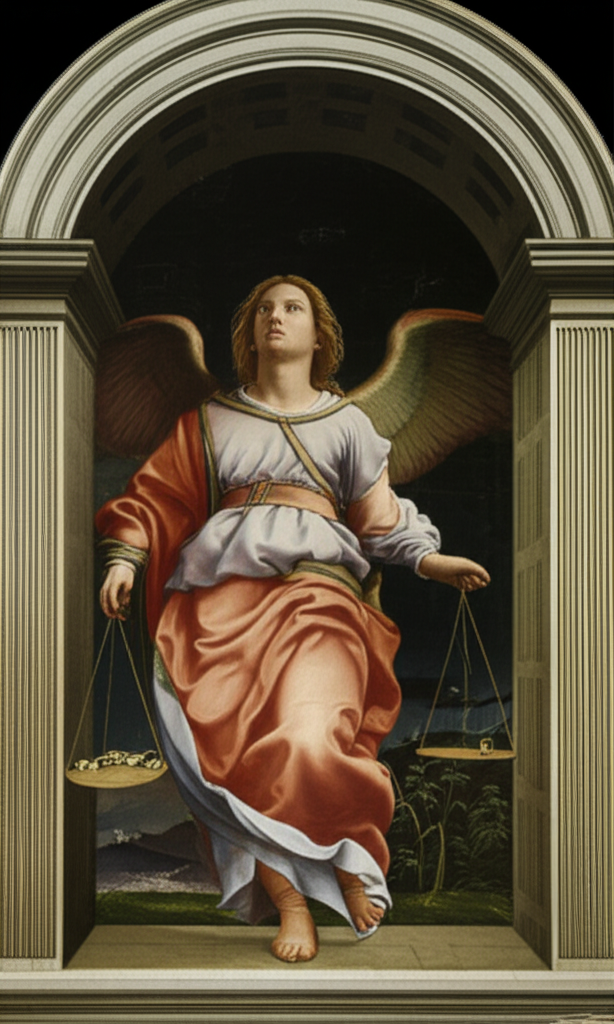 holding scales, while figures representing virtues and vices stand on either side, symbolizing the moral accounting of human actions. The expressions on the faces of the judged reflect despair or hope, and intricate details reveal the symbolic consequences of their earthly deeds.)
4. Modern Reinterpretations and the Shifting Sands of Morality
The Enlightenment and subsequent philosophical movements brought radical challenges to traditional notions of sin and judgment, leading to a re-evaluation of morality itself.
Nietzsche and the "Revaluation of All Values"
Friedrich Nietzsche, in works like On the Genealogy of Morality, launched a scathing critique of Christian morality, arguing that its concepts of sin and good and evil were products of a "slave morality." He contended that this morality, born of resentment from the weak, inverted the natural aristocratic values of strength and nobility. For Nietzsche, sin was a tool to subjugate, and judgment a mechanism of control, hindering the development of the Übermensch (Overman) who would create their own values beyond conventional good and evil. His work profoundly questions the very foundations of traditional moral judgment.
Existentialism and Radical Freedom
The existentialist movement, particularly through figures like Jean-Paul Sartre, further detached morality from external dictates. For Sartre, "existence precedes essence," meaning humans are not born with a predetermined nature or inherent good and evil. We are condemned to be free, meaning we are entirely responsible for creating our own values and making choices without recourse to God, nature, or universal moral laws. Sin, in this context, might be understood as "bad faith"—the attempt to deny one's radical freedom and responsibility by blaming external forces or pretending to be a thing rather than a conscious agent. Judgment becomes an internal, agonizing process of self-evaluation against the immense weight of one's own chosen values.
Secular Ethics and Humanism: Morality Without Religion
In increasingly secular societies, the quest for a moral framework independent of religion has gained prominence.
- Utilitarianism: Developed by thinkers like Jeremy Bentham and John Stuart Mill, utilitarianism proposes that the morally right action is the one that maximizes overall happiness or utility for the greatest number of people. Judgment here is consequentialist: an action is good if its outcomes are beneficial, and "sinful" if they cause unnecessary suffering.
- Humanism: Emphasizes human values, reason, and ethics, often advocating for a morality grounded in human flourishing and universal human rights, rather than divine commandments. Good and evil are defined by their impact on human well-being.
- Ethical Relativism vs. Universal Ethics: The modern discourse also grapples with whether moral judgment is culturally relative or if there are universal ethical principles applicable to all humanity. The concept of sin itself becomes highly contextualized in this debate.
The Psychology of Guilt and Shame: Internalized Judgment
Modern psychology has explored the internal experience of sin and judgment through the lenses of guilt and shame. While often intertwined, guilt typically relates to a specific action ("I did something bad"), while shame is a more pervasive feeling about the self ("I am bad"). These emotional responses are powerful internal mechanisms of judgment that compel individuals to conform to moral norms, seek atonement, or, conversely, lead to psychological distress and maladaptive behaviors. Understanding these internal states offers a new dimension to how we perceive the impact of sin and the process of judgment.
Conclusion: The Unfolding Dialogue
The concepts of sin and moral judgment are not static artifacts of ancient thought but living, evolving ideas that continue to shape our understanding of human nature, society, and the cosmos. From the theological pronouncements of Augustine and Aquinas to the rational ethics of Kant and the radical critiques of Nietzsche and Sartre, philosophers have ceaselessly grappled with the fundamental questions: What constitutes a transgression? By what standard do we judge? And what are the implications for our freedom and responsibility?
As we navigate an increasingly complex world, these questions remain as urgent as ever. Whether viewed through a religious lens, a secular ethical framework, or a psychological perspective, the enduring weight of conscience, the struggle to define good and evil, and the necessity of judgment persist as central to the human condition. The dialogue continues, inviting each generation to re-examine, re-interpret, and re-articulate the profound meanings of sin and moral judgment in their own time.
📹 Related Video: What is Philosophy?
Video by: The School of Life
💡 Want different videos? Search YouTube for: "Philosophy of Sin and Guilt - Great Thinkers Explained"
📹 Related Video: ARISTOTLE ON: The Nicomachean Ethics
Video by: The School of Life
💡 Want different videos? Search YouTube for: "Kantian Ethics vs. Virtue Ethics - Moral Philosophy Debate"