

The Concept of Sin and Moral Judgment: A Philosophical Inquiry
The concepts of sin and moral judgment lie at the very heart of human experience, traversing theological doctrines, ethical frameworks, and the profound questions of good and evil. Far from being mere relics of religious dogma, these ideas form the bedrock upon which civilizations have built their moral codes, legal systems, and understandings of personal responsibility. This pillar page delves into the multifaceted nature of sin and judgment, exploring their historical evolution, philosophical interpretations, and enduring relevance in shaping our understanding of what it means to live a morally upright life. We shall navigate the complex interplay between divine commands, human reason, and the often-perplexing landscape of moral accountability, drawing insights from the enduring wisdom contained within the Great Books of the Western World.
Unpacking Sin: From Transgression to Moral Failing
At its core, sin is often understood as a transgression against divine law or a fundamental moral principle. However, its interpretation varies wildly, moving from a specific act of disobedience to a state of being, an inherent flaw in human nature.
Historical and Religious Roots
Historically, the concept of sin is deeply embedded in nearly all religions. In Abrahamic faiths, particularly Judaism, Christianity, and Islam, sin is primarily an offense against God.
- Judaism: Focuses on mitzvot (commandments) and the breaking of covenants. Sin (חטא, chet) often implies missing the mark or going astray, with an emphasis on repentance and return to God's path.
- Christianity: Introduces the concept of "original sin," inherited from Adam's disobedience, which fundamentally affects human nature. Sin is not just an act but a condition, necessitating divine grace for redemption. Moral judgment, in this context, is often seen as God's ultimate prerogative.
- Islam: Sin (dhanb, khatīʾah) is a conscious act of disobedience to Allah's will, emphasizing individual accountability and the possibility of forgiveness through repentance.
Philosophical Interpretations of Sin
Beyond religious dogma, philosophers have grappled with the essence of sin, often reframing it within secular ethical systems.
- Plato: In works like Republic, Plato might not use the term "sin," but he certainly addresses moral failings. For Plato, evil often stems from ignorance. To know the Good is to do the Good; therefore, wrongdoing is a result of a lack of true knowledge, a misapprehension of what is truly beneficial for the soul.
- Aristotle: In Nicomachean Ethics, Aristotle defines vice as a deviation from the mean, an excess or deficiency in character that prevents one from achieving eudaimonia (flourishing). While not "sin" in a theological sense, it represents a moral failing that undermines human potential.
- Augustine of Hippo: A pivotal figure bridging theology and philosophy, Augustine, particularly in Confessions and City of God, elaborates on the concept of sin as a perversion of the will. It's not ignorance, but a deliberate turning away from God, a love of lesser goods over the supreme Good. This emphasizes free will as the origin of sin and introduces a profound sense of guilt and the need for divine grace.
- Immanuel Kant: While rejecting the theological notion of original sin, Kant, in Religion within the Bounds of Bare Reason, speaks of a "radical evil" inherent in human nature. This is not a desire for evil itself, but a propensity to subordinate the moral law (duty) to self-love, even when recognizing the moral law. This is a profound philosophical interpretation of a moral failing that mirrors the deep-seated nature of sin.
The Nature of Moral Judgment: Who Judges What, and Why?
The act of judgment is an inescapable aspect of human interaction and self-reflection. It involves evaluating actions, intentions, and character against a set of moral standards.
Divine vs. Human Judgment
- Divine Judgment: In many religious traditions, God is the ultimate judge, possessing perfect knowledge and absolute authority. This judgment often pertains to an afterlife, determining eternal reward or punishment based on one's earthly conduct. The concept of a final judgment instills a powerful moral imperative.
- Human Judgment: On a more immediate level, humans constantly judge each other and themselves. This occurs in various forms:
- Legal Judgment: Based on codified laws and legal precedent.
- Social Judgment: Based on societal norms, customs, and expectations.
- Personal Moral Judgment: Based on individual conscience, ethical principles, and empathy.
Subjectivity vs. Objectivity in Morality
One of the most enduring philosophical debates surrounding moral judgment concerns whether moral truths are objective (universal and independent of human opinion) or subjective (dependent on individual or cultural perspectives).
- Objective Morality: Philosophers like Plato (with his Forms of the Good) and Kant (with his Categorical Imperative) argue for objective moral principles that apply universally. For them, good and evil are not arbitrary but are discoverable through reason or divine revelation.
- Subjective Morality: Others, like certain Sophists in ancient Greece or modern ethical relativists, argue that morality is culturally or individually determined. What is considered "sinful" in one society might be acceptable in another, making universal moral judgment problematic.
The Role of Conscience
Central to human moral judgment is the concept of conscience. Often described as an inner voice or faculty, conscience guides individuals in distinguishing right from wrong and can evoke feelings of guilt or peace. Thinkers from Aquinas to Butler have explored conscience as a natural human capacity, potentially a reflection of divine law or an evolved moral sense.
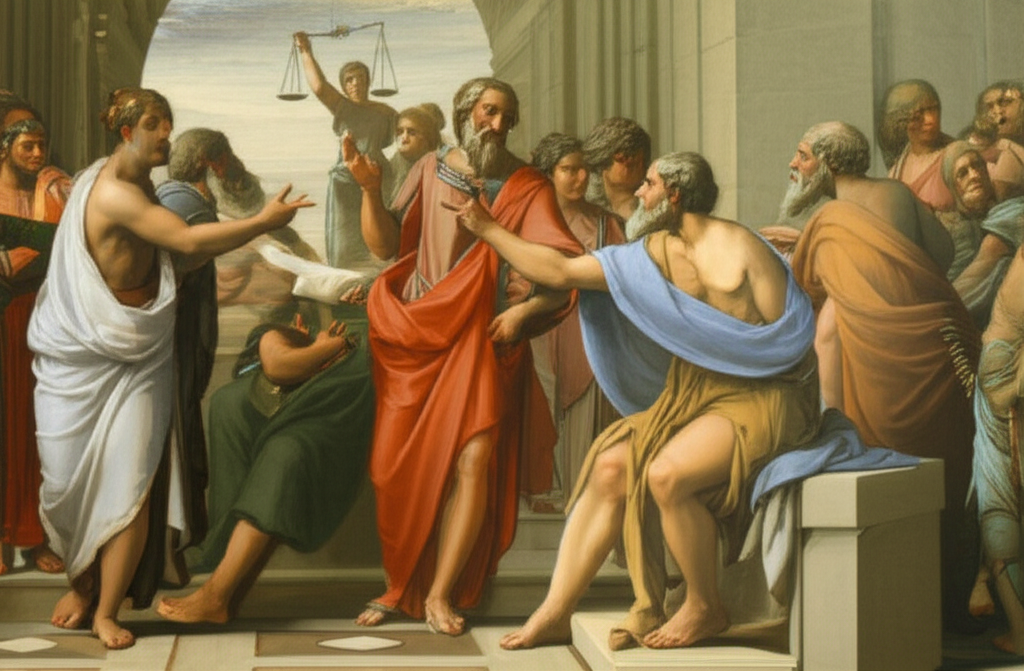
The Interplay of Good and Evil: Defining the Moral Compass
The very possibility of sin and judgment presupposes a distinction between good and evil. How we define these fundamental concepts shapes our entire ethical landscape.
Teleological vs. Deontological Ethics
Two primary approaches in Western philosophy offer different lenses through which to understand good and evil:
- Teleological Ethics (Consequentialism): Focuses on the ends or consequences of actions. An action is judged as good if it produces a desirable outcome.
- Aristotle's Virtue Ethics: While not strictly consequentialist, Aristotle's focus on eudaimonia (human flourishing) as the ultimate end implies that virtuous actions are those that lead to this good life.
- Utilitarianism (Bentham, Mill): An action is good if it maximizes overall happiness or minimizes suffering for the greatest number of people.
- Deontological Ethics (Duty-Based): Focuses on the inherent rightness or wrongness of actions themselves, irrespective of their consequences.
- Immanuel Kant: Argued that moral actions are those performed out of duty, in accordance with universal moral laws (Categorical Imperatives). An action is good if it can be consistently willed as a universal law, and individuals are treated as ends in themselves, never merely as means.
The Problem of Evil
The existence of evil in a world supposedly created by an omnipotent, omnibenevolent God poses a significant philosophical challenge, often referred to as the "Problem of Evil." Philosophers like Leibniz (in Theodicy) and Augustine wrestled with how evil can exist if God is perfectly good. Solutions often involve free will (evil as a result of human choice) or the idea that evil is necessary for a greater good (e.g., character development).
Nietzsche's Critique of Good and Evil
Friedrich Nietzsche, a radical voice from the Great Books, famously critiqued traditional notions of good and evil in works like On the Genealogy of Morality. He argued that these concepts, particularly "good" as self-sacrifice and "evil" as self-assertion, were initially products of a "slave morality" designed by the weak to control the strong. Nietzsche advocated for a revaluation of values, moving beyond these inherited categories to create one's own meaning and virtue.
Sin in a Secular Age: Modern Interpretations and Challenges
While the language of "sin" might seem archaic to some, its underlying concerns persist in contemporary thought, re-framed through psychology, sociology, and existentialism.
Psychological Perspectives
Modern psychology often reinterprets the internal experience of sin as:
- Guilt: The emotional distress arising from the belief that one has done something wrong, often linked to violating personal or societal standards.
- Shame: A more pervasive feeling of being fundamentally flawed or unworthy, often tied to one's identity rather than a specific act.
- Moral Injury: A concept often used in military contexts, referring to the psychological distress resulting from actions that violate one's deeply held moral beliefs, or from witnessing such violations.
Sociological Implications
Sociology examines how societies define and respond to deviations from norms.
- Crime: Legal transgressions against the state, often carrying formal penalties.
- Social Deviance: Actions that violate societal norms but are not necessarily illegal.
- The study of these phenomena often seeks to understand the social functions of defining "wrongdoing" and the mechanisms of social control and judgment.
Existentialist Views
Existentialist philosophers like Jean-Paul Sartre and Albert Camus, while not using "sin," emphasize individual responsibility and freedom. For Sartre, to deny one's freedom or to blame external factors for one's choices is "bad faith" – a kind of self-deception that prevents authentic living. This echoes the Augustinian emphasis on the will, but without the divine framework. The burden of judgment rests entirely on the individual for their choices in an absurd world.
Philosophical Perspectives on Atonement and Redemption
If sin represents a moral failing, then atonement and redemption offer paths to reconciliation and moral repair. These concepts, too, transcend purely religious contexts, finding philosophical analogues in ideas of justice, forgiveness, and self-improvement.
- Justice vs. Mercy: This enduring tension often plays out in discussions of how to respond to wrongdoing. Should the focus be on strict retribution (justice) or on rehabilitation and forgiveness (mercy)?
- The Role of Forgiveness: Philosophically, forgiveness can be understood as a complex act involving letting go of resentment, restoring relationships, and fostering healing, both for the wronged and the wrongdoer.
- Self-Improvement and Moral Progress: Whether through secular therapy, ethical reflection, or spiritual practices, the desire to overcome past failings and strive for moral betterment is a universal human aspiration.
Key Philosophical Approaches to Moral Transgression
| Philosopher/Tradition | Nature of Transgression (Sin) | Basis of Judgment | Path to Moral Repair |
|---|---|---|---|
| Plato | Ignorance of the Good | Rational understanding | Education, philosophical inquiry |
| Augustine | Perversion of the Will (turning from God) | Divine Law, Conscience | Divine Grace, Repentance |
| Aristotle | Vice (deviation from the mean) | Practical Reason, Virtue | Habituation, cultivating virtues |
| Kant | Violation of Moral Duty | Categorical Imperative | Acting from duty, adherence to universal moral law |
| Nietzsche | Adherence to "slave morality" | Self-created values | Revaluation of values, self-overcoming |
📹 Related Video: PLATO ON: The Allegory of the Cave
Video by: The School of Life
💡 Want different videos? Search YouTube for: ""Plato's Ethics: The Good Life and the Forms" - A video exploring Plato's concept of the Good and how it relates to human action and moral judgment."
📹 Related Video: KANT ON: What is Enlightenment?
Video by: The School of Life
💡 Want different videos? Search YouTube for: ""Kant's Categorical Imperative Explained" - An explanation of Kantian deontology and its implications for understanding moral duty and right action."
Conclusion: The Enduring Relevance of Sin and Moral Judgment
The journey through the concepts of sin and moral judgment reveals them to be far more than archaic religious terms. They are deeply ingrained philosophical questions that continue to challenge our understanding of human nature, responsibility, and the very fabric of our societies. From the ancient Greek pursuit of virtue to the Abrahamic understanding of divine commandment, and from Kant's categorical imperative to Nietzsche's radical critique, the perennial quest to define good and evil and to hold ourselves and others accountable remains a central pillar of philosophical inquiry. Engaging with these concepts, therefore, is not merely an academic exercise but a vital step in navigating the complexities of human morality and striving for a more just and ethical existence.