

The Unseen Architecture: How Signs and Symbols Build the World of Mathematics
At the heart of mathematics lies a profound reliance on Sign and Symbol. Far from being mere shorthand, these abstract representations form the very language through which mathematical ideas are conceived, communicated, and explored. They are the essential tools that allow us to transcend the limitations of concrete experience, enabling the manipulation of concepts that might otherwise remain inaccessible to the human mind. This article delves into the philosophical underpinnings of how signs and symbols function within mathematics, examining their distinct roles and their collective power in shaping our understanding of quantity, structure, and change.
The Foundation of Thought: Defining Sign and Symbol
To truly appreciate their role, we must first distinguish between a sign and a symbol within the mathematical context, a distinction often explored in the philosophical traditions found within the Great Books of the Western World when discussing logic and epistemology.
- Signs are typically direct indicators or operators. They often have a more immediate, less abstract meaning, frequently representing an action or a specific relationship.
- Symbols are representations of ideas, concepts, or entities. They are often more abstract, conventional, and gain their meaning through an established system or agreement.
In mathematics, this distinction becomes clear:
| Feature | Sign | Symbol |
|---|---|---|
| Function | Indicates an operation or relationship | Represents a concept, quantity, or variable |
| Meaning | Often direct and operational | Abstract, conventional, conceptual |
| Examples | + (addition), - (subtraction), = (equality), > (greater than) |
5 (the quantity five), x (an unknown variable), π (Pi), ∫ (integral) |
The sign + tells us to perform an action, to combine quantities. The symbol 5 stands for the abstract idea of "five-ness," a specific cardinality. Together, these elements form a powerful and unambiguous language.
Mathematics as a Universal Language
The genius of mathematics lies in its universal language, built meticulously from Sign and Symbol. Unlike natural languages, which are fraught with ambiguity and cultural nuance, the mathematical lexicon strives for absolute precision. Each symbol represents a singular idea, and each sign dictates an unequivocal action or relationship. This precision is what allows mathematical statements to transcend linguistic and cultural barriers, making them universally comprehensible to anyone who understands the underlying symbolic conventions.
Consider the equation: E = mc². This concise arrangement of symbols and signs communicates a profound idea about the relationship between energy, mass, and the speed of light, an idea that is understood identically by physicists across the globe, regardless of their native tongue. This universality is a testament to the power of well-defined Sign and Symbol systems.
From Concrete to Abstract: The Evolution of Mathematical Ideas
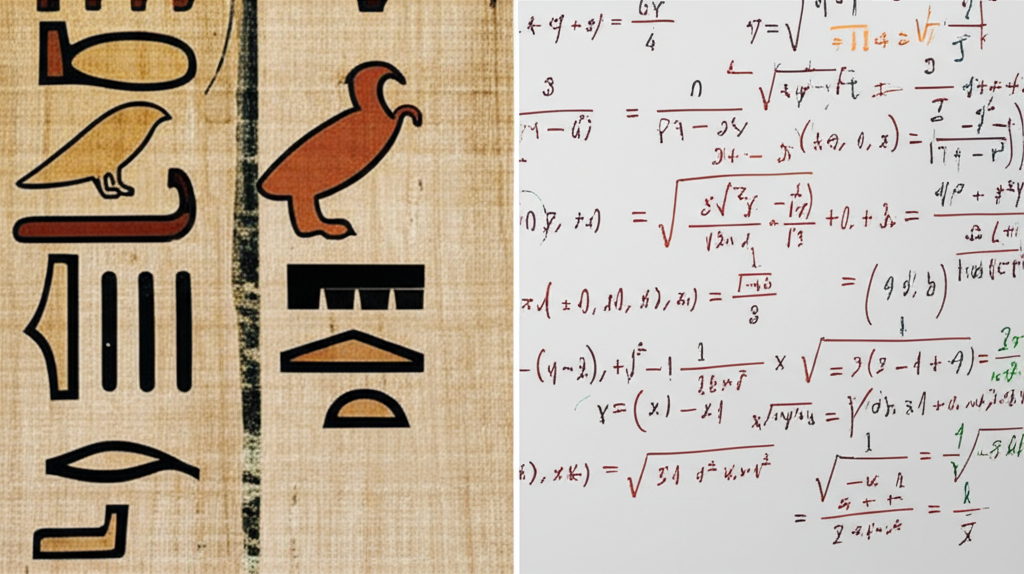
The progression of mathematical thought, from ancient counting systems to modern abstract theories, is inextricably linked to the development and refinement of its Sign and Symbols. Early mathematics often relied on concrete representations – notches on bones, pebbles for counting, geometric diagrams. While effective for basic tasks, these methods severely limited the complexity of ideas that could be conceived or expressed.
The introduction of symbolic algebra, for instance, marked a revolutionary leap. Before symbols like x and y were widely adopted, expressing and solving equations was an arduous task, often requiring lengthy verbal descriptions. The advent of symbolic notation allowed mathematicians to:
- Represent unknowns: Enabling the formulation and solution of general problems.
- Manipulate abstract entities: Working with concepts like infinity, imaginary numbers, or complex functions without needing concrete analogues.
- Compress complex information: A single symbol can encapsulate a vast amount of meaning, enabling more efficient thought and communication.
The Philosophical Implications of Symbolic Representation
The philosophical implications of Sign and Symbol in mathematics are profound. They touch upon questions of epistemology (how we know), ontology (what exists), and the very nature of human cognition.
- Shaping Thought: Do symbols merely represent pre-existing ideas, or do they actively shape and enable those ideas? Many philosophers argue that mathematical symbols are not just tools for expression but are integral to the very act of mathematical discovery. Without the symbol '0', for instance, the concept of zero as a placeholder and a number in its own right might never have fully emerged or been consistently applied, profoundly impacting our number system.
- The Problem of Reference: What do mathematical symbols refer to? Do numbers, sets, and functions exist independently in some Platonic realm, or are they constructs of the human mind, given form and reality through our symbolic systems? This debate, echoed in the Great Books discussions on universals and particulars, continues to animate the philosophy of mathematics.
- Efficiency and Economy: The symbolic language of mathematics provides an unparalleled economy of thought. Complex relationships and intricate logical arguments can be condensed into concise symbolic expressions, allowing the mind to grasp and manipulate them with greater ease and less cognitive load. This efficiency is crucial for tackling problems of immense complexity.
Conclusion: The Enduring Power of Abstraction
The concept of Sign and Symbol in mathematics is far more than a practical convenience; it is the fundamental architecture upon which the entire discipline is built. These abstract tools provide the language necessary to articulate and explore sophisticated ideas, enabling a universal dialogue that transcends cultural and linguistic boundaries. From the simplest arithmetic to the most complex theories of physics, the power of mathematics lies in its ability to abstract reality into a system of signs and symbols, allowing us to manipulate, understand, and ultimately, reshape our world through the sheer force of pure thought. They are the unseen scaffolding that supports the grand edifice of human knowledge.
📹 Related Video: What is Philosophy?
Video by: The School of Life
💡 Want different videos? Search YouTube for: "Philosophy of Mathematics - What is Math?"
📹 Related Video: KANT ON: What is Enlightenment?
Video by: The School of Life
💡 Want different videos? Search YouTube for: "The History of Mathematical Notation and Symbols"