

A Philosophical Look at Mathematical Language: Signs, Symbols, and the Ideas They Convey
In the grand tapestry of human knowledge, mathematics stands as perhaps the most precise and universal language. Yet, within its seemingly rigid structure lies a profound distinction, often overlooked, between the humble sign and the potent symbol. This article delves into this critical difference, exploring how signs serve as direct indicators while symbols encapsulate complex ideas, shaping our understanding of mathematical concepts and echoing philosophical debates on representation and meaning. For anyone who has ever pondered the true nature of 'x' or the profound implications of 'π', understanding this distinction is key to unlocking a deeper appreciation for the architecture of mathematical thought.
The Directness of the Mathematical Sign
At its most fundamental, a sign in mathematics is a direct, unambiguous indicator. It points to a specific quantity, operation, or placeholder without necessarily carrying a deeper, layered meaning beyond its immediate referent. Signs are the bedrock upon which mathematical expressions are built, serving as the foundational elements of its language. They are the fundamental characters, the singular utterances that, when combined, begin to form coherent statements.
- Definition: A sign refers to a singular idea or object. It is often arbitrary but consistently applied within a given context. Its meaning is typically fixed and immediate.
- Function: To denote, indicate, or represent a single, clear entity or action.
Examples in Practice
Consider the following common mathematical signs:
| Sign | Description | Represents the Idea of... |
|---|---|---|
1 |
The numeral one | A single unit |
+ |
The addition operator | The act of combining |
x |
A variable | An unknown quantity |
= |
The equality sign | Equivalence |
< |
The less than sign | A relationship of magnitude |
Each of these elements, when encountered, immediately directs the mind to a single, specific idea or action. They are the punctuation and basic vocabulary of mathematical language, essential for constructing expressions, but not typically imbued with layers of abstract meaning in themselves.
The Depth of the Mathematical Symbol
In contrast to the directness of the sign, a symbol in mathematics transcends mere indication. A symbol is a richer, more complex entity that stands for, evokes, or embodies a multifaceted idea, concept, or even an entire system of thought. It often carries a historical weight, a depth of abstraction, and a capacity to communicate vast amounts of information concisely. Symbols are the metaphors and allegories of mathematical language, pregnant with meaning that unfolds upon contemplation.
- Definition: A symbol refers to a complex idea, a relationship, a process, or a collection of concepts. Its meaning can be rich, abstract, and often requires context and understanding of underlying principles.
- Function: To encapsulate, represent, and communicate sophisticated, abstract ideas efficiently.
Embodying Complex Ideas
Let's examine some quintessential mathematical symbols:
- π (Pi): Far more than just the number 3.14159..., pi symbolizes the fundamental ratio between a circle's circumference and its diameter. It embodies the idea of circularity, irrationality, and transcendence, appearing ubiquitously across geometry, trigonometry, and calculus, linking seemingly disparate areas of mathematics.
- ∫ (Integral Sign): This elongated 'S' is not merely an operator; it symbolizes the concept of summation over an infinite number of infinitesimally small parts. It represents the idea of accumulation, area under a curve, total change, and is central to the entire edifice of integral calculus.
- ∞ (Infinity): Not a number in the conventional sense, the infinity symbol represents the idea of unboundedness, an endless quantity, or a limit that is never reached. Its philosophical implications are profound, touching upon the limits of human comprehension and the nature of the cosmos.
- Σ (Sigma): While sometimes used as a simple summation sign, in more advanced contexts, it symbolizes the process of adding a sequence of numbers, often representing complex series or statistical aggregations, embodying the idea of collection and totalization.
These symbols are not just shorthand; they are conceptual shorthand, encapsulating entire fields of study and generations of intellectual endeavor into a single glyph.
The Dynamic Relationship: From Sign to Symbol
The distinction between sign and symbol is not always rigid, and indeed, the beauty of mathematical language often lies in the dynamic interplay between the two. A sign can, through context, abstraction, and repeated use, evolve into a symbol. For instance, 'x' as a simple variable is a sign; but 'x' in the context of Cartesian coordinates, representing an entire axis and a dimension of space, begins to take on symbolic weight. Similarly, the numeral '0' is a sign for absence, but as the symbol for the identity element in addition or the concept of 'nothingness' that allows for positional notation, its meaning deepens profoundly.
This evolution underscores the power of mathematical notation: it allows for the concise communication of highly complex ideas, building layers of meaning upon simpler foundations.
Mathematics as a Language of Ideas: A Philosophical Perspective
The very nature of sign and symbol in mathematics has profound philosophical implications, echoing themes explored in the Great Books of the Western World. Philosophers from Plato to Wittgenstein have grappled with how abstract concepts are represented and communicated.
- Plato's Forms: The mathematical symbol, in its capacity to represent perfect, abstract ideas (like the ideal circle represented by π), resonates with Plato's theory of Forms. Mathematical entities, for Plato, were not merely earthly approximations but reflections of eternal, unchanging Forms, accessible through intellect. The symbol becomes a gateway to these perfect ideas.
- Aristotle's Logic and Language: Aristotle's meticulous analysis of language and logic in works like Organon provides a framework for understanding how signs (terms) are combined into propositions and arguments. While he didn't explicitly distinguish mathematical signs and symbols in modern terms, his emphasis on clear definitions and the structure of reasoning underpins the precise use of mathematical notation.
- Leibniz's Universal Characteristic: The dream of a universal language (characteristica universalis) by figures like Leibniz, who sought to create a system where all ideas could be represented by unambiguous signs and symbols, highlights the philosophical ambition inherent in mathematical notation. This quest was, in essence, an attempt to perfect the mathematical language itself.
- Whitehead and Russell's Principia Mathematica: This monumental work, a direct descendant of the Great Books tradition in its ambition, was an attempt to derive all of mathematics from a set of logical axioms using a rigorous system of signs and symbols. It demonstrated the immense power and complexity that could be built from fundamental logical operators, showcasing how signs could be combined into symbolic systems of immense explanatory power.
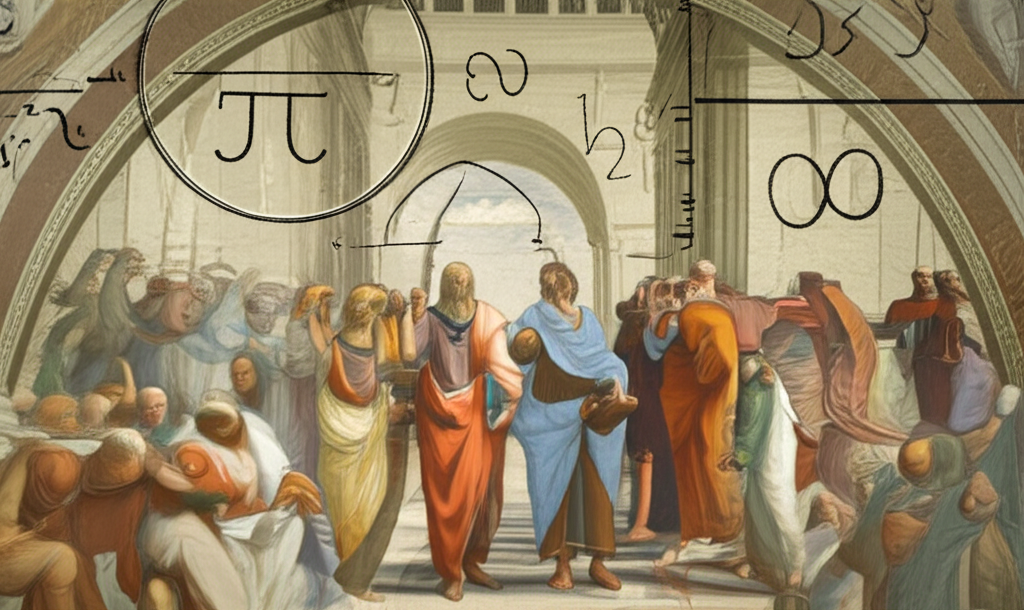
The continuous refinement of mathematical language through its signs and symbols is a testament to humanity's enduring quest to articulate, understand, and manipulate abstract ideas.
Conclusion: The Architecture of Mathematical Thought
The distinction between sign and symbol is more than a semantic nuance; it is fundamental to appreciating the depth and power of mathematics. Signs provide the direct, unambiguous pointers, the essential vocabulary of mathematical language. Symbols, on the other hand, are the rich, compact encapsulations of complex ideas, allowing for profound communication and conceptual leaps.
To truly engage with mathematics is to understand not just what a sign represents, but what a symbol evokes. It is to recognize the philosophical weight carried by these marks on a page, marks that connect us to millennia of human thought and the timeless pursuit of universal truths. By understanding this distinction, we gain a clearer perspective on how mathematics serves as a powerful language for articulating the most abstract and intricate ideas that the human mind can conceive.
📹 Related Video: What is Philosophy?
Video by: The School of Life
💡 Want different videos? Search YouTube for: ""Philosophy of Mathematics Signs Symbols""
📹 Related Video: ARISTOTLE ON: The Nicomachean Ethics
Video by: The School of Life
💡 Want different videos? Search YouTube for: ""What is a Mathematical Symbol? Semiotics in Math""