

The Silent Language of Reason: Unpacking Sign and Symbol in Mathematics
Mathematics, often hailed as the universal language, operates through an intricate system of signs and symbols that transcend cultural and linguistic barriers. Far from mere shorthand, these graphic representations are the very scaffolding upon which complex ideas are built, communicated, and explored. This article delves into the philosophical distinction between a sign and a symbol within the realm of mathematics, examining how these constructs enable profound abstraction and shape our understanding of reality, drawing insights from the enduring wisdom of the Great Books of the Western World. We will see how these seemingly simple marks on a page become conduits for the most sophisticated human thought, bridging the tangible world with the realm of pure reason.
Navigating the Semantic Landscape: Sign vs. Symbol
To truly appreciate the power of mathematical notation, we must first establish a clear distinction between a sign and a symbol. While often used interchangeably in common parlance, their philosophical implications, particularly in the rigorous domain of mathematics, warrant careful consideration.
-
The Sign: An Immediate Indicator
A sign primarily functions as an indicator, a direct pointer to something specific or an immediate representation of a quantity or object. In the context of mathematics, a numeral like "5" is a sign for the quantity five, a unique numerical value. The shape of a triangle drawn on a blackboard is a sign representing a triangle. Its meaning is often relatively straightforward and directly referential. Like a road sign indicating a turn, a mathematical sign often directs our attention to a concrete instance or a singular, unambiguous concept. -
The Symbol: A Vessel for Abstract Ideas
A symbol, conversely, carries a deeper, more abstract, and often conventional meaning. It stands for an idea or a concept that may not have a direct physical counterpart. The power of a symbol lies in its ability to encapsulate complex relationships, operations, or universal truths. Consider the following:- The plus sign (+) is a symbol for the idea of addition, an abstract operation.
- The integral sign (∫) is a symbol for the idea of summation over continuous infinitesimals.
- Pi (π) is a symbol representing an irrational constant, the ratio of a circle's circumference to its diameter—a profound idea about the nature of circles.
- The equality sign (=) is a symbol for the idea of equivalence, stating that two expressions represent the same value or concept.
As thinkers from Plato to Locke have explored, symbols are the tools by which we grasp and manipulate ideas that exist beyond immediate sensory experience. They are not merely labels but active participants in the construction of meaning.
Mathematics as a Language of Ideas
If language is a system of communication, then mathematics is arguably its most precise and universal form, built almost entirely upon the judicious application of signs and symbols. It is a language designed not for poetry or narrative, but for the articulation of pure reason and abstract truth.
The Great Books of the Western World frequently touch upon the nature of language and its relationship to thought. Aristotle, in his Organon, meticulously dissects the structure of propositions and syllogisms, demonstrating how words—and by extension, symbols—are organized to convey logical truths. Similarly, Locke, in his Essay Concerning Human Understanding, explores how words serve as "sensible marks of ideas," a concept directly applicable to mathematical notation where symbols become the indispensable marks of mathematical ideas.
Key Characteristics of Mathematical Language:
- Precision: Mathematical symbols are designed to be unambiguous, conveying exact meanings without the fuzziness often found in natural language.
- Conciseness: Complex ideas can be represented compactly, allowing for efficient manipulation and communication.
- Universality: A mathematical symbol like "∫" or "π" holds the same meaning for mathematicians across the globe, transcending spoken language barriers.
- Generative Power: By combining symbols according to established rules (syntax), mathematicians can generate new ideas and discover new truths.
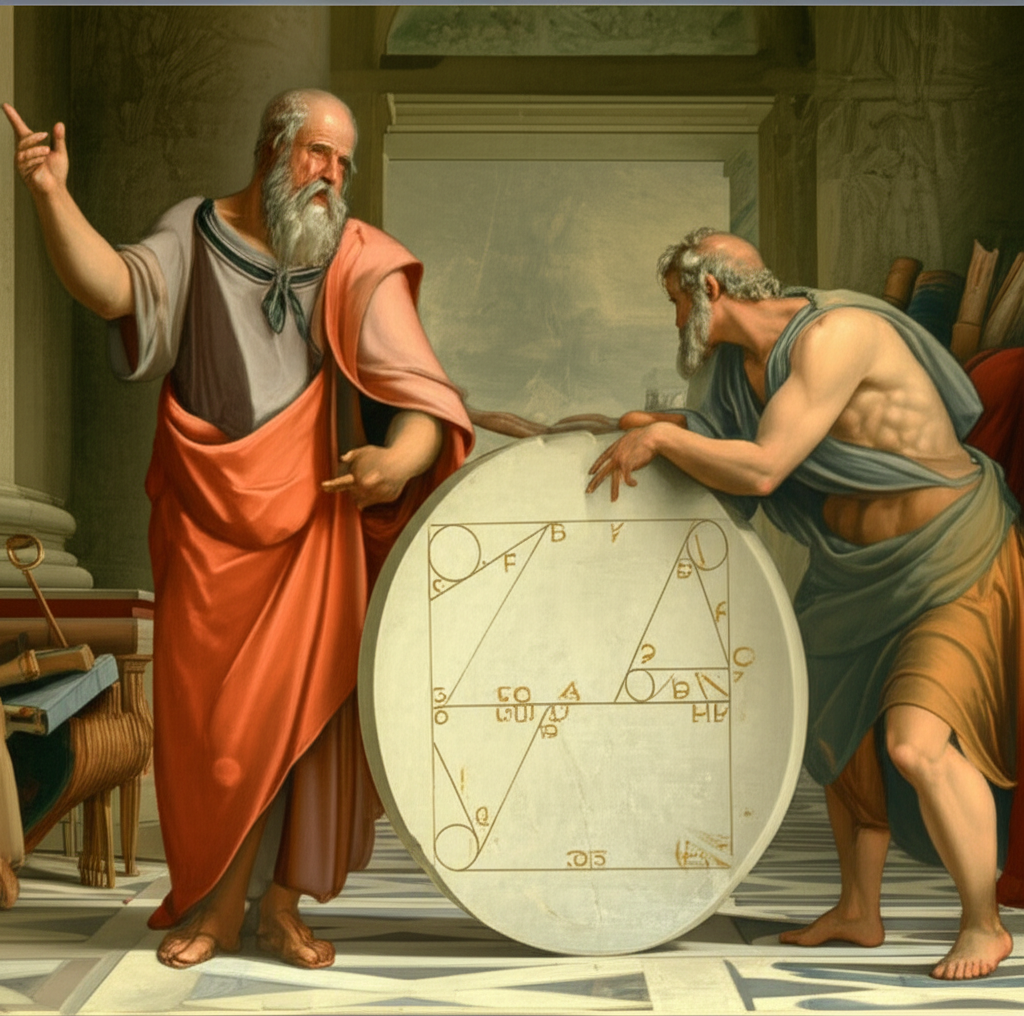 subtly visible in the background or on a scroll beside them, emphasizing the philosophical grounding of abstract mathematical concepts.)
The Abstraction Engine: How Symbols Drive Mathematical Thought
The true genius of mathematics lies in its capacity for abstraction, and this capacity is fundamentally enabled by its reliance on symbols. Consider the idea of "infinity." It cannot be pointed to, touched, or fully comprehended through direct experience. Yet, the symbol "∞" allows us to conceive of it, to manipulate it in equations, and to reason about its properties.
This move from the concrete to the abstract, mediated by symbols, is a hallmark of philosophical inquiry. Descartes, for instance, sought clear and distinct ideas as the foundation for knowledge, a quest that finds its purest expression in the logical rigor facilitated by mathematical symbolism. Leibniz even dreamed of a "universal characteristic," a perfect symbolic language that could resolve all disputes through calculation, highlighting the profound belief in the power of symbols to embody and process reason itself.
The Role of Symbols in Mathematical Abstraction:
- Encapsulation: A single symbol can encapsulate a vast amount of information or a complex process, freeing the mind from having to hold all details simultaneously.
- Manipulation: Once an idea is represented symbolically, it can be manipulated according to logical rules, allowing for discovery and proof.
- Generalization: Symbols allow us to express general truths (e.g., a + b = b + a) that apply to an infinite number of specific cases, moving beyond individual instances to universal principles.
- Communication: Symbols provide a shared vocabulary for mathematicians to communicate intricate ideas with precision and efficiency.
Philosophical Echoes: Symbols, Reality, and Human Understanding
The relationship between signs and symbols in mathematics and our understanding of reality is a profound philosophical question. Do mathematical ideas exist independently of human thought, and are our symbols merely imperfect reflections of these eternal truths? Or are these symbols the very constructs that bring mathematical ideas into being, shaping our cognitive landscape?
Plato's theory of Forms, discussed extensively in works like The Republic, suggests that true knowledge lies in apprehending unchanging, perfect Forms (or Ideas) that exist beyond the sensory world. From this perspective, mathematical symbols might be seen as our imperfect attempts to represent these ideal mathematical Forms—the perfect circle, the true essence of quantity.
Conversely, a more empirical or constructivist view might argue that while mathematical ideas are powerful, they are ultimately products of human cognition, refined and communicated through the language of signs and symbols. Regardless of one's metaphysical stance, the undeniable fact remains that these abstract marks are indispensable for the advancement of human knowledge and our ability to model and comprehend the universe. They are the silent architects of our scientific and technological progress, allowing us to think beyond the immediate and grasp the truly universal.
Conclusion: The Enduring Power of Abstraction
The distinction between signs and symbols in mathematics is not merely an academic exercise; it is fundamental to understanding the very nature of mathematical thought and its profound impact on human civilization. Signs provide direct reference, while symbols unlock the door to abstract ideas, enabling the formation of a universal language that speaks to the essence of reason itself. Drawing from the deep well of philosophical inquiry, we recognize that these seemingly simple notations are the bedrock upon which the most complex and beautiful structures of human intellect are built, allowing us to explore the cosmos and our place within it, one elegant symbol at a time.
**## 📹 Related Video: What is Philosophy?
Video by: The School of Life
💡 Want different videos? Search YouTube for: "Philosophy of Mathematics: What is Mathematical Reality?"**
**## 📹 Related Video: ARISTOTLE ON: The Nicomachean Ethics
Video by: The School of Life
💡 Want different videos? Search YouTube for: "Semiotics and Mathematics: The Language of Abstract Thought"**