

The Silent Language: Unpacking Signs and Symbols in Mathematical Thought
Mathematics, often hailed as the universal language, speaks not through words but through an intricate tapestry of signs and symbols. Far from being mere shorthand, these glyphs and notations are the very bedrock upon which abstract thought is built, mediating our understanding of quantity, structure, and change. This article delves into the profound philosophical distinction between a sign and a symbol within the realm of mathematics, exploring how these fundamental elements shape our comprehension of mathematical ideas and, by extension, our grasp of reality itself. We will uncover how the seemingly simple act of writing '2' or 'π' connects us to a rich history of human language and a timeless pursuit of truth.
The Foundation of Understanding: Sign and Symbol Defined
To truly appreciate the philosophical depth of mathematics, we must first articulate the difference between a sign and a symbol. While often used interchangeably in common parlance, their distinction is crucial when exploring the architecture of mathematical thought.
- A Sign: A sign typically points directly to something. It is often concrete, specific, and its meaning is largely immediate and unambiguous. Think of a road sign indicating "stop" – its meaning is direct and functional. In mathematics, a sign might be a numeral like '5' representing the quantity five, or the '+' operator indicating addition. Its primary function is indicative; it points to a specific operation or quantity.
- A Symbol: A symbol, by contrast, carries a deeper, often more abstract or representative meaning. It doesn't just point; it stands for an idea or a concept that might be complex, multi-faceted, or even intangible. Symbols often require interpretation, context, and a shared understanding to fully grasp their significance. They evoke a conceptual framework rather than merely indicating a direct referent.
In mathematics, this distinction blurs and deepens. While '5' is a sign for five units, when it appears within a complex equation like E = mc², the 'c' (representing the speed of light) transcends a simple sign. It becomes a symbol encapsulating a fundamental constant of the universe, an idea that has profound physical and philosophical implications.
Mathematics as a Language of Symbols
The power of mathematics lies in its capacity to communicate complex ideas with unparalleled precision and universality. This is achieved almost entirely through its symbolic nature. Unlike natural languages, which are often ambiguous and culturally bound, mathematical symbols strive for a global, unambiguous meaning.
Consider the evolution of mathematical notation. Early forms of arithmetic might have used tally marks – direct signs for quantities. The development of numerals, then algebraic variables (like x or y), and eventually complex operators and functions, marked a shift towards increasingly abstract symbols. These symbols allow us to:
- Condense Information: A single symbol can represent a vast amount of information or a complex operation.
- Facilitate Abstraction: They enable us to manipulate ideas about quantities and relationships without needing to refer to concrete instances.
- Promote Universality: Once defined, a symbol like '∫' (the integral sign) carries the same meaning for mathematicians across the globe, transcending linguistic barriers.
This symbolic language allows mathematicians to explore concepts that might be impossible to articulate or even conceive of using natural language alone. It provides a framework for logical deduction and the construction of elaborate theoretical structures.
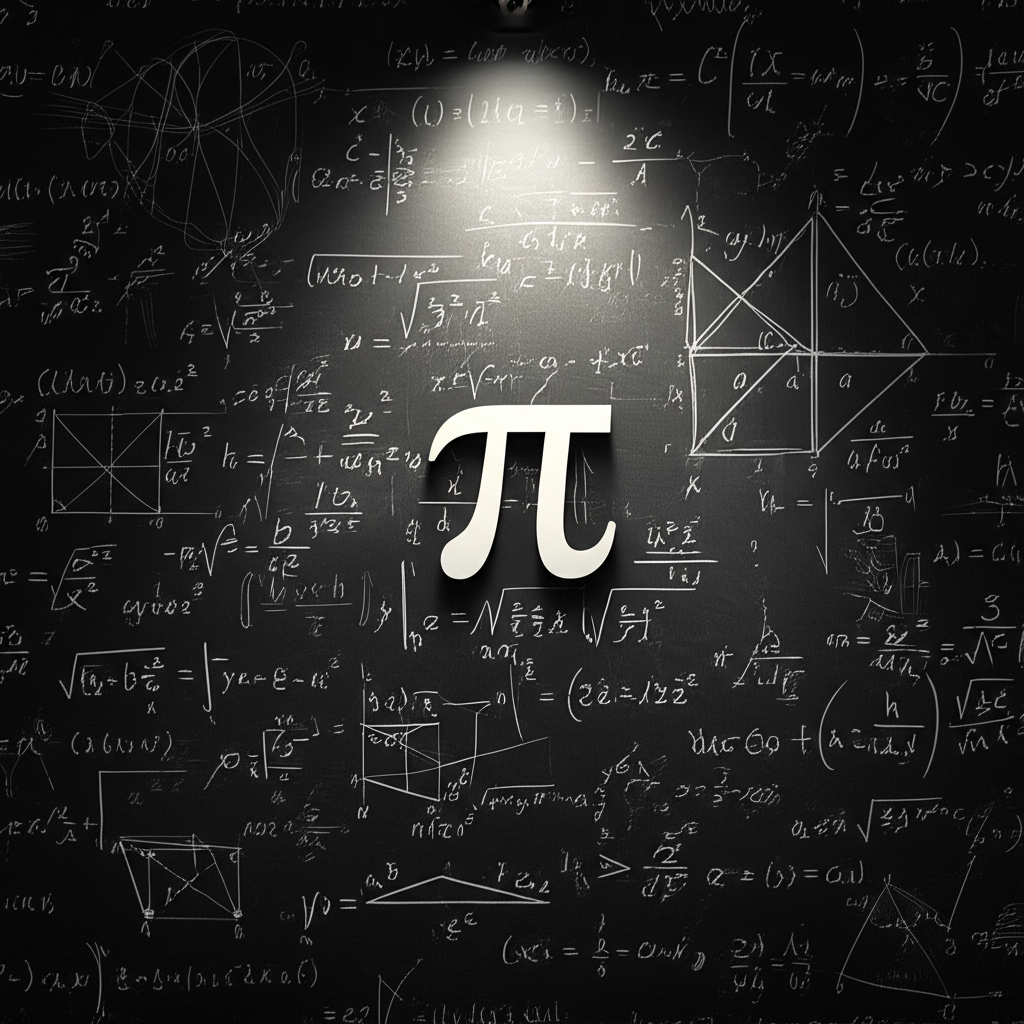 is prominently written, casting a subtle shadow that hints at its infinite nature. Beside it, a hand-drawn representation of a circle with its diameter, emphasizing the conceptual origin of the symbol, while in the background, faint, almost ethereal images of ancient Greek philosophers, like Plato or Pythagoras, seem to observe the notation with contemplative expressions.)
The Philosophical Weight: Symbols, Ideas, and Reality
The Great Books of the Western World offer countless insights into the relationship between language, ideas, and reality. Philosophers from Plato to Locke grappled with how our words and concepts connect to the world around us. In mathematics, this philosophical inquiry takes on a unique dimension.
When we use a mathematical symbol, are we merely creating a convenient representation, or are we tapping into a pre-existing idea or truth? This question lies at the heart of the philosophy of mathematics, particularly the debate between mathematical Platonism and formalism.
- Platonism: Suggests that mathematical ideas and truths exist independently of human thought, in a realm of abstract forms. Our symbols merely discover and denote these pre-existing realities. For a Platonist, the symbol 'π' doesn't create the ratio of a circle's circumference to its diameter; it represents an eternal, immutable truth.
- Formalism: Posits that mathematics is primarily a game of symbols and rules. The meaning of a symbol is determined by its role within a formal system, and mathematical truth is a matter of consistency within that system. Here, the symbol is paramount; it constructs the mathematical reality.
Regardless of one's philosophical stance, the profound impact of mathematical symbols on our understanding is undeniable. They are the scaffolding for our most abstract thoughts, allowing us to conceptualize infinity, dimensions beyond our immediate perception, and the fundamental laws governing the universe. Without the symbolic language of mathematics, many of humanity's greatest intellectual achievements would be inconceivable.
Conclusion: The Enduring Power of Abstraction
The distinction between a sign and a symbol in mathematics is not merely an academic exercise; it is a gateway to understanding the profound philosophical underpinnings of this discipline. Mathematical symbols are more than just marks on a page; they are powerful conduits for ideas, enabling us to transcend the limitations of natural language and directly engage with the abstract structures of the universe. They are the silent architects of our understanding, inviting us to explore the depths of logic and the boundless expanse of intellectual inquiry. In their elegant simplicity, these symbols hold the key to unlocking the most complex truths, reminding us that the greatest ideas often find their voice in the most abstract forms.
YouTube Video Suggestions:
-
📹 Related Video: PLATO ON: The Allegory of the Cave
Video by: The School of Life
💡 Want different videos? Search YouTube for: "Philosophy of Mathematics Platonism vs Formalism"
-
📹 Related Video: KANT ON: What is Enlightenment?
Video by: The School of Life
💡 Want different videos? Search YouTube for: "The Language of Mathematics Symbolic Logic"