

The Unseen Architecture: Unpacking Sign and Symbol in Mathematics
Mathematics, often perceived as a realm of cold, hard logic, is in fact a vibrant language built upon the intricate interplay of signs and symbols. Far from being mere shorthand, these fundamental components serve as the very architecture of abstract thought, enabling us to articulate and manipulate complex ideas that would otherwise remain elusive. This article delves into the philosophical distinction between signs and symbols within the mathematical context, revealing how they not only facilitate calculation but also shape our understanding of the universe.
The Foundation of Mathematical Language
To truly appreciate the power of mathematics, we must first understand its foundational elements: the sign and the symbol. While often used interchangeably in common parlance, their philosophical distinction is crucial for grasping the depth of mathematical expression.
Decoding Signs: The Direct Link
A sign in mathematics typically refers to something that points to or indicates a specific, often singular, entity or operation. Its meaning is generally direct, unambiguous, and requires little interpretation beyond its established convention. Think of a sign as a direct pointer.
- Examples:
- The numeral '5' is a sign for the quantity five.
- The '+' is a sign for addition.
- The '=' is a sign for equality.
- The '−' (minus) indicates subtraction or a negative value.
These signs are indispensable for the practical execution of mathematical operations. They are the bedrock upon which equations are built, providing clear instructions for computation. Their utility lies in their immediate, universally understood referent.
Embracing Symbols: The Abstract Leap
In contrast, a symbol in mathematics carries a deeper, often more abstract, meaning. It doesn't just point to a specific entity; it represents a concept, a variable, a set of possibilities, or an entire idea. Symbols often require context and a deeper understanding of the underlying principles they embody. They are less about direct indication and more about conceptual representation.
- Examples:
- The variable 'x' is a symbol for an unknown quantity, capable of representing an infinite range of values depending on the equation.
- 'π' (pi) is a symbol for the ratio of a circle's circumference to its diameter, an irrational number representing a fundamental geometric idea.
- 'Σ' (sigma) is a symbol for summation, representing the idea of adding a sequence of numbers.
- '∫' (integral sign) is a symbol for integration, embodying the idea of accumulating quantities or finding the area under a curve.
Symbols allow mathematicians to generalize, to speak of universal truths, and to explore relationships between ideas rather than just specific instances. They are the tools for abstraction, enabling the leap from the concrete to the conceptual.
Mathematics: A Universe of Signs and Symbols
The power of mathematics emerges from the seamless integration of these two distinct yet complementary elements.
| Feature | Sign | Symbol |
|---|---|---|
| Function | Direct indication, instruction | Abstract representation, generalization |
| Meaning | Specific, often singular referent | Conceptual, variable, multi-faceted |
| Interpretation | Straightforward, immediate | Requires context, deeper understanding |
| Role | Operational, computational | Conceptual, theoretical, exploratory |
| Examples | 1, 2, +, -, =, < |
x, y, π, Σ, ∫, ∞, Δ |
The Utility of Signs in Calculation
Signs are the workhorses of mathematics. Without them, calculation would be impossible. They provide the necessary grammar for expressing operations and quantities in a clear, unambiguous manner. The numeral 7, the operator * (multiplication), and the relational operator > (greater than) are all signs that allow us to construct and solve problems with precision. They ensure that when we write 3 + 2 = 5, everyone understands the exact process and outcome.
The Power of Symbols in Abstraction
Symbols, on the other hand, elevate mathematics beyond mere arithmetic. They are the engines of higher thought, enabling us to formulate theories, prove theorems, and model complex phenomena. When we use f(x) to denote a function, we are employing a symbol that encapsulates an entire relationship between variables. The use of i for the imaginary unit √-1 opens up the vast field of complex numbers, representing an idea that transcends our everyday experience of quantity. These symbols are not just placeholders; they are containers for profound ideas, allowing for manipulation and exploration at a level of abstraction unmatched by natural language.
From Concrete to Abstract: The Philosophical Journey
The distinction between signs and symbols in mathematics echoes deeper philosophical inquiries into the nature of language, thought, and reality, as explored by thinkers throughout the "Great Books of the Western World."
Language as the Crucible of Thought
Just as natural language shapes our perception and communication of the world, mathematical notation, with its unique blend of signs and symbols, acts as a specialized language that structures our thinking about quantity, space, and change. It provides the framework within which abstract ideas can be not only expressed but also discovered. The very act of formulating a problem using algebraic symbols can often reveal solutions or properties that would be invisible without that symbolic representation. This aligns with the philosophical notion that language is not merely a tool for expressing pre-existing thoughts but is actively constitutive of thought itself.
The Platonic Echo: Ideas and Their Representation
The capacity of mathematical symbols to represent abstract, universal ideas resonates strongly with Platonic philosophy. Plato posited that true reality lies in the realm of eternal, unchanging Forms or Ideas, of which our sensory world is but a shadow. Mathematical concepts, such as the perfect circle or the number itself, are often seen as existing in this ideal realm. A symbol like 'π' does not merely refer to a specific measurement; it attempts to grasp the Idea of a fundamental ratio inherent in all circles, an idea that exists independently of any physical manifestation. In this sense, mathematical symbols become our most precise tools for approaching and manipulating these pure ideas, building a bridge between the empirical and the ideal.
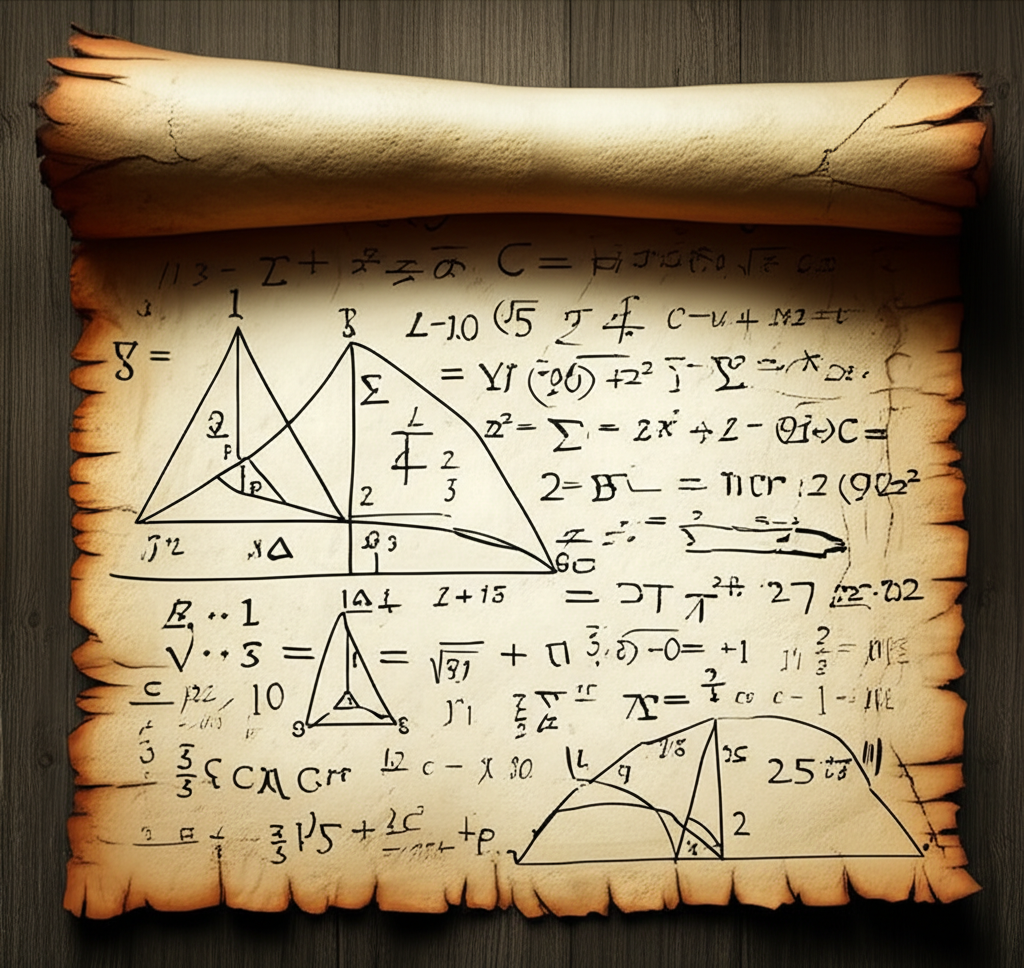 and early symbols (Greek letters for points and lines). One corner of the scroll subtly fades into a starry, cosmic background, symbolizing the abstract and universal nature of mathematical thought originating from concrete representations.)
In conclusion, the journey through mathematics is a profound philosophical exploration, guided by the precise yet expansive language of signs and symbols. They are not merely conventions but the very sinews of abstraction, enabling us to articulate, manipulate, and ultimately comprehend the intricate tapestry of ideas that define our universe. Through this unique language, mathematics offers a singular path to understanding, connecting the concrete with the profoundly abstract.
YouTube Video Suggestions:
-
📹 Related Video: What is Philosophy?
Video by: The School of Life
💡 Want different videos? Search YouTube for: ""philosophy of mathematics symbols signs abstraction""
-
📹 Related Video: PLATO ON: The Allegory of the Cave
Video by: The School of Life
💡 Want different videos? Search YouTube for: ""Plato mathematics forms ideas language""