

The Unfathomable Horizon: Exploring the Concept of Infinity in Theology
Summary:
The concept of infinity stands as a cornerstone in Theology, profoundly shaping our understanding of God and the divine realm. Far from a mere mathematical abstraction, theological infinity describes God's boundless nature – His eternal existence, omnipotence, omniscience, and perfect goodness – placing Him beyond the confines of space, time, and finite comprehension. This article delves into how theological traditions, drawing from ancient philosophical insights, have grappled with portraying a God whose very essence is limitless, and how this understanding informs our perception of creation, Eternity, and the human quest for the divine.
The Unfathomable Horizon: Exploring the Concept of Infinity in Theology
From the earliest stirrings of philosophical inquiry to the grand edifices of systematic theology, humanity has grappled with concepts that push the very limits of finite understanding. Among these, infinity holds a unique and profoundly significant place, particularly within the realm of Theology. It is not merely a quantitative measure of endlessness, but rather a qualitative descriptor of the ultimate reality – God Himself. To speak of God is, almost by definition, to speak of the Infinite.
The journey to comprehend this boundless attribute has been a long and winding one, shaped by the insights of ancient philosophers and the profound reflections of theologians across millennia, many of whom are chronicled within the venerable pages of the Great Books of the Western World. It is here, in the confluence of reason and revelation, that the true depth of theological infinity begins to unfold.
The Philosophical Antecedents: Seeds of the Infinite
Before infinity became inextricably linked with the divine, its conceptual seeds were sown in ancient Greek philosophy. Thinkers like Zeno of Elea, with his famous paradoxes, challenged conventional notions of divisibility and motion, hinting at the perplexing nature of the infinitely small and the infinitely many. Aristotle, in his Physics, distinguished between potential infinity (something that can always be added to, like the number series) and actual infinity (a completed, unbounded whole), largely rejecting the latter as physically impossible in the created world.
This distinction proved crucial for later theological thought. While the physical universe might exhibit potential infinity in its expanse or the divisibility of matter, the idea of an actual infinite — a being that is complete and utterly boundless in its very essence — became reserved for the divine. It set the stage for understanding God not merely as "very big," but as beyond all measure and category.
God as the Embodiment of Infinity
In theological discourse, infinity is not just one attribute among many; it is fundamental to the very definition of God. It permeates His being, His actions, and His relationship with creation.
The Multifaceted Nature of Divine Infinity
When we speak of God's infinity, we are referring to several interconnected aspects:
- Infinite Being and Existence: God is uncreated, without beginning or end. He is the ultimate ground of all existence, pure actuality. This transcends mere longevity; it signifies a being whose existence is not contingent upon anything else, a concept eloquently explored by thinkers like St. Augustine in his Confessions, where he marvels at a God who is "ancient of days, yet ever new."
- Infinite Power (Omnipotence): God's ability to act is unlimited. He can do all things that are logically possible and consistent with His nature. This is not arbitrary power, but power rooted in perfect wisdom and goodness.
- Infinite Knowledge (Omniscience): God possesses perfect and complete knowledge of all things – past, present, and future, actual and possible. His understanding knows no bounds, encompassing every detail of creation and every thought of every creature.
- Infinite Goodness and Love: God is perfectly good, holy, and loving. His moral attributes are not merely great, but infinite, forming the ultimate standard of righteousness and compassion. This boundless love is the wellspring of creation and redemption.
- Eternity: Closely tied to infinite existence, Eternity describes God's transcendence of time. God does not exist in time as creatures do, moving from one moment to the next. Rather, He is the author and sustainer of time, experiencing all moments simultaneously in an eternal present. As Boethius articulated, eternity is "the whole, simultaneous and perfect possession of interminable life." This concept profoundly separates God from His temporal creation.
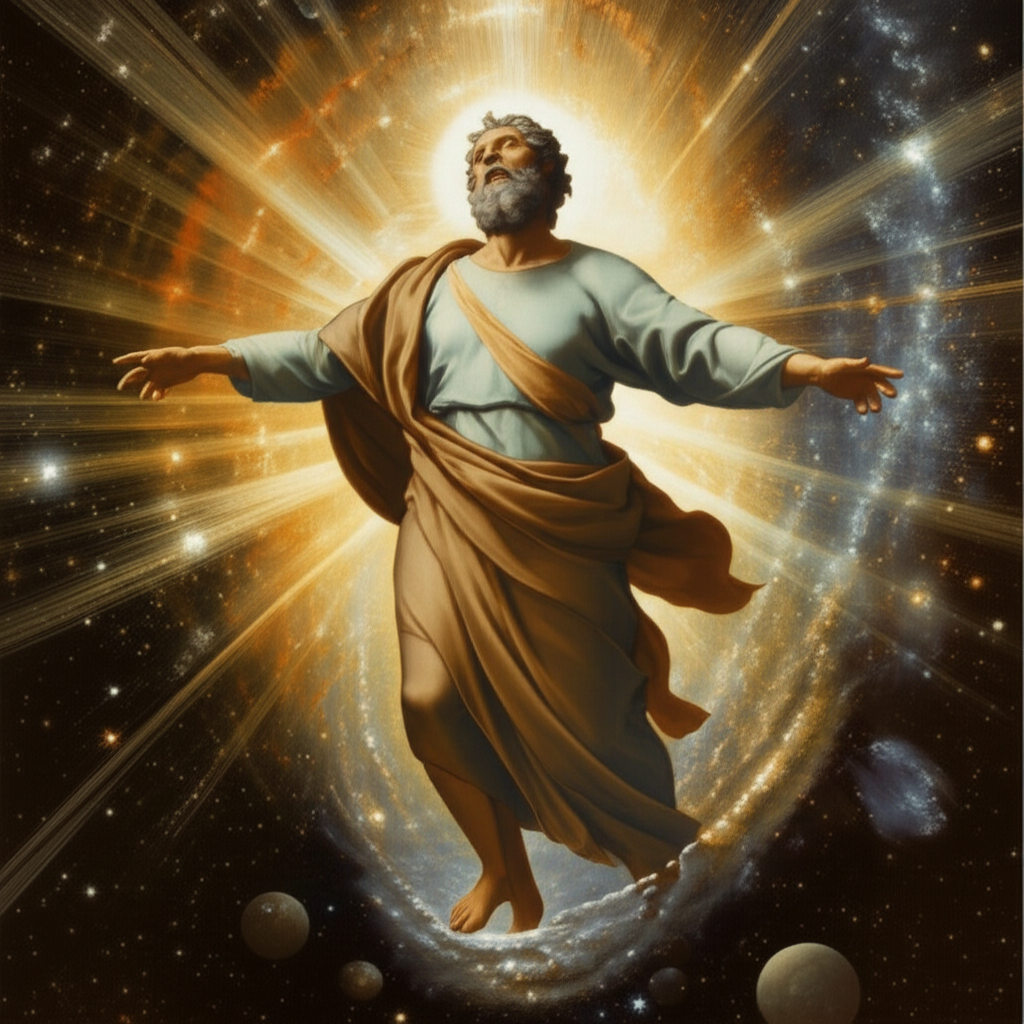
The Finite Encountering the Infinite: Creation and Human Understanding
The theological concept of infinity creates a dynamic tension between the Creator and creation. While God is infinite, the universe He brought into being is, by its very nature, finite and contingent. Yet, creation, in its vastness and intricate order, often serves as a mirror, reflecting glimmers of the infinite wisdom and power of its maker.
For humanity, finite beings with finite minds, comprehending the infinite God is a profound challenge. It is an act of faith and intellectual humility. We can apprehend aspects of God's infinity through revelation, reason, and spiritual experience, but we can never fully encapsulate Him within our limited categories. This inherent mystery is not a flaw in our understanding, but an essential aspect of God's nature. It invites perpetual wonder, awe, and worship.
Implications for Faith and Worship
The recognition of God's infinite nature carries profound implications for the life of faith:
- Awe and Humility: Recognizing God's infinite nature fosters profound awe and humility in the believer, reminding us of our place in the grand scheme.
- Trust and Assurance: An infinitely powerful, knowing, and loving God provides ultimate grounds for trust and hope in the face of life's uncertainties.
- Purpose and Meaning: The finite span of human life gains profound meaning when understood in relation to an infinite, eternal purpose orchestrated by God.
- The Limitless Scope of Salvation: God's infinite love and mercy extend to encompass the salvation of humanity, offering boundless grace and redemption.
Enduring Reflections from the Great Books
The enduring significance of infinity in theology is evident throughout the Great Books of the Western World. Thinkers like St. Thomas Aquinas, in his Summa Theologica, systematically dissect God's attributes, with infinity being a foundational premise for understanding His simplicity, perfection, and immutability. He argues that God is infinite because He is pure act, devoid of any potentiality that would limit Him.
Later philosophers, even those who approached God from a more rationalist or pantheistic perspective, like Baruch Spinoza, still found the concept of an infinite substance to be the necessary starting point for their metaphysical systems. Whether through the lens of classical theology or philosophical exploration, the boundless nature of the divine remained a central, undeniable truth.
Conclusion: The Eternal Mystery
The concept of infinity in Theology is more than an abstract idea; it is the very fabric of our understanding of God. It defines Him as the ultimate, unconditioned reality, boundless in His existence, power, knowledge, and goodness, and existing in an unchanging Eternity. While our finite minds can never fully grasp the entirety of the Infinite, the pursuit of this understanding enriches our spiritual lives, deepens our worship, and continually reminds us of the profound mystery and majesty that lies at the heart of existence. It is a horizon that forever recedes, inviting us to an endless journey of contemplation and devotion.
YouTube Video Suggestions:
-
📹 Related Video: KANT ON: What is Enlightenment?
Video by: The School of Life
💡 Want different videos? Search YouTube for: ""Aquinas God's Attributes Infinity Eternity""
2. ## 📹 Related Video: PLATO ON: The Allegory of the Cave
Video by: The School of Life
💡 Want different videos? Search YouTube for: ""Philosophical Theology Concept of Infinity Divine Attributes""