

The Enduring Dance: Unpacking Good and Evil in Moral Systems
Summary
The concepts of Good and Evil form the bedrock of all moral systems, serving as the fundamental poles around which human action, judgment, and societal structures revolve. This article delves into how philosophy has grappled with defining these elusive terms, exploring their manifestations through Duty, the implications of Sin, and the profound significance of Virtue and Vice in shaping individual character and collective morality. From ancient Greek inquiries into the ideal life to modern ethical dilemmas, understanding this dichotomy is crucial for navigating the complex tapestry of human experience.
The Ancient Question, The Modern Relevance
From the earliest campfire stories to the most intricate legal codes, humanity has been preoccupied with distinguishing between what is right and what is wrong. This isn't merely an academic exercise; it's a deeply practical one, shaping our laws, our relationships, and our very sense of self. How do we define Good and Evil? Are they objective truths, universal principles etched into the fabric of the cosmos, or are they subjective constructs, products of culture, religion, and individual perspective? The Great Books of the Western World offer a relentless pursuit of these answers, revealing a rich intellectual heritage that continues to inform our contemporary moral debates.
Defining the Dichotomy: What is Good? What is Evil?
At its core, "good" often refers to that which promotes well-being, harmony, flourishing, or adherence to a perceived ideal. "Evil," conversely, denotes that which causes suffering, destruction, disharmony, or a deviation from that ideal. But the devil, as they say, is in the details – or perhaps, in the very definition of the devil itself.
- Platonic Idealism: For Plato, the Good was the ultimate Form, the source of all truth, beauty, and justice, illuminating all other Forms. To act rightly was to align oneself with this ultimate Good.
- Aristotelian Teleology: Aristotle viewed "good" in terms of telos, or purpose. The good for a human being was to fulfill their potential, to live a life of flourishing (eudaimonia) through rational activity and the cultivation of character.
- The Problem of Evil: If a benevolent, omnipotent God exists, why does evil persist? This theological conundrum has spurred profound philosophical inquiry, questioning the nature of divine power, human free will, and the very definition of suffering.
The Weight of Duty: Moral Imperatives
Beyond abstract definitions, how do we act morally? This is where the concept of Duty steps onto the stage. Duty refers to a moral or legal obligation; a commitment to act in a certain way, regardless of personal inclination or potential outcome.
Kant and the Categorical Imperative
Perhaps no philosopher articulated the concept of duty with greater rigor than Immanuel Kant. For Kant, moral actions are not determined by their consequences, but by the principle (maxim) upon which they are based.
- The Categorical Imperative: Act only according to that maxim whereby you can at the same time will that it should become a universal law. This means asking: "What if everyone did this?" If the action cannot be universalized without contradiction, it is morally wrong.
- Duty for Duty's Sake: Kant argued that truly moral actions are performed from duty, not merely in conformity with duty. The moral worth of an action lies in the intention, in the respect for the moral law itself, rather than in any desired outcome or feeling of benevolence.
- Treat Humanity as an End, Never Merely as a Means: This formulation emphasizes the inherent dignity and value of every rational being, prohibiting their exploitation or use solely for another's benefit.
| Moral Framework | Primary Focus | Key Question |
|---|---|---|
| Deontology (Duty-based) | Actions themselves | Is the action inherently right/wrong, regardless of outcome? |
| Consequentialism | Outcomes/Results | Does the action produce the greatest good for the greatest number? |
| Virtue Ethics | Character of the agent | What kind of person should I be? |
The Shadow of Sin: Transgression and Its Implications
While Duty often speaks to what we ought to do, Sin addresses what we ought not to do, representing a transgression against moral or divine law. Though heavily rooted in theological traditions, the philosophical implications of sin are profound, touching upon free will, responsibility, and the nature of human failing.
Historically, sin has been understood as:
- Violation of Divine Law: In Abrahamic religions, sin is an offense against God, leading to spiritual alienation.
- Moral Transgression: Philosophically, sin can be interpreted as a deliberate act against one's own conscience or against universal moral principles, a failure to live up to one's rational or ethical potential.
- Imperfection and Error: Some perspectives view sin less as malice and more as a fundamental human flaw or error in judgment, an inevitable consequence of our finite nature.
The concept of sin often brings with it ideas of guilt, repentance, and redemption, highlighting the human capacity for both error and moral growth. It underscores the idea that our actions have consequences, not just for others, but for our own moral standing and inner peace.
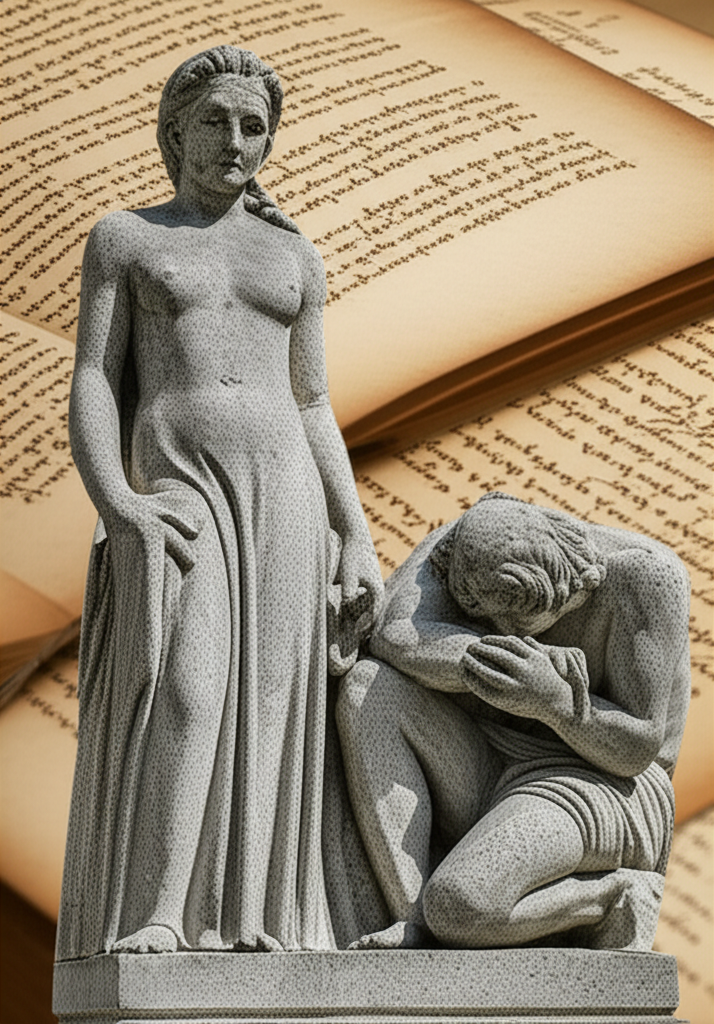
The Cultivation of Character: Virtue and Vice
Moving beyond individual actions or transgressions, Virtue and Vice speak to the very fabric of one's character. Rather than asking "What should I do?", virtue ethics asks, "What kind of person should I be?"
Aristotle and the Golden Mean
Aristotle's Nicomachean Ethics remains a cornerstone of virtue ethics, positing that moral excellence is achieved not through strict adherence to rules, but through the cultivation of virtuous habits.
- Virtue: A disposition to behave in the right manner and as a mean between extremes of deficiency and excess. It is a state of character, not a feeling or a capacity.
- Vice: The opposite of virtue, representing an excess or deficiency of a particular trait. For example, courage (virtue) lies between cowardice (deficiency) and rashness (excess).
- Eudaimonia: The ultimate goal of human life, often translated as flourishing, well-being, or living well. Aristotle believed that living a virtuous life was the path to eudaimonia.
Examples of Virtues and their Vices:
| Virtue | Deficiency (Vice) | Excess (Vice) |
|---|---|---|
| Courage | Cowardice | Rashness |
| Temperance | Insensibility | Self-indulgence |
| Generosity | Stinginess | Prodigality |
| Honesty | Dishonesty | Bluntness |
The emphasis here is on practical wisdom (phronesis) – the ability to discern the right course of action in specific situations. Virtues are not innate; they are developed through practice, reflection, and habituation, much like mastering a skill.
Conclusion: The Ongoing Dialogue
The concepts of Good and Evil, Duty, Sin, and Virtue and Vice are not static philosophical constructs. They are dynamic, evolving aspects of human inquiry, continually re-evaluated in light of new knowledge, societal changes, and individual experiences. From the Socratic dialogues to contemporary ethical debates on artificial intelligence, humanity's quest to understand and define the moral landscape remains one of its most profound and enduring intellectual challenges. By engaging with these foundational ideas, we not only gain insight into the history of thought but also equip ourselves with the tools to critically examine our own moral systems and strive for a more just and flourishing world.
📹 Related Video: PLATO ON: The Allegory of the Cave
Video by: The School of Life
💡 Want different videos? Search YouTube for: ""Plato's Theory of Forms explained", "Kant's Categorical Imperative explained""