

The Enduring Dichotomy: Navigating Good and Evil in Moral Systems
The concepts of Good and Evil stand as the bedrock upon which all moral systems are built, yet their definitions remain as elusive as they are fundamental. From ancient philosophical inquiries to contemporary ethical dilemmas, humanity has grappled with discerning what constitutes a virtuous life, a righteous action, or an inherently malevolent intent. This article delves into how various moral frameworks, drawing heavily from the rich tapestry of the Great Books of the Western World, have attempted to define, categorize, and navigate this foundational dichotomy, exploring the roles of Duty, Sin, and the perennial struggle between Virtue and Vice.
The Perennial Question of Good and Evil
At its core, the philosophical quest to understand Good and Evil is a search for meaning, purpose, and a guide for human conduct. Is good an objective truth, a universal principle discoverable through reason or divine revelation? Or is it a subjective construct, shaped by culture, individual experience, and the shifting sands of societal norms? These questions have propelled thinkers for millennia, leading to diverse and often conflicting answers that underscore the complexity of moral philosophy.
Ancient Roots: Virtue and Vice in Classical Thought
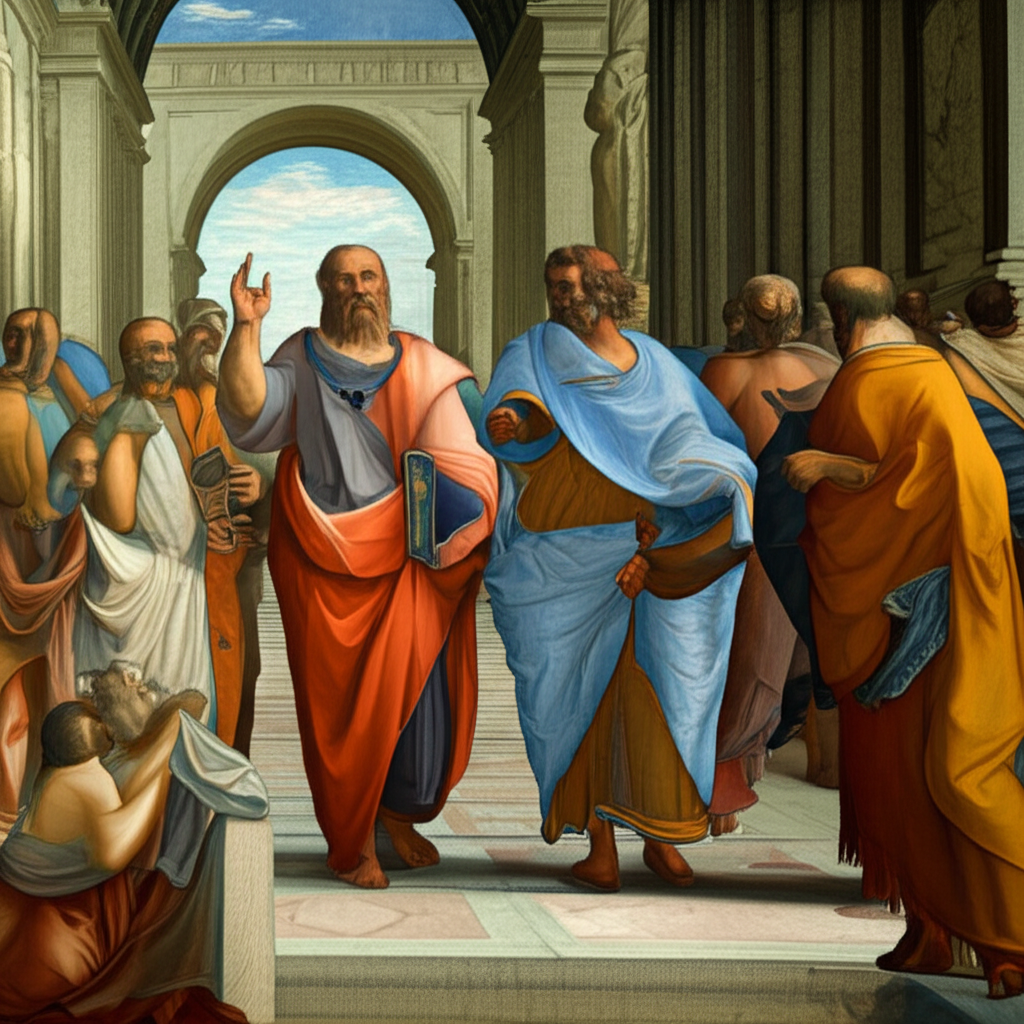
For many classical philosophers, particularly those of ancient Greece, the concept of Good was intrinsically linked to human flourishing, or eudaimonia. Thinkers like Plato and Aristotle saw the good life as one lived in accordance with Virtue.
Aristotle's Ethics of Character:
Aristotle, in his Nicomachean Ethics, argued that Virtue is a disposition to behave in the right manner and as a mean between extremes of deficiency and excess. For instance, courage is a virtue between cowardice (deficiency) and rashness (excess). Vice, conversely, represents these extremes. The path to good, therefore, was not merely about following rules, but about cultivating character.
- Virtues: Courage, Temperance, Generosity, Justice, Wisdom
- Vices: Cowardice, Self-indulgence, Stinginess, Injustice, Ignorance
The pursuit of these virtues, through habit and rational deliberation, was believed to lead to a life of excellence and true human Good. Evil, in this framework, often manifested as a failure to achieve this balance, an inclination towards Vice, or a lack of rational control over one's desires.
The Abrahamic Lens: Duty and Sin
With the advent of Abrahamic religions, the understanding of Good and Evil took on a new dimension, heavily influenced by divine command and covenant. Here, Good is often defined by obedience to God's will, while Evil is understood as Sin – a transgression against divine law or a separation from God.
The Role of Divine Command:
In this perspective, morality is not primarily about character cultivation (though that is valued), but about adherence to a prescribed set of rules and commandments. Duty becomes paramount: the moral agent's primary obligation is to fulfill God's commands.
- Good: Following the Ten Commandments, demonstrating faith, charity, and obedience.
- Evil (Sin): Idolatry, murder, theft, covetousness, pride – acts that violate God's law and sever one's relationship with the divine.
This framework introduces the concept of moral culpability in a profound way, where Sin carries spiritual consequences and necessitates repentance or atonement. The struggle between Good and Evil becomes an internal battle against temptation, guided by faith and a sense of Duty to a higher power.
Enlightenment and Beyond: Reason, Consequence, and the Categorical Imperative
The Enlightenment brought a renewed emphasis on human reason as the arbiter of morality, shifting away from purely divine decree. Immanuel Kant, a central figure in this era, posited a radical understanding of Duty.
Kant's Deontology:
For Kant, an action is morally Good not because of its consequences or because of any divine command, but because it is done out of Duty to the moral law itself, a law discoverable through reason. His "Categorical Imperative" provides a test for moral actions: Act only according to that maxim whereby you can at the same time will that it should become a universal law.
- Good: Actions performed from a sense of Duty, universally applicable, treating humanity as an end in itself, not merely as a means.
- Evil: Actions that violate the categorical imperative, motivated by self-interest or desires rather than Duty, or that treat individuals as mere instruments.
In contrast to Kant's focus on Duty and intent, other Enlightenment-era philosophies, like utilitarianism, define Good based on consequences. An action is Good if it produces the greatest good for the greatest number, and Evil if it causes harm or reduces overall happiness.
The Relational Aspect: Context and Interpretation
As we navigate the vast landscape of moral systems, it becomes clear that the definitions of Good and Evil are rarely static. They are shaped by historical context, cultural values, and individual interpretation. What one society deems a Virtue, another might see as a Vice. What one religion considers a Sin, another might not even recognize.
The ongoing philosophical dialogue surrounding Good and Evil is not merely an academic exercise; it is a fundamental aspect of human self-understanding and societal organization. It challenges us to reflect on our own moral compass, to question assumptions, and to engage thoughtfully with the diverse ways humanity has sought to define and live the "good life."
YouTube Video Suggestions:
-
📹 Related Video: PLATO ON: The Allegory of the Cave
Video by: The School of Life
💡 Want different videos? Search YouTube for: ""Plato's Ethics: The Forms and the Good""
2. ## 📹 Related Video: KANT ON: What is Enlightenment?
Video by: The School of Life
💡 Want different videos? Search YouTube for: ""Kant's Categorical Imperative explained""