

Unpacking the Moral Compass: The Concept of Good and Evil in Philosophical Systems
The human quest to define Good and Evil stands as one of philosophy's most enduring and profound inquiries. From ancient city-states to modern global societies, the struggle to articulate what constitutes right and wrong actions, virtuous character, and just systems has shaped our understanding of ourselves and our place in the cosmos. This article delves into how various moral systems, drawing heavily from the foundational texts within the Great Books of the Western World, have grappled with these fundamental concepts, exploring the interplay of Duty, Sin, Virtue, and Vice. We'll journey through the evolving landscape of ethical thought, revealing that while the answers may differ, the questions remain universally compelling.
The Ancient Foundations: Virtue, Vice, and the Flourishing Life
Our earliest forays into systematically defining Good and Evil often centered on character and human flourishing. For the ancient Greeks, particularly as illuminated by Plato and Aristotle, the concept of good was inextricably linked to aretē, or excellence. An action or a person was good if it fulfilled its purpose well.
- Plato's Ideal Forms: In his dialogues, Plato posits that true Good exists as a transcendent Form, an ultimate reality that illuminates all lesser goods. Our understanding of justice, beauty, and truth are mere reflections of this perfect Form of the Good. Evil, in this framework, often represents a privation or a departure from this ideal, born from ignorance or a disordered soul.
- Aristotle's Eudaimonia: Aristotle, in his Nicomachean Ethics, grounds good in human experience, defining the ultimate good as eudaimonia – often translated as flourishing or living well. For Aristotle, virtue is the path to eudaimonia. A virtuous person acts according to reason, finding the "golden mean" between extremes of vice. For instance, courage is the mean between the vices of cowardice and recklessness. Actions are deemed good if they contribute to this flourishing, while those that detract represent evil.
Key Ancient Moral Concepts:
- Virtue: A character trait that is morally good; a disposition to act in a morally excellent way (e.g., courage, temperance, justice).
- Vice: A character trait that is morally bad; a habit that leads away from human flourishing (e.g., cowardice, gluttony, injustice).
- Good: That which fulfills its purpose, leads to flourishing, or aligns with an ideal form.
- Evil: That which hinders flourishing, corrupts purpose, or deviates from the ideal.
The Divine Imperative: Sin, Duty, and the Sacred Law
With the rise of Abrahamic traditions, particularly Christianity as articulated by figures like Augustine and Aquinas (whose works are foundational in the Great Books), the understanding of Good and Evil underwent a profound transformation. Here, good is often defined by divine command, and evil takes on the specific form of sin.
- Augustine's Theology of Evil: Augustine wrestled deeply with the problem of evil. He argued that evil is not a substance or a created entity, but rather a privation of good, a turning away from God. Humanity's fall, marked by original sin, introduced a fundamental disorder into the human will, making it prone to choose lesser goods over the ultimate Good (God).
- Aquinas and Natural Law: Thomas Aquinas integrated Aristotelian philosophy with Christian theology. He argued for a natural law accessible through reason, which reflects God's eternal law. To act in accordance with natural law is good; to violate it is sin. For Aquinas, human duty is to live in accordance with both revealed divine law and the natural law discoverable through reason, striving towards communion with God, the ultimate Good.
In these systems, Good and Evil are not merely matters of character or societal benefit, but are ontologically grounded in the will of a divine creator. Moral duty becomes an obligation to obey divine commands and live according to God's intended order.
The Enlightenment's Rational Turn: Duty and the Categorical Imperative
The Enlightenment era brought a shift towards reason as the primary arbiter of morality, exemplified by Immanuel Kant, another cornerstone of the Great Books. Kant sought to establish a moral system based on pure reason, independent of religious dogma or personal desires.
- The Good Will: For Kant, the only thing that is good without qualification is a good will. An action is morally good not because of its consequences or because of any inclination, but solely because it is done from duty.
- The Categorical Imperative: Kant's most famous contribution is the Categorical Imperative, a universal moral law. It dictates that one should "Act only according to that maxim whereby you can at the same time will that it should become a universal law." If an action cannot be universalized without contradiction, it is morally impermissible, or evil. For Kant, moral duty is an absolute, rational obligation. To act morally is to act out of respect for this law, not for personal gain or happiness.
- Good and Evil are thus determined by the rationality and universalizability of one's maxims. Actions that violate the categorical imperative are considered evil, as they are inherently contradictory or undermine the possibility of a rational moral order.
Intersecting Concepts in Moral Systems
The journey through these philosophical traditions reveals a complex tapestry of moral concepts. While their definitions and origins vary, they often intersect and inform one another.
| Concept | Primary Focus | Key Philosophical Systems | Relationship to Good/Evil |
|---|---|---|---|
| Good and Evil | Fundamental moral categories | All | The core distinction; objective (Plato, Divine Command, Kant) or subjective/relative (some modern views). |
| Virtue | Character excellence, dispositions to act well | Ancient Greek Ethics (Plato, Aristotle) | The path to Good; a virtuous person performs good actions. |
| Vice | Character flaw, dispositions to act poorly | Ancient Greek Ethics (Plato, Aristotle) | The path to Evil; a vicious person performs evil actions. |
| Sin | Transgression against divine or natural law | Abrahamic Traditions (Augustine, Aquinas) | A specific form of Evil, defined religiously. |
| Duty | Moral obligation, what one ought to do | Abrahamic Traditions (to God), Kantian Ethics (to Reason) | Actions done from duty are often considered Good; neglect of duty can be Evil. |
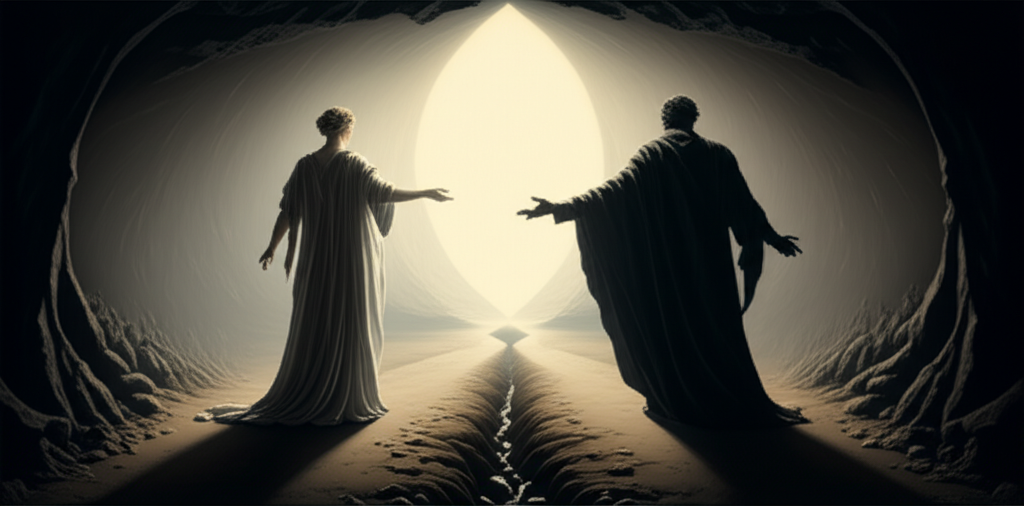
The Enduring Dialogue
From the ancient Greek pursuit of eudaimonia to the divine commands of theological ethics and Kant's rational duty, the concept of Good and Evil remains the bedrock of moral inquiry. While the specific definitions of Good and Evil, the nature of Sin, the scope of Duty, and the cultivation of Virtue (or avoidance of Vice) have evolved dramatically, the underlying human need to understand and navigate the moral landscape persists. These foundational philosophical discussions, preserved and debated through the Great Books, continue to challenge us to define our own moral compass in an ever-complex world.
YouTube Video Suggestions:
- YouTube: "Plato and Aristotle on Virtue Ethics Explained"
- YouTube: "Kant's Categorical Imperative Duty Philosophy"
📹 Related Video: What is Philosophy?
Video by: The School of Life
💡 Want different videos? Search YouTube for: "The Concept of Good and Evil in Moral Systems philosophy"