

The Unseen Hand: Exploring the Concept of God's Will in Philosophy and Theology
A Guiding Principle or an Inscrutable Mystery?
The concept of God's Will stands as a monumental pillar within the vast intellectual edifice of philosophy and theology. Far from a simple, monolithic idea, it represents a complex nexus of divine intention, action, and purpose that has captivated, perplexed, and inspired thinkers for millennia. At its core, God's Will grapples with the fundamental questions of existence: Why is there something rather than nothing? What is the ultimate Cause of all things? And what, if anything, does the divine desire for creation, for humanity, and for the moral order of the cosmos? This exploration delves into the historical evolution, theological dimensions, and profound philosophical implications of God's Will, drawing upon the enduring wisdom of the Great Books of the Western World to illuminate its multifaceted nature.
What is "God's Will"? A Philosophical and Theological Definition
Before dissecting its intricacies, we must first attempt to define what "God's Will" entails. Broadly, it refers to the divine determination or intention that directs all of creation. However, this broad definition quickly splinters into distinct, sometimes conflicting, interpretations:
- Divine Command: The explicit decrees or laws that God imposes upon creation, particularly moral laws for humanity.
- Divine Plan/Purpose: The overarching design or telos (end goal) that God has for the universe, often encompassing providence and destiny.
- Divine Intention/Desire: What God inherently wishes or prefers, which may or may not be perfectly realized due to other factors (e.g., human free will).
- Divine Action: The actual power and execution of God's intentions, bringing things into being or directing events.
Understanding these nuances is crucial, as different philosophers and theologians have emphasized various aspects, leading to diverse conclusions about the nature of reality, morality, and human agency.
Historical Trajectories: Tracing God's Will Through the Ages
The concept of a divine will has deep roots, evolving significantly across different intellectual epochs.
Ancient Echoes: Fate, Reason, and the Divine Order
In ancient Greek thought, while not always explicitly "God's Will" in the monotheistic sense, ideas of a cosmic order or fate (Moira) often played a similar role. Plato, in works like Timaeus, speaks of a divine Craftsman (Demiurge) who fashions the world according to eternal Forms, implying a rational, benevolent design. Aristotle's concept of a Prime Mover is the ultimate efficient Cause of motion, though its "will" is more akin to a self-sufficient thought that inspires movement rather than active intervention.
Abrahamic Revelations: Commandment and Providence
The Abrahamic traditions (Judaism, Christianity, Islam) place God's Will at the very center of their theology. Here, God is an active, personal agent whose will is revealed through:
- Scripture: Divine commands (e.g., the Ten Commandments) are seen as direct expressions of God's Will.
- Prophecy: God's intentions communicated through chosen individuals.
- Providence: The ongoing divine care and guidance over the world and human events.
Augustine of Hippo, a towering figure in Christian thought, extensively explored God's Will in relation to human freedom and the problem of evil. In Confessions and City of God, he grapples with divine foreknowledge and predestination, asserting that God's Will is perfectly just, even if inscrutable to human understanding. He emphasizes God as the ultimate Cause of all good, and even evil, in a paradoxical way, is permitted by God's Will for a greater, ultimate good.
Medieval Scholasticism: Systematizing the Divine Will
The medieval period saw philosophers and theologians, most notably Thomas Aquinas, meticulously systematize the concept of God's Will. In his Summa Theologica, Aquinas distinguishes between:
- God's Antecedent Will: What God wills in itself, without considering any defects or obstacles (e.g., God wills all men to be saved).
- God's Consequent Will: What God wills considering all circumstances, including human free choices (e.g., God permits some men to be lost due to their rejection of grace).
Aquinas also firmly establishes God as the First Cause, whose will is the ultimate source of all being and action. This framework provided a robust intellectual apparatus for understanding divine action without negating human responsibility.
Early Modern Debates: Rationalism, Voluntarism, and Determinism
The Enlightenment brought new challenges and perspectives.
- Descartes emphasized God's omnipotence to such an extent that even eternal truths (like mathematical axioms) were seen as products of God's arbitrary will (divine voluntarism).
- Spinoza, in Ethics, presented a highly deterministic view where God (or Nature) acts according to necessary laws, not out of free will in the human sense. God's Will is simply the inherent necessity of God's nature.
- Leibniz, in Theodicy, argued that God, being perfectly rational and good, chose to create the "best of all possible worlds" from an infinite array of possibilities, thus exercising a will guided by reason and benevolence.
Image: 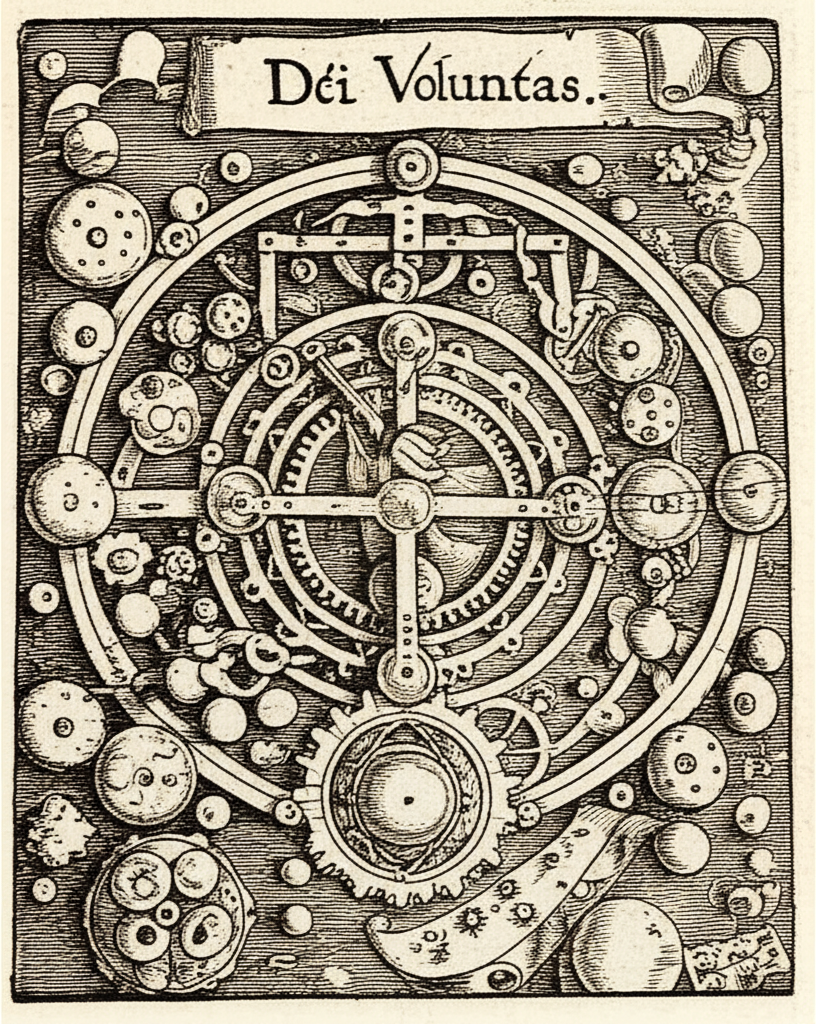 as the prime mover. Below, small human figures are shown engaged in daily activities, seemingly oblivious to the grand cosmic machinery above, yet subtly influenced by its turning.)
Theological Dimensions: The Intricacies of Divine Intention
Theological discourse continues to refine and debate the nuances of God's Will, particularly concerning its relationship to human freedom, suffering, and revelation.
Divine Sovereignty vs. Human Free Will
Perhaps the most persistent dilemma surrounding God's Will is its interplay with human free will. If God's Will is sovereign and determinative, how can humans be truly free and morally responsible? This tension has fueled debates from Augustine to Calvin and beyond.
- Calvinism: Emphasizes God's absolute sovereignty and predestination, where God's Will is the ultimate Cause of salvation or damnation.
- Arminianism: Stresses human free will and God's desire for all to be saved, with salvation being contingent on human response.
God's Will and the Problem of Evil
If God is omnipotent, omniscient, and perfectly good, and God's Will directs all things, why does evil exist? This perennial "problem of evil" is a direct challenge to the benevolent aspect of God's Will. Solutions often involve:
- Permissive Will: God permits evil for a greater good, without directly willing it.
- Free Will Defense: Evil is a consequence of human free will, which God values more than a world without evil.
- Soul-Making Theodicy: Evil and suffering serve to develop moral character and spiritual growth.
Categorizing God's Will: A Theological Framework
Theologians often categorize God's Will to articulate its various aspects more precisely.
| Category of God's Will | Description | Examples/Implications |
|---|---|---|
| Decretive Will | God's sovereign, unchangeable plan or decree that infallibly comes to pass. Also called the secret will. | The creation of the universe, the incarnation of Christ, the ultimate triumph of good. This is the Cause of all that will happen. |
| Preceptive Will | God's revealed commands and moral expectations for humanity. Also called the revealed will. | The Ten Commandments, the moral teachings of Jesus. What God wills us to do. This can be disobeyed. |
| Permissive Will | God's allowing certain events or actions (including evil) to occur, without directly willing or causing them. | The existence of sin, suffering, or natural disasters. God allows these for reasons known only to Him, often in relation to human freedom or a greater plan. |
| Dispositive Will | God's specific actions or interventions in history, often in response to prayer or human actions. | Miracles, specific answers to prayer, divine guidance in particular situations. How God disposes events according to His broader plan. |
Philosophical Implications: Ethics, Causality, and Knowledge
The concept of God's Will extends its influence into almost every domain of philosophical inquiry.
Ethics and Morality: The Euthyphro Dilemma Revisited
One of the most profound ethical questions posed by God's Will is the Euthyphro dilemma, famously explored by Plato: Is something good because God wills it, or does God will it because it is good?
- If good is simply what God wills (divine command theory), then morality seems arbitrary; God could, in theory, will cruelty to be good.
- If God wills something because it is inherently good, then goodness exists independently of God's Will, suggesting a higher standard to which God also conforms.
Many philosophers and theologians seek a middle ground, arguing that God's Will is an expression of His perfect, unchanging nature, which is goodness itself.
Causality and Determinism: The First Cause
The notion of God as the First Cause is central to understanding the universe's origin and ongoing operation. If God's Will is the ultimate efficient Cause of all reality, then questions of determinism naturally arise. Does God's Will predetermine every event, leaving no room for contingency or genuine human choice? This leads back to the complex dance between divine sovereignty and human freedom.
Epistemology: How Do We Know God's Will?
Finally, how can finite beings apprehend the infinite Will of God? Different epistemological paths have been proposed:
- Revelation: Through sacred texts, prophets, or direct divine communication.
- Reason: Through philosophical inquiry and natural theology, discerning God's rational design in the universe.
- Conscience: An inner moral compass believed by some to reflect God's moral law.
- Experience: Personal encounters or spiritual insights.
Each path presents its own challenges and interpretations, contributing to the rich tapestry of human attempts to understand the divine.
Conclusion: An Enduring Quest for Understanding
The concept of God's Will remains one of the most intellectually stimulating and spiritually profound subjects in philosophy and theology. From ancient notions of fate to medieval scholastic distinctions, and through modern debates on determinism and morality, it continues to challenge our understanding of divine power, human freedom, and the very fabric of existence. It is a concept that demands humility in the face of the inscrutable, yet invites rigorous inquiry into the Cause and purpose of all that is. As we continue our philosophical journey, grappling with God's Will compels us to confront the deepest mysteries of the cosmos and our place within it.
YouTube Suggestions:
-
📹 Related Video: What is Philosophy?
Video by: The School of Life
💡 Want different videos? Search YouTube for: "Euthyphro Dilemma explained philosophy animated"
2. ## 📹 Related Video: KANT ON: What is Enlightenment?
Video by: The School of Life
💡 Want different videos? Search YouTube for: "Thomas Aquinas First Cause Argument explained"