

The Unseen Hand: Unraveling the Concept of God as First Cause
The human mind, ever curious, inevitably encounters the profound question of origins. Why is there something rather than nothing? For millennia, philosophers and theologians alike have grappled with this ultimate cause, often culminating in the concept of God as the First Cause. This isn't merely a religious declaration; it's a fundamental tenet of classical metaphysics, seeking to identify the ultimate principle that underpins all existence. This article explores the rich history and enduring philosophical significance of understanding God as the initial, uncaused origin of the universe, drawing insights from the venerable texts of the Great Books of the Western World.
The Unmoved Mover: Aristotle's Cosmological Foundation
Our journey into the First Cause often begins with the profound insights of ancient Greece, particularly with Aristotle. In his Metaphysics, Aristotle observed the ceaseless motion and change in the world. Everything that moves, he reasoned, must be moved by something else. This chain of movers cannot extend infinitely, for if it did, there would be no initial mover to set the entire process in motion.
Aristotle's Prime Mover and the Chain of Causation
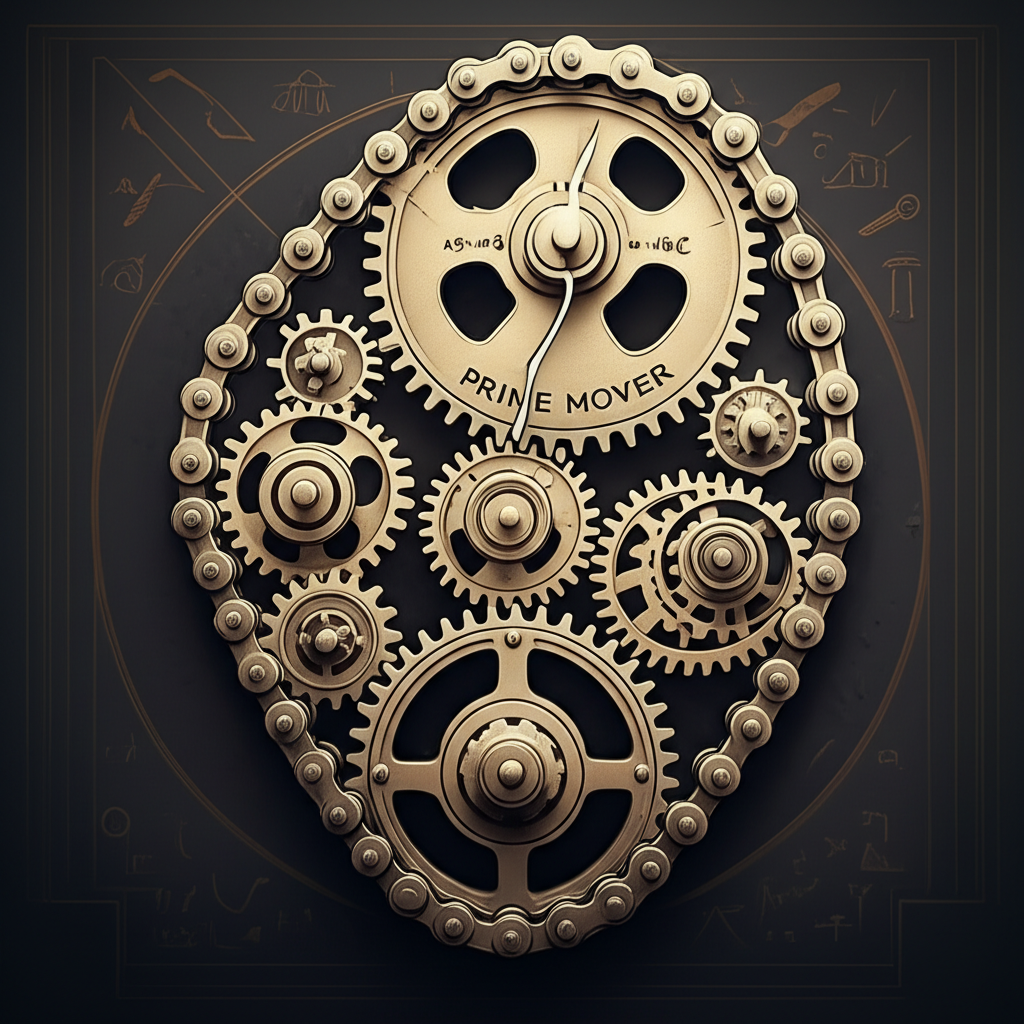
Aristotle posited a Prime Mover – an entity that causes motion but is itself unmoved. This Prime Mover is not a creator in the Judeo-Christian sense, but rather a final cause, acting as an object of desire or love, drawing all things towards its perfection. It is pure actuality, without potentiality, and its activity is pure thought, thinking about thinking. This concept laid a crucial philosophical groundwork: the necessity of an ultimate, uncaused cause to explain the dynamic reality we experience.
- Key Attributes of Aristotle's Prime Mover:
- Unmoved: Does not move or change itself.
- Eternal: Exists outside of time, without beginning or end.
- Pure Actuality: Possesses no potentiality, fully realized.
- Immaterial: Not composed of matter.
- Final Cause: Draws things towards itself as an object of desire or perfection.
The Medieval Synthesis: Aquinas and the Cosmological Argument
Centuries later, the medieval scholastic tradition, notably through Thomas Aquinas, integrated Aristotelian philosophy with Christian theology. In his monumental Summa Theologica, Aquinas famously presented his "Five Ways" to demonstrate the existence of God. The first three of these ways are cosmological arguments, directly engaging with the concept of God as the First Cause.
Thomas Aquinas's Five Ways: The First Way
Aquinas's First Way, often called the argument from motion, directly echoes Aristotle. He observes that everything in the world is in motion, and whatever is in motion must be moved by something else. This chain of movers cannot go on infinitely, leading to the conclusion that there must be a First Mover, unmoved by anything else, and this all men understand to be God.
His Second Way, the argument from efficient causation, is perhaps even more direct for our topic. Every effect has a cause. Nothing can be the efficient cause of itself, for it would have to exist prior to itself, which is impossible. Therefore, there must be a first efficient cause, to which everyone gives the name God.
This theological extension of the First Cause principle asserts a God who is not just an unmoved mover, but a conscious, intelligent creator who initiates and sustains all being.
The Rationalist Turn: Descartes, Leibniz, and the Principle of Sufficient Reason
The Enlightenment brought new philosophical lenses to the concept of the First Cause. Rationalist thinkers like René Descartes and Gottfried Wilhelm Leibniz continued to explore the necessity of a foundational principle for existence.
From Self-Caused Substance to Necessary Being
Descartes, in his Meditations on First Philosophy, sought to establish certainty through reason. When contemplating his own existence, he realized he could not be the cause of himself, nor could he be sustained by himself. He concluded that a perfect, all-powerful being — God — must be the ultimate cause and sustainer of his being. This "self-caused" aspect of God (causa sui) highlights God's absolute independence and self-sufficiency.
Leibniz, building on this, introduced the Principle of Sufficient Reason, which states that for every fact, there must be a sufficient reason why it is so and not otherwise. Applying this to the universe, he argued that the contingent existence of the world demands a sufficient reason for its being. This reason cannot be found within the world itself, as every part of the world is contingent. Therefore, the ultimate sufficient reason must lie outside the world, in a necessary being — God — who is the ultimate cause of all contingent things.
Leibniz's argument solidifies the idea that the First Cause is not just an initiator, but a necessary being whose existence is self-explanatory, providing the ultimate principle for the entire cosmos.
The Enduring Philosophical Principle
Beyond specific theological doctrines, the concept of God as First Cause remains a powerful philosophical principle. It addresses the deep-seated human need for coherence and explanation, positing that the universe is not an arbitrary accident but possesses an ultimate rationale. It’s a metaphysical anchor, suggesting that the causal chains we observe daily must ultimately terminate in something uncaused, something foundational.
This idea continues to fuel debates in contemporary metaphysics, cosmology, and philosophy of religion. Whether one accepts a personal God or a more abstract necessary being, the quest for a First Cause speaks to our fundamental understanding of reality itself.
Summary of Philosophical Approaches to the First Cause
| Philosopher/Tradition | Key Concept of First Cause | Primary Argument/Focus |
|---|---|---|
| Aristotle | Prime Mover | Argument from Motion; Final Cause |
| Aquinas | First Mover/Efficient Cause | Cosmological Arguments (Five Ways) |
| Descartes | Self-Caused Substance | Argument from Contingency of Self |
| Leibniz | Necessary Being | Principle of Sufficient Reason |
Critiques and Contemporary Challenges
While profoundly influential, the concept of God as First Cause has faced rigorous scrutiny. David Hume questioned the very notion of necessary causation, suggesting we only observe constant conjunction, not an inherent causal link. Immanuel Kant argued that causation is a category of human understanding, applicable only to the phenomenal world, and thus cannot be used to infer a transcendent First Cause.
Modern cosmology, with theories like the Big Bang, describes an origin point for the universe but doesn't necessarily identify a cause in the philosophical sense, leaving room for ongoing scientific and philosophical inquiry. Yet, even with these challenges, the principle of seeking an ultimate explanation for existence persists, ensuring the concept of the First Cause remains a vital area of philosophical exploration.
Conclusion: The Perpetual Search for Origins
The concept of God as First Cause is more than a historical artifact; it is a testament to humanity's enduring quest for ultimate understanding. From Aristotle's Prime Mover to Aquinas's First Efficient Cause, and through the rationalist inquiries of Descartes and Leibniz, this idea has shaped our metaphysics and theology, providing a profound principle for explaining the universe's existence. While the nature of this ultimate Cause remains a subject of intense debate, the very act of seeking it underscores our fundamental drive to comprehend the deep mysteries of being.
📹 Related Video: ARISTOTLE ON: The Nicomachean Ethics
Video by: The School of Life
💡 Want different videos? Search YouTube for: ""Aristotle Prime Mover explained""
📹 Related Video: KANT ON: What is Enlightenment?
Video by: The School of Life
💡 Want different videos? Search YouTube for: ""Thomas Aquinas Cosmological Argument First Way""