

The Unpredictable Tapestry: Navigating Chance in Human Affairs
Life, in its intricate dance, often presents us with moments that defy prediction, events that seem to arise from nowhere, shaping our paths in profound ways. This is the essence of chance – the unpredictable element woven into the fabric of human experience. From the serendipitous meeting that alters a career trajectory to the unforeseen natural disaster that reshapes communities, chance plays a pivotal, often bewildering, role. This article explores the philosophical concept of chance, contrasting it with notions of fate and will, and examining its indelible impact on both individual lives and the grand sweep of history, drawing insights from the rich tradition of Western thought. Understanding chance isn't about surrendering to chaos, but about recognizing the limits of our control and appreciating the dynamic interplay between the random and the deliberate in our lives.
What is Chance? An Introduction to the Unforeseen
At its core, chance refers to events that occur without apparent design or intention, events whose causes are either unknown to us or so numerous and complex as to be practically indeterminable. It’s the unexpected, the contingent, the "what if" that becomes "what is." Philosophers throughout history have grappled with distinguishing chance from other forms of causation. Is it merely a manifestation of our ignorance of underlying deterministic laws, or does it represent a genuine indeterminacy in the universe?
- Aristotle, for instance, in his Physics, discussed tychē (chance) and automaton (spontaneity) as accidental causes, distinguished from causes that operate "for the sake of something." For him, chance was an accidental cause in things that act for an end, but where the outcome achieved was not the intended one. It's the unexpected benefit or harm that arises from an action aimed at something else entirely.
Consider the simple act of dropping a coin: the outcome (heads or tails) is often attributed to chance, not because it's acausal, but because the precise forces, angles, and environmental factors are too numerous and subtle for us to predict reliably.
Chance vs. Fate: A Philosophical Tug-of-War
The concept of chance often stands in stark opposition to fate. Where chance implies randomness and contingency, fate suggests an predetermined course of events, an unavoidable destiny.
| Aspect | Chance | Fate |
|---|---|---|
| Nature | Unpredictable, contingent, accidental | Predetermined, inevitable, divinely or cosmically ordained |
| Cause | Unknown, complex, or genuinely indeterminate | Ultimate design, divine plan, inherent cosmic order |
| Human Role | Respond to, adapt to, or be shaped by | Submit to, fulfill, or be carried along by |
| Implication | Uncertainty, possibility, freedom (to some extent) | Certainty (of outcome), lack of true freedom |
Many ancient philosophies, particularly Stoicism, emphasized the acceptance of fate, viewing events as part of a rational, ordered cosmos. For Stoics like Epictetus and Marcus Aurelius, while we cannot control external events (fate), we can control our reactions to them (will). This perspective reframes chance events not as random disruptions, but as integral parts of a larger, divinely ordered plan, even if its specifics are beyond our comprehension.
However, the notion of genuine chance challenges this deterministic view. If true chance exists, then the future is not entirely written, and human actions, our will, gain significant agency.
The Indomitable Will: Our Response to the Unforeseen
This brings us to the crucial role of will. While chance may present us with circumstances beyond our control, our will—our capacity for conscious choice and action—determines how we respond. We may not choose the hand we are dealt, but we choose how we play it.
- Existentialist thinkers later highlighted this profoundly, arguing that in a world devoid of inherent meaning or predetermined paths (a world rich with chance), individuals are condemned to be free, to define themselves through their choices and actions. Every decision, every reaction to an unexpected event, becomes an affirmation of our agency.
- Augustine's discussions on free will, while often framed within a theological context, explore the tension between divine foreknowledge (akin to fate) and human responsibility. He grappled with how our choices could be genuinely free if God already knew them, a problem that resonates with the modern philosophical debate on determinism versus free will in the face of chance.
The intersection of chance and will is where true human drama unfolds. A chance encounter might open a door, but it is our will that decides whether to walk through it. A sudden misfortune might derail our plans, but it is our will that determines if we rebuild or succumb.
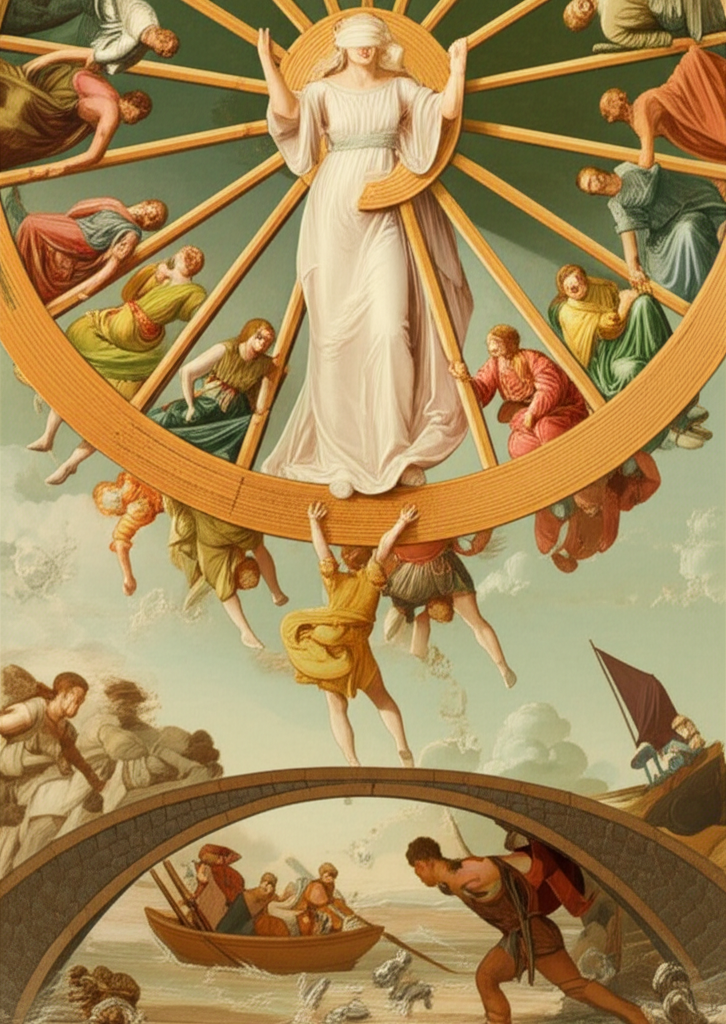
Chance and the Grand Narrative of History
Beyond individual lives, chance profoundly influences the course of history. Major historical events are rarely the result of a single, linear cause. Instead, they often emerge from a complex web of intended actions, unforeseen circumstances, and sheer accidents.
Consider the "butterfly effect" in a historical context: a seemingly minor event, a sudden storm, a chance illness, a miscommunication, can ripple outwards to alter the trajectory of empires, wars, and social movements.
Examples of Chance in History:
- The Weather at Waterloo: A sudden downpour the night before the Battle of Waterloo delayed Napoleon's attack, allowing Prussian forces to arrive and turn the tide against him. A chance weather event with monumental historical consequences.
- The Assassination of Archduke Franz Ferdinand: While underlying tensions were high, the specific chain of events leading to the assassination—a wrong turn by the driver, a chance encounter with Gavrilo Princip—was highly contingent, yet it ignited World War I.
- Scientific Discoveries: Many groundbreaking discoveries, from penicillin to X-rays, were the result of accidental observations, fortunate mistakes, or unexpected findings, demonstrating how chance can open doors to human ingenuity and progress.
Historians, from Thucydides to Machiavelli, have implicitly or explicitly acknowledged the role of contingency in their narratives, showing how even the most carefully laid plans can be undone by the unexpected. The study of history, therefore, isn't just about understanding cause and effect, but also about appreciating the role of the improbable in shaping our present.
Embracing the Contingent: A Philosophical Stance
Recognizing the pervasive nature of chance is not an invitation to fatalism, but rather a call to a more nuanced understanding of existence. It encourages:
- Humility: Acknowledging that much is beyond our control.
- Resilience: Developing the capacity to adapt and respond to unforeseen challenges.
- Openness: Being receptive to unexpected opportunities and paths.
- Responsibility: Understanding that our will and choices become even more significant in a world where outcomes are not guaranteed.
The Great Books continually invite us to reflect on these profound questions: How do we live meaningfully when so much is uncertain? How do we exercise our will effectively when chance can intervene at any moment? The answer, perhaps, lies in the continuous effort to find meaning, to act with purpose, and to learn from the unpredictable unfolding of history, even as we acknowledge that the dice are always, to some extent, still rolling.
Conclusion: The Enduring Dance
The concept of chance in human affairs remains a vibrant area of philosophical inquiry. It reminds us that while we strive for order, predictability, and control, life itself is a dynamic interplay of intention and accident, will and contingency. By understanding the profound difference between chance and fate, and by recognizing the power of our own will to navigate the currents of the unforeseen, we can approach the tapestry of our lives and the grand narrative of history with greater wisdom, adaptability, and a deeper appreciation for the unpredictable beauty of existence.
📹 Related Video: What is Philosophy?
Video by: The School of Life
💡 Want different videos? Search YouTube for: ""Free Will vs Determinism" Crash Course Philosophy"
📹 Related Video: ARISTOTLE ON: The Nicomachean Ethics
Video by: The School of Life
💡 Want different videos? Search YouTube for: ""Ancient Greek Philosophy: Aristotle on Chance""