

The Unseen Hand: Navigating Chance in Human Affairs
Summary
The concept of Chance in human affairs has long fascinated philosophers, historians, and every individual grappling with life's unpredictable currents. Is our existence a meticulously pre-scripted drama dictated by Fate, or are we the captains of our own destiny, charting courses with our Will amidst a sea of random events? This article explores the nuanced philosophical perspectives on chance, distinguishing it from fate and examining its profound impact on individual lives and the grand sweep of History, drawing insights from the enduring wisdom found in the Great Books of the Western World. We will delve into how different thinkers have attempted to reconcile the undeniable presence of unforeseen occurrences with our innate desire for order and control.
The Elusive Nature of Chance
What exactly is Chance? At its core, chance refers to events that occur without any apparent or discernible cause, or at least without a cause that is predictable or within our immediate control. It’s the unexpected turn, the serendipitous encounter, the sudden misfortune. Unlike a deliberate act of Will, chance seems to operate outside our conscious direction, often leading to outcomes we neither intended nor foresaw.
Philosophical inquiry into chance often begins with its perceived opposite: order and determinism. If every effect has a cause, where does chance fit in?
- Ancient Greek Perspectives: Thinkers like Aristotle recognized tyche (chance or fortune) as a secondary cause, an accidental outcome of an intentional act. For instance, digging a well (intentional) and finding treasure (accidental). Other schools, particularly the Epicureans, allowed for atomic "swerves" – an element of randomness at the fundamental level of reality – to account for free will and break from strict determinism.
- Stoic View: The Stoics, in contrast, emphasized a universe governed by an all-encompassing divine reason or logos. For them, what we perceive as chance is merely our ignorance of the intricate, predetermined causal chain of Fate. Everything happens for a reason, even if that reason is beyond our comprehension.
Chance vs. Fate: A Timeless Dichotomy
The distinction between Chance and Fate is pivotal. While both represent forces seemingly beyond our immediate control, their natures are fundamentally different:
| Feature | Chance | Fate |
|---|---|---|
| Nature | Unpredictable, random, uncaused (or unknown cause) | Predetermined, inevitable, divinely or naturally ordained |
| Source | Apparent randomness, accidental conjunctions | Cosmic plan, divine will, natural law |
| Human Agency | Can be influenced or mitigated by Will | Generally seen as unalterable by Will |
| Philosophical Basis | Epicurean swerves, accidental causes, statistical probability | Stoic logos, Christian Providence, predeterminism |
| Example | A sudden storm derailing travel plans | A prophecy fulfilling itself, one's predestined life path |
For many, Fate implies an inescapable destiny, a pre-written script that we merely act out. Boethius, in The Consolation of Philosophy, grappled with the interplay of Divine Providence (a form of fate) and human freedom, suggesting that while God knows all outcomes, human Will still makes choices within that framework, leading to a complex relationship between the two.
The Power of Will in a World of Chance
If chance is the unpredictable, and fate is the predetermined, where does human Will reside? This is where the concept of agency truly emerges. Our will is our capacity to make choices, to act intentionally, and to strive for particular outcomes.
- Machiavelli's Fortuna and Virtù: Niccolò Machiavelli famously explored the relationship between Fortuna (fortune or chance) and Virtù (skill, strength, and will) in his political writings. He argued that while Fortuna might govern half of human actions, the other half is left to our Virtù. A leader with strong Virtù can anticipate, adapt to, and even bend Fortuna to their advantage, demonstrating that Will is not powerless in the face of Chance.
- Existentialist Perspective: Later philosophies, particularly existentialism, emphasize radical freedom and responsibility. For them, while we are "thrown" into a world of chance, our Will defines our essence through the choices we make, creating meaning in an otherwise indifferent universe.
Our Will doesn't eliminate chance, but it allows us to respond to it. We can prepare for contingencies, seize opportunities presented by chance, or bravely endure its misfortunes. This active engagement transforms chance from a purely external force into an element with which our agency can interact.
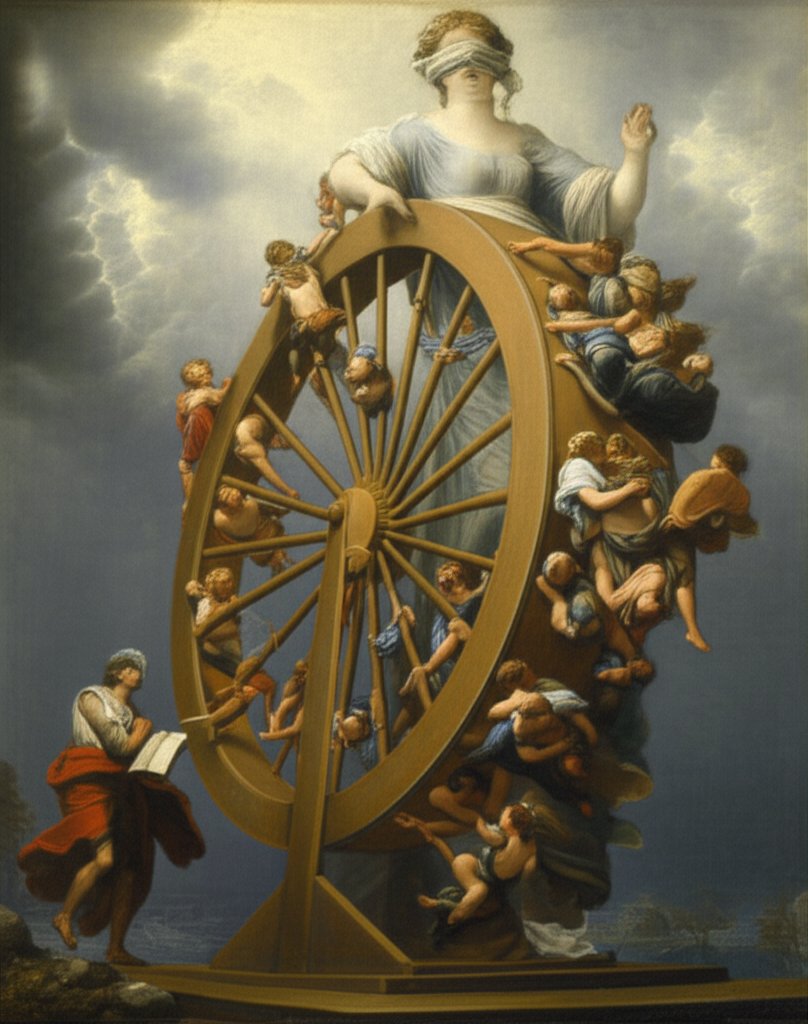
Chance as a Driver of History
The grand narrative of History is often presented as a series of inevitable developments, driven by economic forces, social movements, or powerful individuals. Yet, a closer look reveals the indelible fingerprints of Chance.
Consider how many pivotal historical events hinged on a seemingly minor, unpredictable occurrence:
- Weather: A sudden storm that cripples an invading fleet, altering the course of a war.
- Health: The unexpected illness or death of a key leader, shifting political power.
- Accidental Discovery: The chance finding of a new resource or a scientific breakthrough that propels societal change.
Historians grapple with how to weigh these elements of Chance against more deterministic factors. Are great leaders merely products of their time, or do their personal choices and reactions to chance events genuinely steer the ship of History? The Great Books often present history as a complex tapestry woven with threads of grand design, human Will, and outright unpredictability. Thucydides, for instance, meticulously details the human decisions and the "fortunes of war" that shaped the Peloponnesian conflict, implicitly acknowledging the role of contingency.
Navigating the Unforeseen: A Philosophical Stance
Understanding the concept of Chance is not about surrendering to randomness, but about cultivating a philosophical posture that acknowledges its pervasive influence. It encourages:
- Humility: Recognizing that much is beyond our control.
- Preparedness: Anticipating potential unforeseen circumstances.
- Adaptability: Developing the flexibility to respond to unexpected turns.
- Resilience: Building the inner strength to recover from misfortunes.
Ultimately, the philosophical journey through Chance reveals that while we may not control the cards we are dealt, our Will profoundly shapes how we play the hand, and how we write our own small chapter within the vast, unpredictable book of History.
YouTube Suggestions:
-
📹 Related Video: What is Philosophy?
Video by: The School of Life
💡 Want different videos? Search YouTube for: ""The Philosophy of Chance and Free Will""
2. ## 📹 Related Video: What is Philosophy?
Video by: The School of Life
💡 Want different videos? Search YouTube for: ""Fate vs. Free Will Ancient Philosophy""