

The Unforeseen Hand: Unpacking the Concept of Chance in Human Affairs
The human experience is a perpetual dance between what we control and what lies beyond our grasp. At the heart of this tension lies the concept of Chance – an elusive, often disquieting force that shapes our lives, careers, and even the grand sweep of History. This article delves into the philosophical understanding of chance, distinguishing it from Fate, exploring the interplay with human Will, and examining its profound impact on our collective journey, drawing insights from the rich tapestry of the Great Books of the Western World. Ultimately, we’ll see that embracing the contingent nature of existence is not merely a surrender, but a pathway to deeper understanding and more meaningful action.
The Unpredictable Tapestry of Existence
From the sudden downpour that alters a battle's outcome to the serendipitous encounter that sparks a lifelong partnership, Chance weaves itself into the fabric of our existence. We, as human beings, inherently seek order, causality, and predictability. Yet, the world persistently reminds us of its stubborn refusal to conform entirely to our designs. This fundamental dichotomy – our desire for control against the backdrop of an unpredictable reality – forms the bedrock of philosophical inquiry into chance.
What is Chance?
Before we can grapple with its implications, we must first attempt to define this elusive concept. Philosophers, from Aristotle onwards, have wrestled with distinguishing chance from mere random occurrence or divine intervention.
- Aristotle, in his Physics, distinguished between spontaneity and chance. Spontaneity (or automaton) refers to events that happen for no specific purpose, but could have had one. Chance (tyche) is a subset of spontaneity, applying specifically to events that occur for a human agent's sake, but were not intended by that agent. For example, finding money in the market when you went for another purpose is chance; a stone falling and breaking a branch is spontaneity. It’s an accidental cause, an unforeseen intersection of two independent causal chains.
- Later thinkers often viewed chance as the intersection of independent causal series, where the outcome is not intended or foreseen by any single agent involved. It’s not an absence of cause, but an absence of intended or predictable cause from a particular perspective.
Consider the following distinctions:
| Feature | Chance | Randomness |
|---|---|---|
| Definition | Unintended, unforeseen outcome from converging causes | Lack of pattern or predictability in a sequence |
| Context | Often relates to human action/purpose (or lack thereof) | Statistical, applies to data, probabilities |
| Cause | Accidental, intersection of causal chains | Often seen as acausal or beyond current knowledge |
| Impact | Can be significant, life-altering, historical | Can be trivial or significant depending on scale |
Chance vs. Fate: The Age-Old Debate
One of the most persistent philosophical tensions is that between Chance and Fate. Is there truly room for unforeseen events, or is everything ultimately predetermined?
- Fate (or destiny) posits a predetermined course of events, often guided by a higher power, cosmic law, or an unbreakable chain of causality. The Stoics, for instance, famously advocated for an acceptance of logos – a rational, divine order that governs all things, including every event. For them, what appears as chance is merely our limited understanding of this grand, unfolding design.
- Boethius, writing The Consolation of Philosophy while awaiting execution, grappled with the apparent injustice of his fortune. He distinguishes between Providence (the divine plan) and Fortune (the seemingly arbitrary events of human life). He suggests that what we perceive as the capricious whims of fortune are, in fact, integral parts of a larger, benevolent, albeit incomprehensible, providential order. Thus, chance, in this view, is merely fate misunderstood or experienced from a limited human perspective.
However, the very concept of chance implies a degree of openness, a potential for things to have unfolded differently. This is where the human element, particularly our Will, enters the discourse.
The Role of Will: Agency in a World of Contingency
If chance exists, what then of human Will? Do we merely react to the unforeseen, or can our choices and intentions genuinely navigate, mitigate, or even shape the impact of chance?
- Free Will vs. Determinism: This classic philosophical debate directly impacts our understanding of chance. If all is determined (as some interpretations of fate suggest), then our will is an illusion, and chance is simply a label for events whose causes we haven't yet discerned. However, if we possess genuine free will, then our choices become potent forces in a world of contingency.
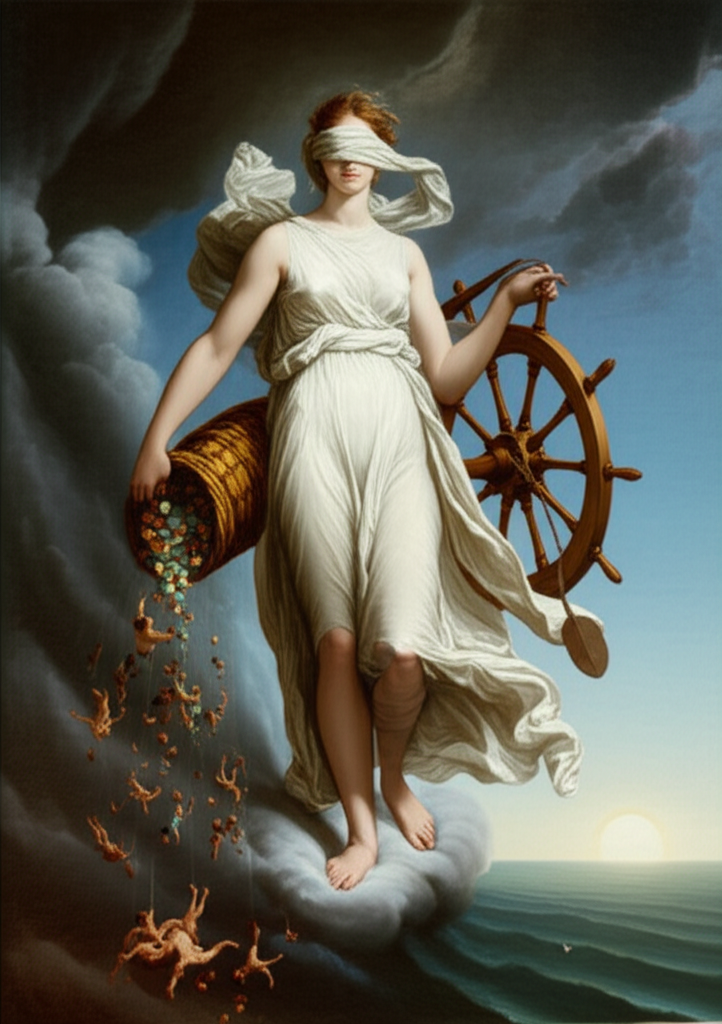
- Machiavelli's Fortuna: In The Prince, Machiavelli famously discusses Fortuna (Fortune) as a river that, when swollen, can overwhelm everything in its path. Yet, he argues that in times of calm, men can build "dikes and dams" to prepare for its onslaught. This metaphor beautifully illustrates the interplay: while chance (Fortuna) is powerful and unpredictable, human Will (virtù, or skill/courage) can anticipate, adapt, and even partially control its effects. A wise ruler is one who understands both the power of fortune and the necessity of preparing for it with prudence and decisive action.
- Existentialism: Later philosophers, particularly existentialists like Sartre, emphasized radical freedom and responsibility in a world devoid of inherent meaning or predetermined paths. For them, chance is a fundamental condition of existence, and our Will is what defines us through the choices we make in response to it.
Ultimately, the human will stands as our primary tool for navigating the sea of chance. It allows us to:
- Prepare: Anticipate potential outcomes and plan contingencies.
- Adapt: Adjust our course when unforeseen events arise.
- Choose: Make decisions that, while influenced by chance, are not entirely dictated by it.
Chance and the Course of History
Perhaps nowhere is the impact of Chance more evident than in the grand narrative of History. Seemingly minor, unpredictable events have frequently altered the trajectory of civilizations, empires, and entire eras.
- Weather and Warfare: Countless battles have been won or lost due to sudden storms, unexpected fogs, or unseasonable cold. The defeat of the Spanish Armada in 1588 was significantly aided by severe storms in the English Channel, a clear instance of chance altering the geopolitical landscape.
- Accidental Discoveries: Penicillin, X-rays, vulcanized rubber – many pivotal scientific and technological advancements arose from serendipitous observations or "happy accidents." These chance events, coupled with the keen Will and intellect of researchers, reshaped human progress.
- The "Butterfly Effect": While often oversimplified, the concept suggests that small, seemingly insignificant events can have massive, cascading consequences over time. A single illness, a chance encounter, or a misplaced document could, in retrospect, be seen as a critical pivot point in a historical narrative.
Historians grapple with how much weight to give to such contingencies. Is history driven by grand, deterministic forces, or is it a more chaotic, unpredictable interplay of human Will, structural conditions, and pure Chance? The answer, likely, is a complex blend of all three.
Navigating the Unforeseen: Philosophical Responses
Given the inescapable presence of chance, how should we, as individuals and societies, respond? Philosophers throughout History have offered various approaches:
- Acceptance (Stoicism): Embrace what cannot be controlled. Focus energy on what is within our power (our judgments, our will), and accept the external world, including chance events, as part of the natural order. This fosters inner tranquility.
- Prudence and Preparation (Aristotle, Machiavelli): While chance cannot be eliminated, its effects can be mitigated through foresight, planning, and the cultivation of practical wisdom (phronesis). A prudent person makes choices that account for potential contingencies.
- Resilience and Adaptability: Develop the capacity to bounce back from adversity and adjust to new circumstances. This isn't about controlling chance, but controlling our reaction to it.
- Embracing Serendipity: Recognize that not all chance events are negative. Some lead to unexpected opportunities, discoveries, or connections. An openness to the unforeseen can lead to novel paths.
Conclusion: Embracing the Contingent Reality
The concept of Chance in human affairs is not merely an acknowledgment of randomness; it is a profound philosophical challenge to our desire for absolute control and predictability. It forces us to confront the limits of our knowledge and the inherent contingency of existence. While Fate may suggest a predetermined path, and our Will strives to carve out agency, Chance reminds us that the world is an intricate, often surprising, place.
By understanding chance – not as an enemy, but as an inherent component of reality – we can cultivate wisdom, resilience, and a deeper appreciation for the unpredictable unfolding of History and our individual lives. It is in this dynamic interplay of intention and accident that the richness of human experience truly lies.
Further Exploration:
-
📹 Related Video: What is Philosophy?
Video by: The School of Life
💡 Want different videos? Search YouTube for: "Philosophy of Chance and Contingency"
-
📹 Related Video: STOICISM: The Philosophy of Happiness
Video by: The School of Life
💡 Want different videos? Search YouTube for: "Stoicism and the Acceptance of Fate"