

The Enduring Philosophical Resonance of Angelic Being
The concept of angelic being, often relegated to the realms of myth or religious dogma, holds a surprisingly rich and enduring position within the history of Western philosophy, particularly as explored in the Great Books of the Western World. Far from mere celestial messengers, angels, in a philosophical context, serve as profound thought experiments on the nature of existence, consciousness, and the very structure of reality. This article delves into how philosophers, from antiquity through the Scholastic period, grappled with the idea of a purely intellectual substance, an angelic Being, exploring its implications for metaphysics, epistemology, and Theology, often through the lens of Form and immaterial existence.
Unveiling the Angelic: A Summary
At its core, the philosophical concept of angelic being posits the existence of intelligent, non-corporeal substances – beings entirely without physical Form or matter. These Angels challenge our anthropocentric understanding of existence, prompting inquiries into how knowledge, will, and individuality can subsist without a body. Throughout the philosophical tradition, particularly within Christian Theology, the Angel becomes a critical touchstone for understanding pure intellect, divine emanation, and the hierarchy of Being, forcing thinkers to articulate the very essence of what it means to exist beyond the material realm.
The Ancient Roots: Ideas of Pure Intellect and Form
Before the explicit theological discussions of angels, ancient Greek philosophy laid crucial groundwork for conceiving of incorporeal intelligences.
Plato's Forms and the Intelligible Realm
Plato, in his theory of Forms, introduced the idea of a perfect, unchanging, and non-physical reality accessible only through intellect. While he didn't speak of "angels" as such, his concept of pure Forms existing independently of the material world provided a philosophical framework for understanding non-physical Being. For Plato, true reality resided in these intelligible Forms, making the notion of a Being purely intellectual, divorced from sensory experience, a natural extension of his metaphysics.
Aristotle's Unmoved Mover and Separated Intelligences
Aristotle, though more empirically minded, also posited the existence of immaterial intelligences. His "Unmoved Mover," the ultimate cause of motion in the cosmos, is pure actuality, thought thinking itself, entirely without matter. Furthermore, in his cosmology, he suggested the existence of other "separated intelligences" responsible for the motions of the celestial spheres. These beings, pure Form without matter, were akin to what later Theology would describe as Angels – living examples of pure Being whose activity was contemplation.
Theologians and Philosophers: Defining Angelic Being
The synthesis of Greek philosophy with Abrahamic Theology truly brought the concept of the Angel into sharp philosophical focus, notably in the works of Augustine and Aquinas.
Augustine of Hippo: Messengers of Divine Will
For Augustine, a pivotal figure in early Christian thought, Angels were integral to understanding God's creation and divine providence. He viewed them as intellectual creatures, created ex nihilo by God, whose primary function was to serve as divine messengers and ministers. They existed in a state of pure intellect, capable of direct apprehension of divine truths. Augustine’s focus was less on their metaphysical structure and more on their role in the cosmic order and their relationship to humanity's salvation, emphasizing their free will and the fall of some Angels.
Thomas Aquinas: The Metaphysics of Pure Form
It was Thomas Aquinas, drawing heavily on Aristotle, who provided the most systematic and philosophically rigorous analysis of Angelic Being. In his Summa Theologica, Aquinas dedicated considerable attention to the nature of Angels, treating them as a distinct species of Being.
Key Tenets of Aquinas's Angelic Philosophy:
- Pure Intellectual Substances: Aquinas posits that Angels are entirely immaterial, pure intellectual substances. Unlike humans, who are a composite of body and soul (Form and matter), Angels are subsistent Forms – their Form is their Being. They are not "souls without bodies"; they are complete, individual Beings whose essence is intellect.
- Individuation: A significant philosophical challenge is how to individuate Angels if they lack matter, which typically individuates Forms in the material world. Aquinas argued that each Angel is its own species. There are no two Angels of the same species because each Angel perfectly exhausts the Form of its Being. They are individual Forms.
- Mode of Knowledge: Angels do not learn through sensory experience or discursive reasoning like humans. Instead, they possess innate knowledge, directly apprehending truths through intellectual intuition. Their knowledge is infused by God, perfect within their nature.
- Will and Freedom: Angels possess free will, but their choices are made with perfect clarity of intellect. Their initial choice for or against God was definitive because they understood the consequences fully, unlike humans whose understanding is obscured by matter.
| Aspect | Human Being (Aquinas) | Angelic Being (Aquinas) |
|---|---|---|
| Composition | Composite of substantial Form (soul) and matter (body) | Pure, subsistent Form (intellectual substance) |
| Individuation | By matter (each human body is distinct) | Each Angel is its own species; individuated by its unique Form |
| Mode of Knowledge | Through senses and abstract reasoning | Innate, intuitive, infused knowledge |
| Nature of Intellect | Discursive, moves from premises to conclusions | Intuitive, apprehends truth directly and perfectly |
| Relation to Matter | Intimately united with matter | Wholly separate from matter |
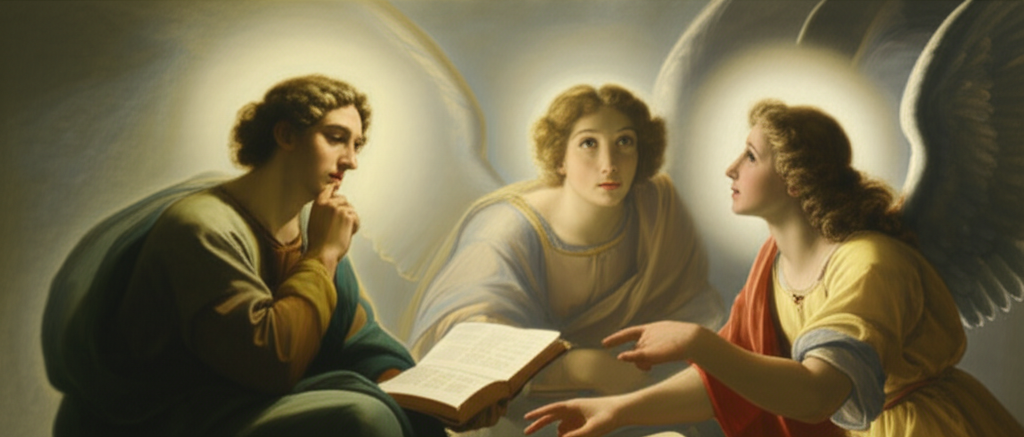
Philosophical Implications and Enduring Questions
The philosophical exploration of Angelic Being is not merely a historical curiosity; it raises profound questions about the nature of reality itself.
- The Nature of Being: What does it mean to exist as pure Being without material extension? How does this challenge our understanding of substance and accident?
- Consciousness Without a Body: If Angels are pure intellect, how does consciousness manifest without a brain or sensory organs? This pushes the boundaries of our contemporary understanding of mind.
- Individuality and Identity: If matter is the principle of individuation for corporeal beings, how are Angels distinct from one another? Aquinas's solution (each an individual species) is a radical departure from our everyday experience.
- The Hierarchy of Existence: The concept of Angels reinforces a hierarchical view of Being, bridging the gap between the divine and the human, providing a spectrum of intelligent life.
Conclusion: A Legacy of Thought
The concept of Angelic Being, as illuminated by the Great Books of the Western World, transcends its theological origins to offer a potent philosophical challenge. It compels us to consider the possibility of pure intellect, of Forms existing independently, and of a hierarchy of Being that extends beyond our material perception. Whether one accepts their literal existence or not, the philosophical inquiry into Angels continues to enrich our understanding of metaphysics, Theology, and the boundless possibilities of thought itself, reminding us that reality might be far stranger and more complex than we often imagine.
📹 Related Video: PLATO ON: The Allegory of the Cave
Video by: The School of Life
💡 Want different videos? Search YouTube for: ""Aquinas Angels Metaphysics" or "Plato Aristotle Immaterial Substance""