

The Luminous Logic of Angelic Being
The concept of an Angel, often relegated to the realm of myth or religious dogma, holds a surprisingly profound and enduring place within philosophical discourse, particularly within the classical tradition explored in the Great Books of the Western World. Far from mere winged messengers, Angelic Being presents a compelling challenge to our understanding of existence itself, pushing the boundaries of metaphysics and Theology. This article delves into how philosophers have grappled with the nature of these immaterial entities, exploring what their existence implies about Form, intellect, and the very fabric of reality beyond the corporeal. We will see that the Angel serves as a crucial thought experiment for dissecting the relationship between matter and spirit, knowledge and intuition, and the complex hierarchy of Being.
Angels as a Philosophical Problem
For many thinkers, especially those within the scholastic tradition, the existence of angels was not merely an article of faith but a logical necessity for a complete understanding of the cosmos. If Being can exist in various forms – from inanimate objects to plants, animals, and humans – then what about Being that is purely intellectual, unencumbered by matter? This question forces us to confront the very definition of existence. Can something exist without a physical body? If so, how does it exist? What is its Form?
Philosophers like St. Thomas Aquinas, drawing heavily on Aristotelian metaphysics and Christian Theology, dedicated significant portions of their work to understanding Angelic Being. They weren't just confirming biblical accounts; they were systematically investigating a category of existence that defied common sensory experience, yet seemed logically coherent within a comprehensive worldview. The Angel thus becomes a crucible for examining the nature of pure intellect and the potential for a non-material existence.
The Nature of Angelic Being: Pure Intellect and Immateriality
The most striking feature of Angelic Being in philosophical consideration is its absolute immateriality. Unlike humans, who are a composite of body and soul, angels are understood as pure spirits, subsistent Forms without matter. This distinction is crucial:
- Absence of Matter: An Angel does not possess a body in the way humans do. This means they are not subject to spatial limitations, growth, decay, or the need for physical sustenance. They don't have organs, nor do they perceive through senses in the human way.
- Pure Intellect: Their existence is defined by intellect and will. They are beings of pure thought, understanding directly and intuitively rather than through abstracting from sensory experience as humans do. This grants them a perfect and immediate grasp of truth.
- Subsistent Forms: Aquinas famously argued that each Angel is its own species. Because they lack matter, which is the principle of individuation for things of the same species (e.g., two human beings are distinct by their matter), each Angel must be unique in its Form. This means there aren't many angels of the "same kind" in the way there are many humans; each is fundamentally distinct in its essence.
This radical immateriality forces us to re-evaluate our everyday assumptions about what it means to be. If existence doesn't necessarily entail physical presence, then the scope of Being expands dramatically, opening doors to understanding spiritual realities within a philosophical framework.
The Problem of Individuation and Knowledge
The immateriality of angels poses fascinating philosophical puzzles, particularly regarding their individuality and mode of knowledge.
Individuation Without Matter
As mentioned, if matter is what distinguishes one individual from another within the same species (e.g., what makes this human distinct from that human), how are individual angels differentiated? Aquinas's solution, profound in its implications, posits that each Angel is a unique species unto itself. There is no shared Form or essence that is then individuated by matter; their very Being is their unique Form. This means that the diversity among angels is not numerical but essential – each Angel represents a distinct way of being a pure intellect.
Angelic Knowledge: Intuitive and Immediate
Unlike human knowledge, which is acquired discursively through sensory experience and abstract reasoning, angelic knowledge is considered intuitive and immediate.
- No Abstraction: Angels do not need to abstract universal concepts from particular instances, as they grasp universals directly.
- Imperfect vs. Perfect Knowledge: While human knowledge is imperfect and progressive, angelic knowledge, being direct, is more perfect, limited only by the Angel's own specific Form and its place in the divine order.
- Communication: Their communication is often conceived not as speech in our sense, but as a direct spiritual illumination, an impressing of thoughts upon another Angel's intellect.
These aspects highlight the radical difference in Being and cognition that the concept of the Angel introduces, challenging our anthropocentric views of intelligence and existence.
Angels and the Hierarchy of Being
Within the grand scheme of classical metaphysics and Theology, angels occupy a critical intermediary position in the "Great Chain of Being." This hierarchy, inherited from Neoplatonic thought and refined by scholastic philosophers, posits a graded order of existence from the simplest matter to the purest spirit.
- Between God and Humanity: Angels are superior to humans in their immateriality and perfection of intellect, yet infinitely inferior to God, who is pure Being itself.
- Mediators: They often serve as intermediaries between the divine and the created world, executing divine will or reflecting divine perfections.
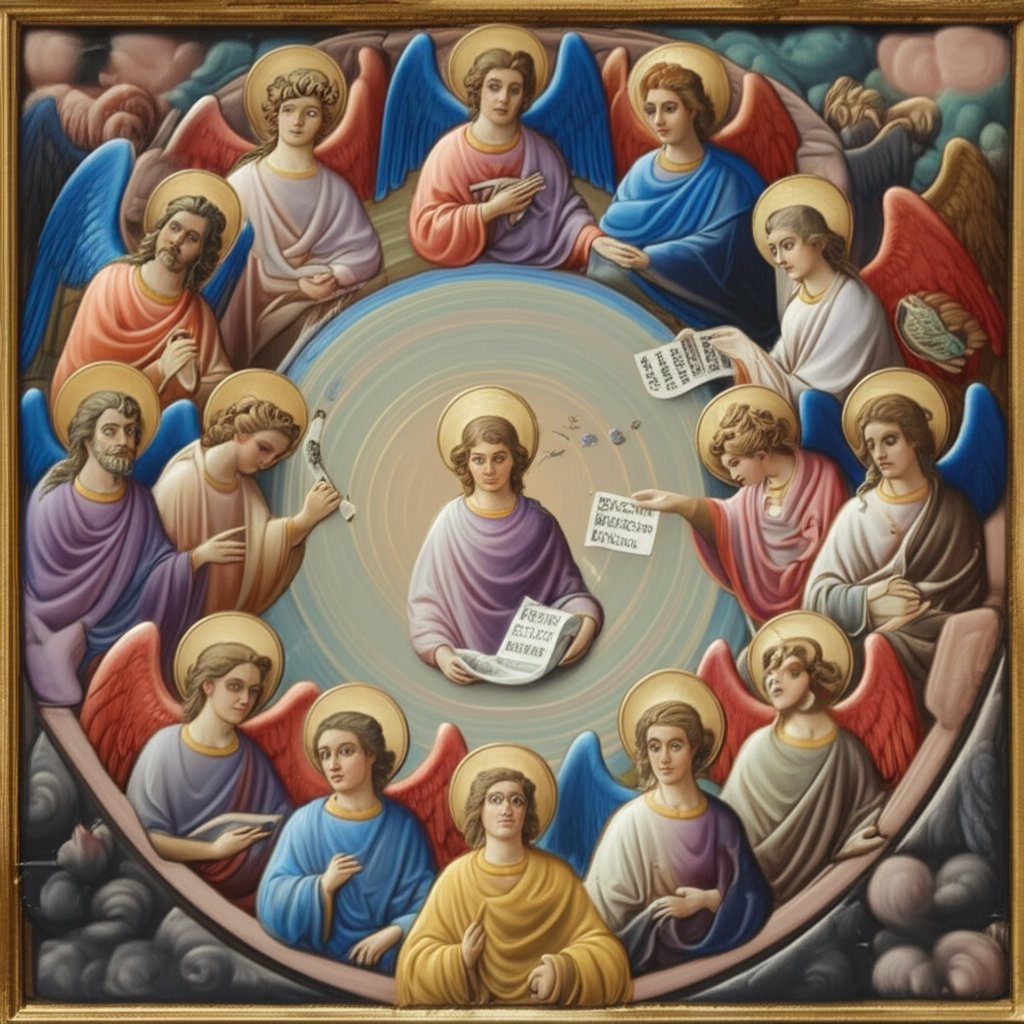
- Orders and Choirs: The traditional nine choirs of angels (Seraphim, Cherubim, Thrones, Dominions, Virtues, Powers, Principalities, Archangels, and Angels) reflect an internal hierarchy of perfection and proximity to God, each representing a distinct Form of Angelic Being.
This hierarchical placement underscores the philosophical utility of the Angel concept: it fills a logical gap, providing a bridge between the purely spiritual and the material, thereby completing a comprehensive metaphysical picture of the cosmos.
The philosophical exploration of Angelic Being transcends mere religious belief, offering a profound intellectual exercise in understanding existence, immateriality, and the diverse Forms that Being can take. By grappling with the nature of angels, thinkers from the Great Books of the Western World tradition have pushed the boundaries of metaphysics, Theology, and epistemology, illuminating the intricate logic that underpins the universe.
📹 Related Video: PLATO ON: The Allegory of the Cave
Video by: The School of Life
💡 Want different videos? Search YouTube for: ""Thomas Aquinas on Angels and Immateriality," "The Great Chain of Being: From Plato to the Enlightenment""