

Beyond the Celestial Veil: Unpacking the Angelic Being
The concept of an angel often conjures images of winged messengers or benevolent guardians, figures deeply embedded in religious folklore and popular culture. Yet, for centuries, the notion of angelic being has been a profound subject of philosophical and theological inquiry, forcing thinkers to grapple with fundamental questions about existence, intelligence, and the very fabric of reality. This article delves into the rich intellectual history of angelic form, exploring how philosophers and theologians, particularly those represented in the Great Books of the Western World, have sought to understand these enigmatic entities not merely as mythical creatures, but as crucial components in the hierarchy of Being. From pure intelligences to subsistent forms, the angel stands as a testament to humanity's enduring quest to comprehend the non-material dimensions of existence.
Angels as Pure Intelligences: A Philosophical Lineage
Before the advent of explicit Christian theology, classical philosophy laid crucial groundwork for conceiving of non-corporeal intelligences. Plato's theory of Forms, for instance, posited a realm of perfect, immutable essences existing independently of the material world. While not "angels" in the later sense, these Forms represent an early philosophical attempt to understand Being that is purely intellectual and non-physical. They provided a conceptual space for contemplating realities beyond sensory experience.
Aristotle, too, contributed significantly with his concept of the Unmoved Mover and the separate intelligences responsible for the motion of the celestial spheres. These were understood as purely actualized beings, unmixed with potentiality, whose activity was solely intellectual contemplation. These Aristotelian intelligences, though distinct from the Abrahamic angel, shared the crucial attribute of being purely intellectual forms, existing without matter, and serving as a bridge to later scholastic understandings of angelic nature. This philosophical lineage provided the intellectual tools necessary for subsequent theology to articulate the nature of spiritual entities.
The Scholastic Synthesis: Aquinas and the Nature of the Angel
It is within the scholastic tradition, particularly through the monumental work of Thomas Aquinas in his Summa Theologica, that the philosophical and theological understanding of the angel reached its most detailed articulation. Aquinas, drawing heavily from Aristotle and Christian revelation, presents angels not as ethereal spirits, but as distinct species of subsistent forms – pure intelligences without any admixture of matter.
Key Attributes of Aquinas's Angelic Being:
- Pure Form, No Matter: Angels are utterly immaterial. They are forms that subsist in themselves, meaning their essence is their existence, unlike corporeal beings which are a composite of form and matter. This makes each angel a unique species, as there is no matter to individuate multiple angels of the same form.
- Intellect and Will: Angels possess perfect intellect and free will. Their knowledge is infused directly by God, rather than acquired through sensory experience or discursive reasoning, allowing for immediate apprehension of truth.
- Immutability: While possessing free will, their choices, once made, are immutable, owing to their perfect intellect's immediate grasp of the consequences.
- Locality by Operation: Lacking a body, angels do not occupy space in the same way material objects do. Instead, they are said to be "locally" wherever they exert their influence or operate.
- Hierarchy of Being: Angels exist in a divinely ordained hierarchy, with different orders (e.g., Seraphim, Cherubim, Thrones) possessing varying degrees of perfection and proximity to God.
Aquinas’s rigorous analysis of the angel pushes the boundaries of metaphysical inquiry, exploring the very nature of being that is not bound by the limitations of the physical world. His work demonstrates how the concept of the angel served as a critical lens through which to examine questions of substance, essence, knowledge, and divine order.
Angelic Hierarchy and Purpose: Order in the Cosmos
The concept of a structured angelic hierarchy, famously articulated by Pseudo-Dionysius the Areopagite and later integrated into scholastic theology, underscores the pervasive idea of order in the cosmos. These hierarchies, consisting of nine choirs arranged into three triads, illustrate a graded ascent towards the divine, with each order fulfilling specific roles:
- First Triad (Counselors): Seraphim, Cherubim, Thrones – closest to God, focused on contemplation and divine love.
- Second Triad (Governors): Dominions, Virtues, Powers – regulate the cosmos, oversee celestial bodies and natural law.
- Third Triad (Messengers): Principalities, Archangels, Angels – interact most directly with the material world and humanity, delivering messages and providing guidance.
This intricate system highlights the angel's purpose not just as individual beings, but as essential components within a vast, interconnected chain of Being, mediating between the divine and the created order. Their existence reinforces a universe where every element, from the lowest stone to the highest angel, has its place and function in God's grand design.
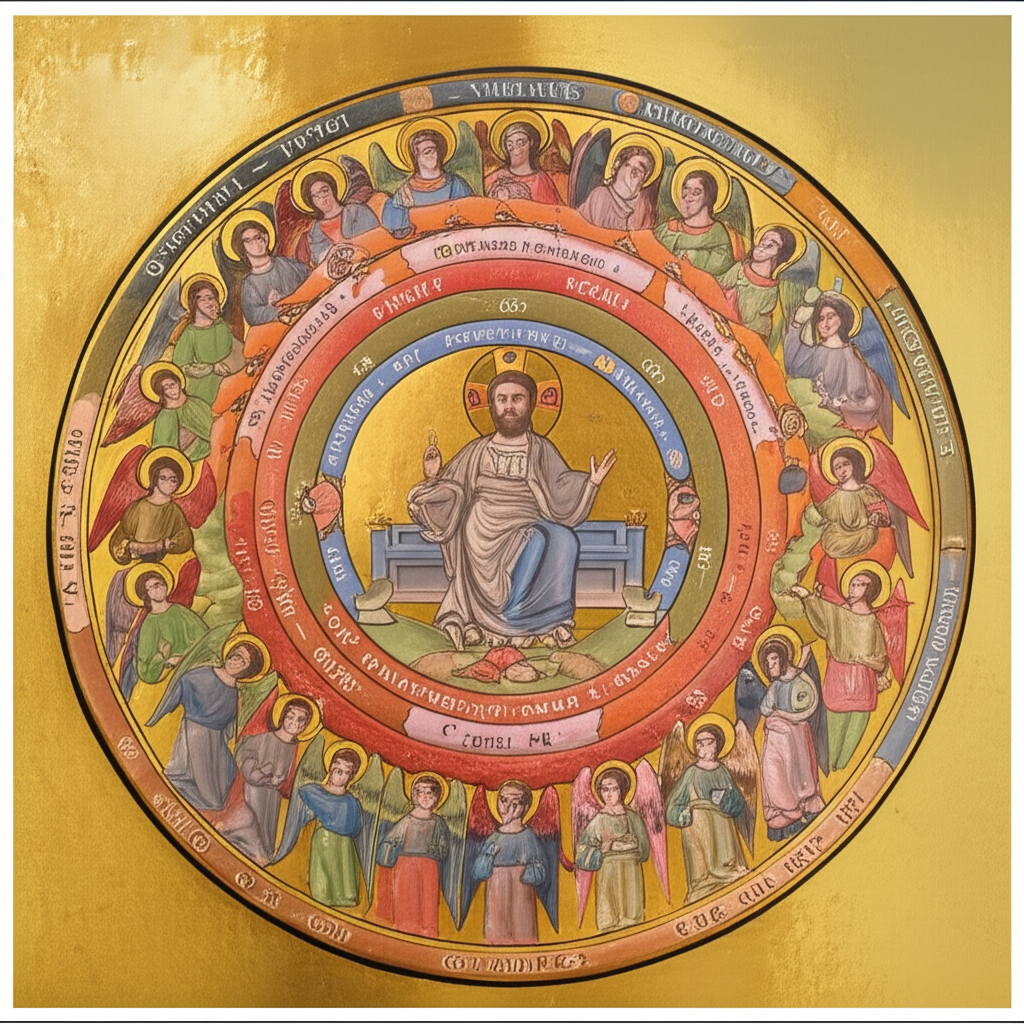 , others holding scepters or globes (Dominions), and the lowest orders appearing more humanoid.)
Beyond Dogma: Literary and Existential Explorations
The philosophical and theological understanding of the angel has not been confined to academic treatises. Its profound implications have resonated through Western literature, offering rich ground for exploration. Dante Alighieri’s Divine Comedy, for instance, vividly portrays the angelic hierarchies, integrating scholastic theology into a poetic vision of the cosmos. John Milton's Paradise Lost presents angels as powerful, complex beings with intellect and agency, capable of both sublime devotion and tragic rebellion, thereby exploring themes of free will, good, and evil through an angelic lens.
Even in contemporary thought, the idea of a purely intellectual being challenges our anthropocentric assumptions about intelligence and consciousness. What does it mean for a being to exist without a body, to know without senses, to act without physical presence? These questions, prompted by the concept of the angel, continue to push the boundaries of metaphysics, inviting us to contemplate the full spectrum of Being and the nature of reality beyond our immediate experience.
The Enduring Enigma of the Angelic Form
The concept of the angel is far more than a simple religious doctrine; it is a profound philosophical construct that has compelled thinkers to confront fundamental questions about the nature of Being, existence beyond matter, and the very essence of intelligence. From the abstract Forms of Plato to the subsistent forms of Aquinas, the angel serves as a powerful intellectual tool for exploring the non-physical dimensions of reality. By examining these immaterial entities, we are invited to expand our understanding of what it means to exist, to know, and to participate in the grand, ordered tapestry of the cosmos. The angel remains an enduring enigma, challenging us to look beyond the visible and ponder the invisible, reminding us that there are more things in heaven and earth than are dreamt of in our philosophy.
📹 Related Video: ARISTOTLE ON: The Nicomachean Ethics
Video by: The School of Life
💡 Want different videos? Search YouTube for: ""Aquinas Angels Summa Theologica Explained""
📹 Related Video: PLATO ON: The Allegory of the Cave
Video by: The School of Life
💡 Want different videos? Search YouTube for: ""Plato's Forms and Aristotelian Metaphysics: Crash Course Philosophy""