

The Cause of Sin and Moral Error: A Philosophical Inquiry
The question of why humans commit sin and fall into moral error has plagued philosophers for millennia, standing as a fundamental challenge to our understanding of human nature, ethics, and the very structure of reality. This article explores the multifaceted philosophical perspectives on the cause of sin and moral error, tracing its roots from ancient Greek intellectualism to modern conceptions of the Will and Duty. We shall see that while some attribute fault to ignorance, others point to a corrupted Will, a failure of Duty, or the inherent limitations of human reason. Ultimately, the cause is rarely singular, often arising from a complex interplay of intellect, desire, and choice.
Unpacking Sin and Moral Error: A Preliminary Distinction
Before delving into the causes, it is crucial to establish a working distinction between "sin" and "moral error," though their boundaries often blur.
- Sin: Often carries theological connotations, implying a transgression against divine law or a fundamental moral order, frequently with an emphasis on intention and the Will. It suggests a knowing or culpable departure from what is right.
- Moral Error: A broader term, often used in secular philosophy, referring to actions or judgments that are objectively wrong, mistaken, or fail to achieve moral good. It can encompass actions committed out of ignorance, weakness, or miscalculation, not necessarily implying malicious intent.
While the causes we explore may apply to both, the emphasis often shifts depending on which concept is in focus.
The Ancient Roots: Ignorance and the Intellect
The earliest philosophical inquiries into the cause of wrongdoing often centered on the intellect.
Socratic Paradox: All Evil is Ignorance
Socrates famously asserted that "no one does wrong willingly." For him, if a person truly knew what was good, they would invariably pursue it. Therefore, the cause of sin or moral error is ultimately ignorance. People act wrongly because they are mistaken about what constitutes the good, believing their harmful actions to be beneficial in some way.
- Key Idea: Virtue is knowledge. Vice is ignorance.
- Implication: Education and moral instruction are the primary remedies for wrongdoing.
Plato, while expanding on Socrates' ideas, acknowledged the role of the spirited and appetitive parts of the soul, suggesting that while reason should guide, these lower parts could overpower it, leading to error even when one "knows" the good. Yet, the ultimate failure still lay in reason's inability to assert its proper authority – a failure of knowledge or understanding.
Aristotle: Weakness of Will (Akrasia)
Aristotle, in his Nicomachean Ethics, provided a more nuanced view, acknowledging the phenomenon of akrasia, or weakness of Will. He observed that people sometimes act against their better judgment, knowing what is good but failing to do it.
- The Cause: While still linked to a form of ignorance (perhaps a temporary or partial eclipse of knowledge by passion), Aristotle recognized that the Will itself could be insufficient to overcome strong desires. The cause here is less about not knowing, and more about failing to apply what one knows, often under the sway of immediate pleasure or pain.
The Augustinian Revolution: Free Will and the Fall
With Augustine of Hippo, the focus shifted dramatically from intellectual error to the Will as the primary cause of sin. His profound exploration in works like Confessions and On Free Choice of the Will laid the groundwork for much of Western theology and philosophy concerning evil.
Augustine argued vehemently against the Manichaean idea that evil was a substance or an external force. Instead, he proposed that evil is a privation of good, and sin is a direct result of the misuse of free will (liberum arbitrium).
- The Cause: The Will freely chooses to turn away from a higher, immutable good (God) towards a lesser, mutable good. This turning away is not compelled by ignorance, but is a deliberate act of choosing wrongly, even when the intellect may apprehend the true good.
- Original Sin: For Augustine, the first sin of Adam and Eve corrupted human nature, making subsequent humans prone to sin—a tendency he called concupiscence. While the Will remains free, it is now damaged, finding it harder to choose the good. This is a crucial distinction: we are free to choose, but our Will is inclined towards sin.
Medieval Scholasticism: Intellect and Will in Concert
Thomas Aquinas, building on Augustine and Aristotle, further refined the understanding of the cause of sin. For Aquinas, human action is a product of both the intellect and the Will.
- The Cause: Sin occurs when the intellect presents a particular good to the Will, but the Will (influenced by passions or a deficient moral habit) chooses that particular good in a way that is disordered or contrary to right reason and the ultimate good.
- Ignorance: Can be a cause, but only if it is vincible (culpable) ignorance – where one should have known better. Invincible ignorance (where one genuinely could not have known) generally excuses from sin.
- Passion: Strong emotions can sway the intellect and Will.
- Malice: A direct, deliberate choice of evil, which Aquinas considered the most grievous form of sin.
Aquinas emphasized that the Will is rational; it always chooses under the aspect of the good, even when that "good" is merely apparent or lesser. The cause of sin is thus a defect in the practical intellect's presentation of the good, or a defect in the Will's adherence to the truly rational good.
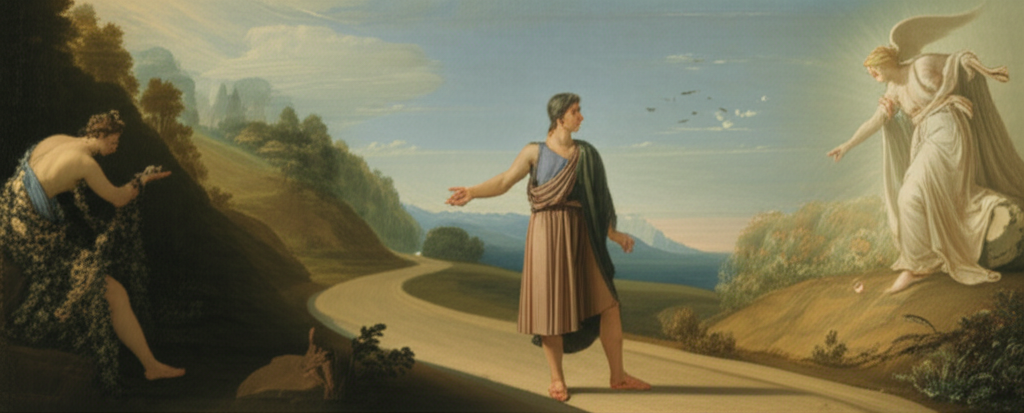
Modern Philosophy: Duty, Reason, and the Imperatives of Will
The Enlightenment brought new perspectives, particularly emphasizing reason and individual autonomy.
Kant: The Failure of Duty
Immanuel Kant shifted the focus from the consequences of actions to the motive behind them. For Kant, a morally good action is one performed out of Duty, not inclination or expected outcome.
- The Cause of Moral Error/Sin:
- Failure to Act from Duty: The primary cause is not necessarily ignorance or a corrupt Will in the Augustinian sense, but a failure to align one's Will with the categorical imperative – the universal moral law derived from reason.
- Self-Love and Inclination: When individuals act based on their desires, preferences, or self-interest rather than out of respect for the moral law, they commit moral error, even if the action appears outwardly good. The Will fails to properly legislate for itself according to reason.
- Radical Evil: Kant also introduced the concept of "radical evil" in human nature, a propensity to prioritize self-love over the moral law, which he saw as an inherent but chosen corruption of the Will's maxims. This is not a corruption of our rational capacity, but a culpable misordering of our priorities.
A Summary of Causal Factors
| Philosophical Tradition | Primary Cause of Sin/Moral Error | Key Concept(s) |
|---|---|---|
| Ancient Greek | Ignorance of the Good | Knowledge, Virtue, Akrasia |
| Augustinian | Misuse of Free Will | Free Will (liberum arbitrium), Original Sin, Privation of Good |
| Thomistic | Disordered Will/Intellect | Rational Will, Passions, Malice, Invincible/Vincible Ignorance |
| Kantian | Failure to Act from Duty | Duty, Categorical Imperative, Radical Evil, Autonomy of Will |
Contemporary Considerations: Beyond Pure Philosophy
While the philosophical foundations remain, contemporary thought often integrates insights from psychology, sociology, and neuroscience to offer a more complete picture of the cause of moral failings.
- Psychological Biases: Cognitive biases (e.g., confirmation bias, self-serving bias) can lead to distorted perceptions of reality and moral judgments, making moral error more likely.
- Social and Environmental Pressures: External factors such as poverty, systemic injustice, peer pressure, or cultural norms can significantly influence individual choices and contribute to actions that are morally wrong.
- Neuroscience: Explores the biological underpinnings of decision-making, suggesting that certain brain structures or chemical imbalances might predispose individuals to certain behaviors, complicating the notion of purely free Will.
These modern perspectives do not necessarily negate the philosophical explanations but add layers of complexity, showing how the Will and intellect operate within a broader context.
Conclusion: The Enduring Complexity of Moral Failure
The cause of sin and moral error remains one of philosophy's most enduring and complex questions. From the Socratic emphasis on ignorance to Augustine's profound exploration of the errant Will, and Kant's focus on the failure of Duty, each era has grappled with why humans so often fall short of moral ideals. While the mechanisms of intellect and Will are central to most explanations, the interplay of internal desires, external pressures, and the inherent ambiguities of human existence ensure that this question will continue to provoke profound thought and debate. Understanding these diverse perspectives is not merely an academic exercise; it is crucial for building more robust ethical frameworks, fostering personal growth, and cultivating a more just and compassionate society.
YouTube Video Suggestions:
-
📹 Related Video: ARISTOTLE ON: The Nicomachean Ethics
Video by: The School of Life
💡 Want different videos? Search YouTube for: "Augustine on Free Will and Evil: The Origin of Sin"
2. ## 📹 Related Video: ARISTOTLE ON: The Nicomachean Ethics
Video by: The School of Life
💡 Want different videos? Search YouTube for: "Kant's Ethics: Duty, Morality, and the Categorical Imperative Explained"