

The Ineffable Grandeur: Unveiling the Beauty of Mathematical Structures
Summary: A Glimpse into the Aesthetic Core of Mathematics
Mathematics, often perceived as a cold, logical discipline, harbors a profound and captivating Beauty that transcends mere utility. This article explores how the elegance of Mathematical structures, from the symmetry of geometric Forms to the intricate logic of abstract proofs, reveals an aesthetic dimension deeply rooted in philosophical Ideas. Drawing inspiration from the Great Books of the Western World, we contend that the appreciation of mathematical beauty is not just an intellectual exercise, but a pathway to understanding the fundamental nature of reality and thought itself.
The Architectonic Symphony: Where Logic Meets Luster
For centuries, philosophers and thinkers have grappled with the peculiar allure of Mathematics. Why do certain equations evoke a sense of satisfaction? What makes a proof "elegant"? The answer, I believe, lies in recognizing that Mathematics is not merely a tool for calculation or a language for science; it is a realm where profound Beauty resides, manifesting in perfect Forms and eternal Ideas.
This beauty is not sensory, like a painting or a melody, but intellectual. It speaks to a deeper part of our understanding, resonating with the very structure of reason. When we encounter a particularly elegant proof, a symmetrical fractal, or a theorem that unifies disparate concepts, we experience a moment of clarity and awe – a glimpse into an underlying order that feels intrinsically right and beautiful.
Plato's Shadow: Mathematical Forms and Eternal Ideas
The Great Books offer a rich foundation for understanding this phenomenon, particularly through the lens of Platonic philosophy. For Plato, the physical world is but a shadow of a higher reality, the realm of perfect, immutable Forms or Ideas. A physical circle may be imperfect, but the Idea of a perfect circle exists eternally, accessible only through intellect.
Mathematics, then, becomes the closest we can get to apprehending these pure Forms. The properties of prime numbers, the Pythagorean theorem, the geometric perfection of an equilateral triangle – these are not inventions, but discoveries of pre-existing, ideal structures. They exist independently of human thought, universally true, and inherently beautiful in their perfection and consistency.
- Plato's Influence on Mathematical Beauty:
- The Realm of Forms: Mathematical objects (e.g., perfect circles, ideal numbers) are seen as manifestations of eternal, unchanging Forms.
- Intellectual Apprehension: True understanding of Mathematics involves grasping these abstract Ideas, not just their physical representations.
- Intrinsic Beauty: The perfection and order of these Forms inherently embody Beauty.
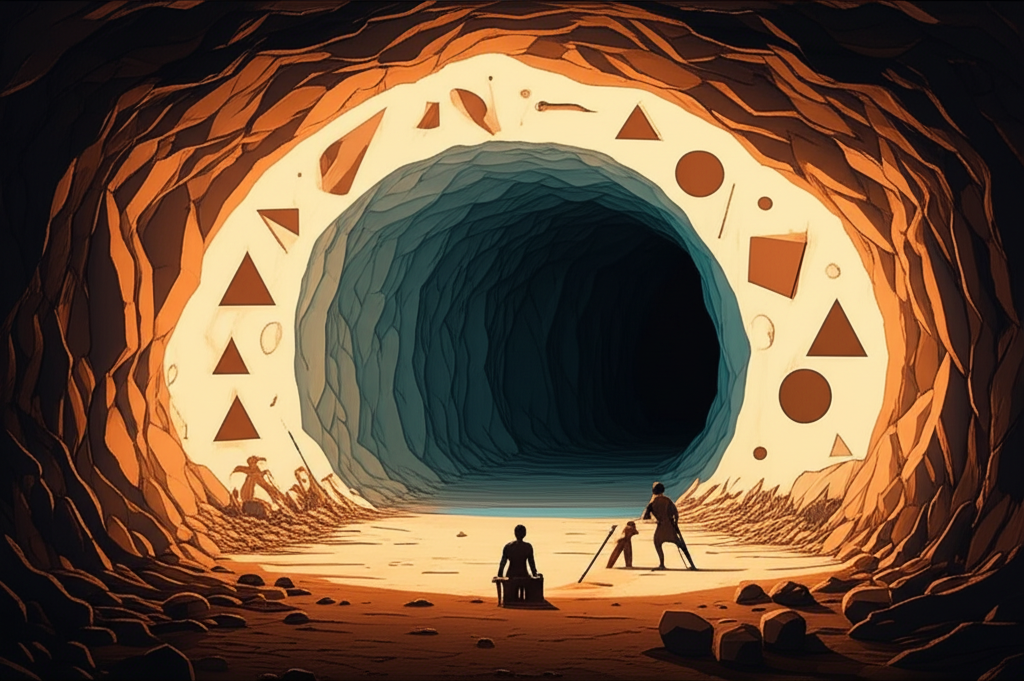 cast by light from a hidden mathematical source, symbolizing the journey from perceiving imperfect physical forms to understanding perfect mathematical Ideas.)
The Elegance of Proof: Structure as Aesthetic Delight
Beyond the objects themselves, the very process of Mathematics can be beautiful. A well-constructed proof is akin to a finely crafted piece of literature or architecture. It possesses:
- Simplicity: Achieving a profound result with minimal assumptions.
- Clarity: Each step logically follows from the last, leading inevitably to the conclusion.
- Symmetry: Balanced arguments, often revealing unexpected correspondences.
- Generality: A proof that illuminates a broader principle, applicable in many contexts.
Consider Euclid's proof that there are infinitely many prime numbers. Its elegant simplicity and irrefutable logic have inspired mathematicians for millennia. It doesn't just demonstrate a fact; it reveals a fundamental truth about numbers in a way that is both intellectually satisfying and aesthetically pleasing. The logical Form itself becomes a source of Beauty.
Table: Elements Contributing to Mathematical Beauty
| Element | Description | Philosophical Connection |
|---|---|---|
| Form (Structure) | The underlying arrangement and organization of mathematical entities. | Platonic Forms, inherent order of reality. |
| Idea (Concept) | The abstract principles and notions that mathematics explores. | Universal truths, conceptual purity. |
| Symmetry | Balance, proportion, and self-similarity within structures. | Harmony, cosmic order, aesthetic balance. |
| Elegance (of Proof) | Simplicity, conciseness, and logical flow leading to a profound conclusion. | Rationality as an art form, efficiency of thought. |
| Generality | The applicability of a concept or theorem across diverse domains. | Unifying principles, interconnectedness of knowledge. |
Mathematics: The Unseen Form of Reality
From the spiraling patterns of galaxies to the atomic structure of matter, Mathematics provides the language through which we comprehend the universe. The laws of physics are expressed mathematically, revealing an inherent order that suggests the world itself is structured according to profound Mathematical Ideas. Is this because our minds impose mathematical order, or because the universe fundamentally is mathematical?
Many philosophers, from Pythagoras to Galileo, have leaned towards the latter. Galileo famously stated that the universe is "written in the language of Mathematics." This perspective suggests that the Beauty we find in mathematical structures is not merely subjective, but a reflection of the deep, objective Form of reality itself. When we discern a mathematical pattern in nature, we are not just describing; we are touching upon a fundamental truth.
Conclusion: A Philosophical Appreciation
The Beauty of Mathematical structures is a profound testament to the power of human intellect and the inherent order of existence. It invites us to look beyond the tangible, to appreciate the abstract Forms and eternal Ideas that underpin both our thoughts and the cosmos. To engage with Mathematics is, in this sense, to engage in a deeply philosophical pursuit – a quest for truth, order, and an intellectual Beauty that enriches our understanding of the world and our place within it.
📹 Related Video: PLATO ON: The Allegory of the Cave
Video by: The School of Life
💡 Want different videos? Search YouTube for: ""Plato's Theory of Forms and Mathematics""
📹 Related Video: What is Philosophy?
Video by: The School of Life
💡 Want different videos? Search YouTube for: ""The Unreasonable Effectiveness of Mathematics in Philosophy""