

The Enduring Allure: Unveiling the Beauty of Mathematical Structures
Summary: Beyond its practical applications, mathematics possesses an intrinsic and profound beauty that captivates minds and illuminates fundamental truths about the universe. This article explores how mathematical structures, through their elegance, symmetry, and logical coherence, reveal an underlying cosmic order, connecting directly to ancient philosophical ideas of perfect form and universal harmony. We delve into the aesthetic dimensions of numbers, geometries, and abstract concepts, arguing that the appreciation of mathematical beauty offers a unique pathway to understanding reality itself.
The Unseen Harmony: Where Logic Meets Aesthetics
For many, mathematics is synonymous with calculation, equations, and problem-solving – a purely utilitarian tool. Yet, for those who truly engage with its essence, mathematics transcends mere utility to reveal a profound and often breathtaking beauty. This isn't the fleeting beauty of a sunset or a painting, but a deeper, more enduring aesthetic found in the elegance of a proof, the symmetry of a geometric form, or the unexpected connections between seemingly disparate concepts.
From the ancient Greeks, who saw in number and geometry the very fabric of the cosmos, to modern theoretical physicists who describe the universe with equations, the pursuit of mathematics has always been intertwined with a search for underlying order and beauty. It is a discipline that, at its highest level, becomes a philosophical endeavor, challenging us to contemplate the nature of reality through the lens of pure reason and abstract idea.
What Constitutes Mathematical Beauty?
The beauty in mathematics isn't always immediately obvious; it often requires a certain way of seeing, a willingness to appreciate structure and form on an abstract plane. However, once perceived, it can be as compelling as any work of art.
- Elegance in Proofs: A truly elegant mathematical proof is concise, insightful, and often surprising. It cuts through complexity with simplicity, revealing a truth in the most economical and aesthetically pleasing way. Think of Euclid's proofs, which for centuries stood as epitomes of logical deduction and clarity, influencing thinkers from Aristotle to Descartes.
- Symmetry and Pattern: The natural world is replete with symmetries and patterns, from the spiral of a seashell to the hexagonal form of a snowflake. Mathematics provides the language to describe and understand these phenomena, revealing the deep-seated principles that govern their creation. The beauty here lies in the universality of these patterns and their ability to manifest across scales.
- The Power of Abstraction: Perhaps the most profound aspect of mathematical beauty lies in its ability to deal with pure ideas and abstract forms. Numbers, sets, functions – these are not physical objects but conceptual entities whose relationships create intricate and beautiful structures. This abstraction allows us to generalize, to find universal truths that apply far beyond any specific instance.
Mathematics as a Reflection of Form and Idea
The philosophical roots of mathematical beauty run deep, particularly in the works of the Great Books of the Western World. Plato, in particular, posited a realm of perfect, eternal Forms or Ideas, which exist independently of the physical world. For Plato, mathematical objects—the perfect circle, the ideal triangle—were glimpses into this realm of perfect Form.
Table: Platonic Connection to Mathematical Beauty
| Philosophical Concept | Mathematical Manifestation | Aesthetic Implication |
|---|---|---|
| Platonic Forms/Ideas | Ideal geometric shapes, perfect numbers | Intrinsic, eternal, objective beauty |
| Immutability | Mathematical truths are constant and unchanging | Reliable, foundational beauty |
| Rational Order | Logical deduction, axiomatic systems (e.g., Euclid) | Elegant, coherent, structured beauty |
| Universal Truth | Mathematical laws apply everywhere | Transcendent, unifying beauty |
Euclid's Elements, a cornerstone of Western thought, beautifully exemplifies this Platonic ideal. Its systematic development of geometry from a few basic axioms and postulates showcases a beauty in logical progression, where each theorem builds upon the last with undeniable clarity and precision. The form of its arguments is as important as its conclusions, demonstrating how rigorous thought can lead to profound and elegant truths.
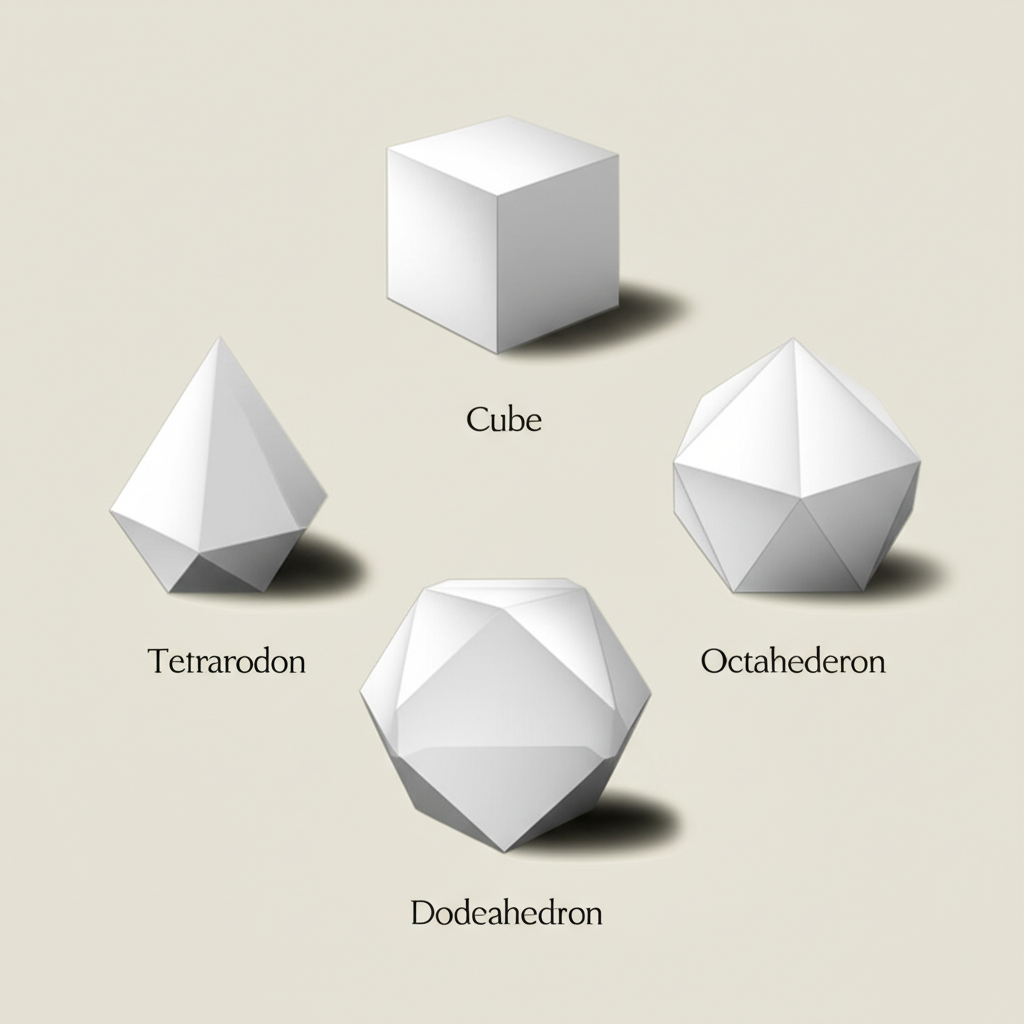 arranged harmoniously on a celestial backdrop, emphasizing their perfect symmetry and geometric elegance, with subtle golden ratio spirals interwoven in the background.)
The Subjectivity vs. Objectivity of Mathematical Beauty
Is mathematical beauty a subjective experience, or does it possess an objective reality? While individual appreciation can vary, there's a striking consensus among mathematicians regarding the beauty of certain proofs, theorems, or theories. The Euler Identity ($e^{i\pi} + 1 = 0$), for example, is almost universally lauded for its elegance, simplicity, and the way it connects five fundamental mathematical constants. This shared aesthetic suggests that the beauty lies not just in the eye of the beholder, but in the inherent form and structure of the mathematics itself. It's akin to recognizing the beauty of a perfectly formed crystal; its structure dictates its aesthetic appeal.
Exploring Specific Manifestations of Beauty
The realm of mathematics offers countless examples of stunning beauty:
- Fractals: These intricate, self-similar patterns, such as the Mandelbrot set, demonstrate infinite complexity arising from simple rules. Their recursive form and endless detail are visually mesmerizing and philosophically profound, suggesting that complex beauty can emerge from fundamental ideas.
- The Golden Ratio (Phi): Appearing in everything from ancient Greek architecture to the growth patterns of plants, the Golden Ratio ($\phi \approx 1.618$) is a testament to a recurring aesthetic form found in both nature and art, linking mathematics directly to our perception of harmony.
- Topology: This branch of mathematics studies properties of spaces that are preserved under continuous deformations. The beauty here lies in its abstract nature, allowing us to see fundamental connections between seemingly different objects (e.g., a coffee cup and a donut are topologically equivalent), revealing a deeper structural idea.
Conclusion: A Glimpse into the Cosmic Order
The beauty of mathematical structures offers more than just intellectual pleasure; it provides a unique window into the fundamental form and idea that underpin our universe. From the logical elegance of Euclidean geometry to the intricate beauty of fractals, mathematics reveals a consistent, rational, and profoundly aesthetic order. To appreciate this beauty is to engage with one of the deepest philosophical questions: What is the nature of reality, and why is it so exquisitely organized? In the elegant equations and perfect forms of mathematics, we find not just answers, but a testament to a cosmic beauty that inspires awe and wonder, inviting us to contemplate the very essence of existence.
YouTube:
-
📹 Related Video: KANT ON: What is Enlightenment?
Video by: The School of Life
💡 Want different videos? Search YouTube for: ""The Mathematical Beauty of Euler's Identity Explained""
2. ## 📹 Related Video: What is Philosophy?
Video by: The School of Life
💡 Want different videos? Search YouTube for: ""Why is Math Beautiful? The Philosophy of Mathematics""