

The Intrinsic Allure: Unveiling the Beauty of Mathematical Structures
The world often views mathematics as a formidable tool, a language of science and engineering, efficient and precise. Yet, to those who delve beyond its utilitarian surface, mathematics reveals a profound and often startling beauty. This article explores the intrinsic aesthetic appeal of mathematical structures, arguing that its elegance, order, and abstract perfection offer a unique form of philosophical beauty, echoing ancient ideas of form and truth. We will uncover how the meticulous logic and harmonious patterns inherent in mathematics resonate with our deepest sense of aesthetic appreciation, transcending mere functionality to touch the sublime.
A Glimpse into the Platonic Realm of Form and Idea
For centuries, philosophers have grappled with the nature of beauty. From the ancient Greeks, particularly Plato, we inherited the idea that true beauty resides not in the fleeting sensory world, but in eternal, perfect Forms. Mathematics, in this light, becomes a direct pathway to apprehending these ideal Forms. When we consider a perfect circle or the unassailable logic of a proof, we are not observing physical imperfections, but rather the pure, unadulterated idea of circularity or logical necessity.
Plato's Republic, for instance, elevates the study of mathematics as a crucial step in the philosopher's journey towards understanding the Good. It is through the abstract reasoning of geometry and arithmetic that the mind is drawn away from the shadows of the cave towards the light of true knowledge – the very Forms that define reality and beauty. The elegance of a mathematical equation, therefore, isn't just about what it describes, but what it reveals about the underlying structure of existence.
Euclid's Elements: The Architecture of Logical Beauty
One of the most enduring testaments to mathematical beauty can be found in Euclid's Elements, a cornerstone of the Great Books of the Western World. Here, beauty is not merely visual, but conceptual, residing in the rigorous logical progression from a few self-evident axioms to a vast, interconnected web of theorems.
Consider the form of a Euclidean proof:
- Axioms and Postulates: Simple, undeniable truths.
- Definitions: Precise and unambiguous.
- Logical Deduction: Each step follows inevitably from the last.
- Theorem: A new truth, proven with absolute certainty.
This systematic construction, where complex truths emerge from simple foundations through an elegant chain of reasoning, embodies a profound intellectual beauty. The satisfaction derived from understanding a well-constructed proof is akin to appreciating a perfectly designed piece of architecture – every part serves a purpose, and the whole is greater than the sum of its parts, achieving a harmonious form.
The Aesthetic of Patterns and Symmetries
Beyond the abstract realm of proof, mathematical beauty manifests visibly in patterns and symmetries that pervade both the natural world and human creations. From the spiral of a seashell to the intricate geometry of a snowflake, mathematics provides the underlying framework for these aesthetic wonders.
- Symmetry: The balanced distribution of form or arrangement, often seen in geometry, group theory, and crystallography. It evokes a sense of order and harmony.
- Fractals: Infinitely complex patterns that are self-similar across different scales. Their recursive form reveals an unexpected beauty in chaos and complexity.
- Fibonacci Sequence and the Golden Ratio: These numerical patterns appear in art, architecture, and biology, suggesting a universal aesthetic principle rooted in mathematics. They often manifest in visually pleasing proportions and growth patterns.
These examples illustrate how mathematics provides the language to describe, predict, and even generate patterns that our minds inherently find appealing. The idea of order emerging from a simple rule or sequence is deeply satisfying.
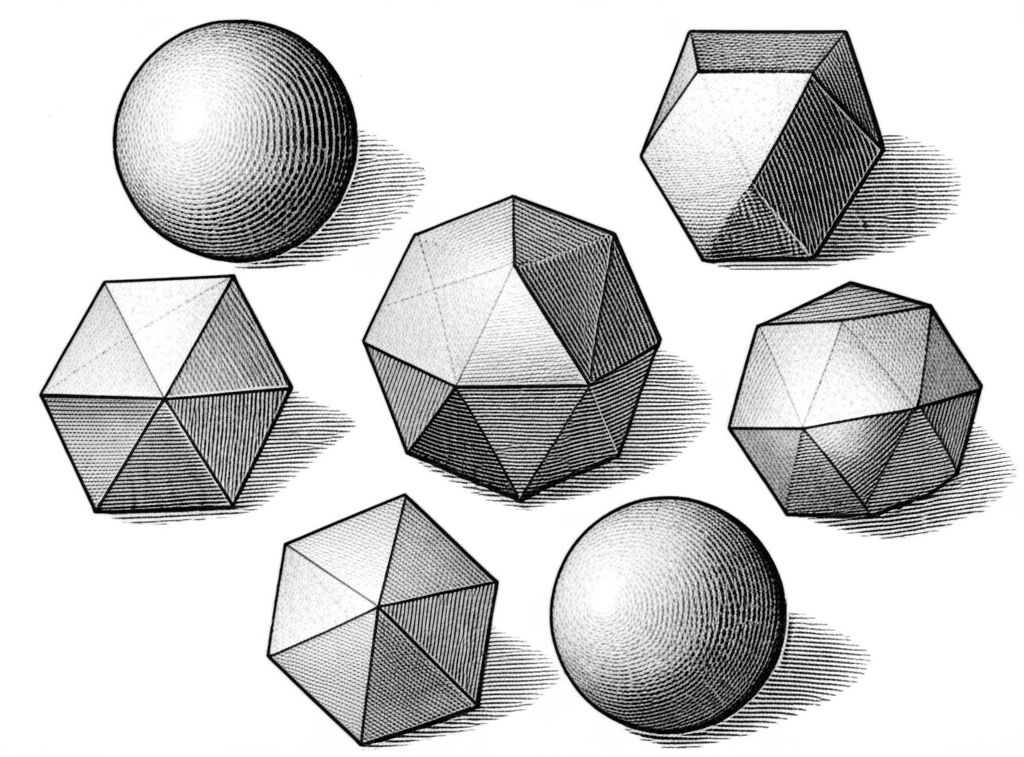 arranged harmoniously, perhaps with a compass and ruler nearby, symbolizing the purity of geometric forms and their connection to cosmic order as discussed in ancient Greek philosophy.)
The Unifying Power of Mathematical Ideas
The beauty of mathematics also lies in its extraordinary power to unify disparate phenomena under a single, elegant idea. From Newton's laws of motion describing both a falling apple and orbiting planets, to Maxwell's equations unifying electricity and magnetism, profound mathematical ideas have revealed the underlying unity of the cosmos. This ability to abstract and generalize, to find a common form behind seemingly unrelated events, is a hallmark of mathematical genius and a source of deep intellectual beauty.
- Calculus: Provides a framework for understanding change and motion across countless fields.
- Set Theory: Offers a fundamental language for all of mathematics, revealing the foundational ideas upon which complex structures are built.
- Group Theory: Illuminates symmetries in physics, chemistry, and mathematics itself, revealing a common underlying form.
This capacity for unification underscores the philosophical significance of mathematics. It suggests that the universe itself is structured according to rational, beautiful forms that are accessible through human reason.
Conclusion: Embracing the Aesthetic of Mathematics
The beauty of mathematical structures is not merely an incidental byproduct of its utility; it is an intrinsic quality, a testament to the elegance of logical form and the profound nature of abstract ideas. From the Platonic pursuit of perfect Forms to the logical architecture of Euclid, and the harmonious patterns found in nature, mathematics offers a unique aesthetic experience. To appreciate mathematics for its inherent beauty is to engage in a philosophical endeavor, revealing a deeper understanding of order, coherence, and the very fabric of existence. It reminds us that truth and beauty are often intertwined, manifesting most purely in the clean, unassailable structures of mathematics.
📹 Related Video: PLATO ON: The Allegory of the Cave
Video by: The School of Life
💡 Want different videos? Search YouTube for: ""Plato's Philosophy of Mathematics" OR "The Golden Ratio in Art and Nature""