

The Ineffable Grace: Unveiling the Beauty of Mathematical Structures
The allure of Mathematics extends far beyond its utility as a tool for calculation or scientific advancement. For those who delve into its depths, there is a profound Beauty to be found in its intricate structures, a Beauty that resonates not just with the intellect but with a deeper philosophical yearning. This article explores the philosophical dimensions of mathematical Beauty, connecting it to the enduring concepts of Form and Idea as discussed by the great thinkers, suggesting that in Mathematics, we encounter a pure and compelling glimpse into the underlying order of the cosmos.
Beyond the Equation: A Philosophical Appreciation of Beauty
When we speak of the Beauty of Mathematics, we are not referring to something visually aesthetic in the conventional sense. It is not the Beauty of a painting or a landscape, but rather an intellectual and conceptual Beauty. This profound appreciation arises from several facets:
- Elegance and Simplicity: The most beautiful mathematical proofs are often the simplest, revealing a complex truth with astonishing clarity and economy of thought.
- Universality: Mathematical truths are not bound by culture or time; they are universally valid, transcending individual perception.
- Profound Interconnectedness: Seemingly disparate mathematical Ideas often reveal deep, unexpected connections, forming a vast, harmonious tapestry of knowledge.
- The "Aha!" Moment: The sudden flash of insight when a complex problem yields to an elegant solution, or a pattern reveals its underlying Form, evokes a powerful sense of intellectual satisfaction that can only be described as beautiful.
This intellectual Beauty is a testament to the human capacity for abstract thought and our innate desire to understand the fundamental Forms that govern existence.
Plato's Forms and the Mathematical Idea
For philosophers like Plato, whose works are foundational in the Great Books of the Western World, the concept of Form or Idea was central to understanding reality. Plato posited a realm of perfect, eternal, and unchanging Forms that exist independently of the physical world. Our sensory experiences are merely imperfect shadows or reflections of these ideal Forms.
It is in Mathematics that we perhaps come closest to apprehending these pure Forms. Consider the perfect circle, the ideal triangle, or the concept of a prime number. These are not physical objects; no drawn circle is ever truly perfect, nor is any physical object a "prime number." Yet, their Ideas are immutable, precise, and universally understood.
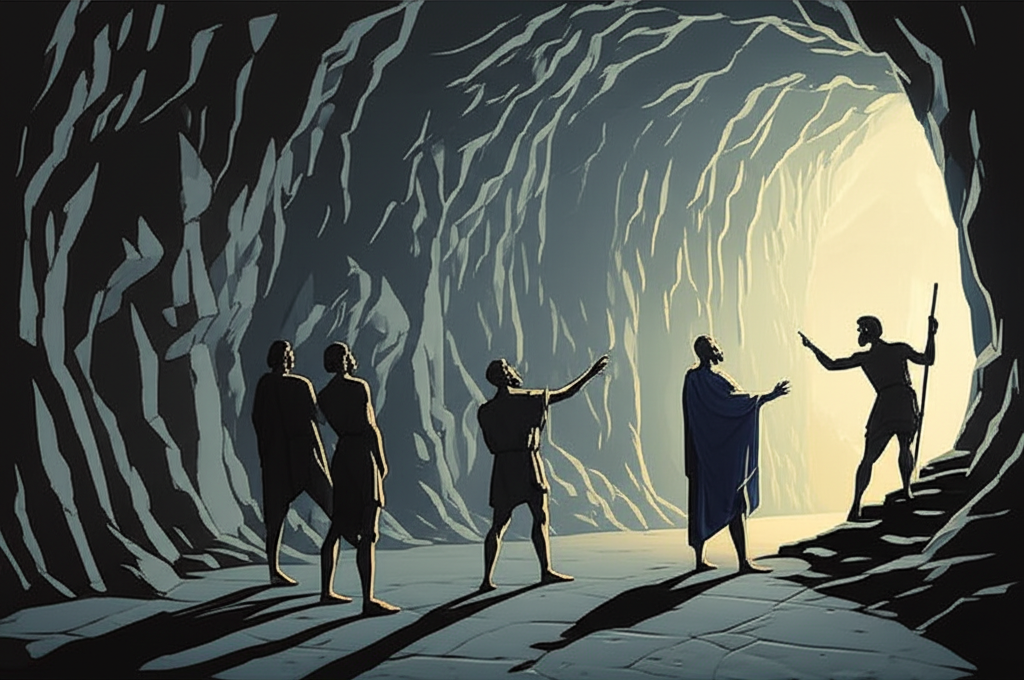
Euclid's Elements, another cornerstone of the Great Books, is a monumental example of this pursuit. Through a rigorous system of axioms, postulates, and logical deductions, Euclid constructed a geometry based on ideal Forms—points, lines, and planes—that exist not in the messy physical world, but in the realm of pure Idea. The Beauty of Euclid's work lies in the elegant progression from simple truths to complex theorems, each building upon the last with undeniable logical Form.
Symmetry, Proof, and the Harmony of Numbers
The diverse branches of Mathematics offer countless examples where this philosophical Beauty manifests.
- Symmetry: From the intricate patterns of a snowflake to the fundamental laws of physics, symmetry is a pervasive Form in both Mathematics and nature. Group theory, a branch of abstract algebra, rigorously studies the Idea of symmetry, revealing deep underlying structures.
- Elegant Proofs: A proof that is not only correct but also concise, insightful, and revelatory is often described as beautiful. It lays bare the logical skeleton of a truth, making its Form utterly transparent.
- Number Theory: The study of integers, particularly prime numbers, reveals astonishing patterns and relationships. The Riemann Hypothesis, one of the most famous unsolved problems in Mathematics, hints at a profound Beauty in the distribution of prime numbers, suggesting an underlying order yet to be fully grasped.
- Fractals: These infinitely complex patterns generated by simple rules demonstrate how intricate Beauty and Form can emerge from iterative mathematical Ideas.
This harmony, this intricate dance of numbers and Forms, speaks to a profound order that underlies not just our intellectual constructs but the very fabric of reality.
Mathematics as the Language of the Cosmos
Perhaps the most compelling argument for the Beauty of mathematical structures lies in their uncanny ability to describe the physical universe. From Newton's laws of motion to Einstein's theories of relativity, and from the quantum mechanics of the very small to the cosmological models of the very large, Mathematics provides the precise language through which we articulate and understand the universe.
That abstract Ideas and Forms conceived by the human mind—like differential equations or group symmetries—can so accurately model the behavior of galaxies, the flight of a projectile, or the properties of elementary particles, is a source of profound wonder. It suggests that the Beauty we perceive in mathematical structures is not merely a human construct, but a reflection of the inherent order and Form of the cosmos itself.
📹 Related Video: PLATO ON: The Allegory of the Cave
Video by: The School of Life
💡 Want different videos? Search YouTube for: ""Plato's Theory of Forms explained" and "The Unreasonable Effectiveness of Mathematics in the Natural Sciences philosophy""
A Glimpse into the Ineffable
The Beauty of mathematical structures offers more than intellectual pleasure; it provides a unique philosophical pathway. It is a testament to the power of abstract thought and a window into what might be considered the fundamental Forms and Ideas that constitute reality. In the elegance of a proof, the universality of a theorem, or the harmonious interconnectedness of its various branches, Mathematics reveals a profound and ineffable Beauty that resonates with our deepest philosophical inclinations, inviting us to contemplate the very nature of truth and existence.