

The Unseen Symphony: Contemplating the Beauty of Mathematical Structures
Summary: Beyond the mere utility of calculation, mathematics reveals a profound and often overlooked dimension of beauty. This article explores the philosophical underpinnings of why we perceive mathematical structures as beautiful, delving into concepts of perfect Form and eternal Idea. Drawing insights from the Great Books of the Western World, we argue that the elegance, symmetry, and universality inherent in mathematical principles resonate with our deepest aesthetic sensibilities, offering a glimpse into a realm of transcendent order.
Beyond Numbers: The Philosophical Allure of Mathematical Beauty
For many, mathematics conjures images of equations, complex calculations, or dry, abstract problems. Yet, for philosophers and mathematicians alike, it is a realm teeming with profound beauty. This isn't the fleeting beauty of a sunset or a painting, but something more fundamental, more enduring – a beauty rooted in clarity, truth, and an intrinsic elegance. It’s a beauty that speaks to the very structure of reality, echoing the ancient Greek admiration for harmony and proportion.
The experience of mathematical beauty often arises from:
- Elegance: A solution or proof that achieves its end with surprising simplicity and directness.
- Symmetry: The harmonious arrangement of parts, whether in geometry or abstract algebraic structures.
- Universality: Mathematical truths hold true regardless of culture, time, or individual perspective.
- Abstract Purity: Mathematical objects exist independently of physical manifestation, in a realm of pure thought.
- Interconnectedness: Seemingly disparate mathematical fields often reveal deep and unexpected relationships.
Platonic Ideals and the Mathematical Realm of Form
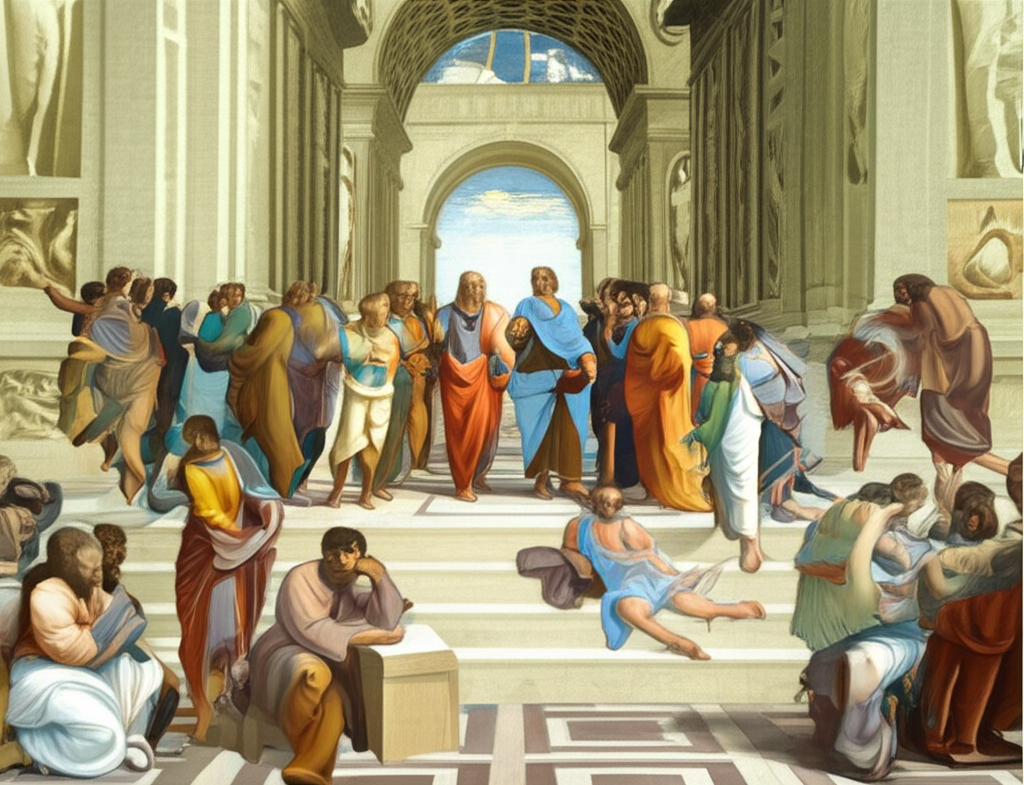
The notion that mathematical structures possess an inherent beauty finds its most compelling philosophical articulation in the works of Plato, a cornerstone of the Great Books of the Western World. For Plato, the physical world is but a shadow of a higher reality populated by perfect, eternal Forms or Ideas. A circle drawn in the sand is imperfect, but the Idea of a perfect circle – with every point equidistant from its center – exists immutably in this transcendent realm.
Mathematics, then, becomes the closest we can come to apprehending these perfect Forms. When we engage with geometry, for instance, we are not merely studying shapes; we are contemplating the pure Form of the triangle, the square, or the sphere. This is why Plato, in works like The Republic and Meno, emphasizes the study of mathematics as a crucial step in the philosopher's journey towards true knowledge and understanding of the good. The beauty we perceive in a perfectly executed geometric proof or a symmetrical mathematical pattern is, in this sense, a reflection of the beauty of the Forms themselves. It is a glimpse into an ordered, rational cosmos.
The Language of Form: Euclid and Axiomatic Elegance
The profound influence of mathematics on philosophical thought is perhaps best exemplified by Euclid's Elements, another monumental work from the Great Books of the Western World. Euclid's genius lay not just in his geometric discoveries, but in his revolutionary method of presenting mathematics as an axiomatic system. Starting from a few self-evident definitions, postulates, and common notions, he built an entire edifice of geometric theorems through rigorous logical deduction.
This axiomatic approach reveals a different facet of mathematical beauty: the beauty of logical coherence and intellectual rigor. The progression from simple truths to complex conclusions, each step perfectly justified, is an aesthetic experience in itself. It demonstrates how profound Ideas can be constructed from fundamental principles, creating a structure of undeniable validity and internal harmony. The Form of a proof, with its elegant flow and irrefutable conclusion, is as beautiful as the geometric shapes it describes.
Consider the following aspects of Euclidean elegance:
- Parsimony of Axioms: Starting with minimal assumptions.
- Logical Progression: Each proposition follows inevitably from those preceding it.
- Universal Applicability: Proofs hold true for any instance of the given figures.
- Clarity and Precision: Unambiguous definitions and statements.
The Enduring Appeal: Mathematics as a Source of Wonder
The beauty of mathematical structures transcends cultural boundaries and scientific disciplines. From the intricate patterns of fractals that mirror natural phenomena to the abstract elegance of group theory that underpins quantum physics, mathematics continually reveals an underlying order in the universe. It invites us to contemplate the nature of reality itself, prompting questions that have occupied philosophers for millennia: Is mathematics invented or discovered? Does its beauty reside in the human mind, or is it an inherent property of the cosmos?
Ultimately, the beauty of mathematics is a testament to the power of human reason and imagination to grasp eternal Forms and coherent Ideas. It offers a unique kind of aesthetic pleasure – an intellectual delight that resonates with our innate desire for order, truth, and understanding. It reminds us that even in the most abstract domains, there is a profound and captivating beauty waiting to be discovered.
YouTube: Plato's Philosophy of Mathematics
YouTube: The Beauty of Mathematical Proofs
📹 Related Video: What is Philosophy?
Video by: The School of Life
💡 Want different videos? Search YouTube for: "The Beauty of Mathematical Structures philosophy"