

The Aristocratic View of Honor: A Legacy of Virtue and Recognition
The concept of honor has long been a cornerstone of human societies, shaping individual conduct and collective values. However, its interpretation varies significantly across cultures and historical epochs. The aristocratic view of honor, rooted deeply in the philosophical traditions preserved within the Great Books of the Western World, presents a particularly rich and complex understanding. This perspective posits honor not merely as an internal feeling of self-worth, but as a public acknowledgment of one's adherence to specific virtues, a recognition bestowed by one's peers and society for embodying excellence and upholding the established custom and convention of a noble class. It is an intricate dance between inherent moral character and external validation, where one's reputation is inextricably linked to their perceived virtue and vice.
Defining Aristocratic Honor
At its core, the aristocratic view of honor is predicated on the idea of aristocracy itself – not simply as a ruling class by birth, but as a "rule by the best" (aristoi in Greek). For this elite, honor was the currency of their social standing, a testament to their inherent superiority and their commitment to societal well-being. It wasn't merely about wealth or power, but about the moral authority derived from exemplary conduct.
The Dual Nature of Honor: Internal Virtue, External Recognition
Aristocratic honor exists in a delicate balance between an internal state of being and external validation:
- Internal Virtue: True honor necessitated the cultivation of specific moral excellences. A person could not genuinely possess honor without embodying virtues such as courage, justice, wisdom, and temperance. This internal moral compass guided actions, dictating what was noble and what was base.
- External Recognition: Crucially, honor was also a public good, conferred by one's community. It manifested as fame, glory, and respect. To be honored was to be seen as worthy, to have one's deeds and character affirmed by those whose opinions mattered. Without this external dimension, even the most virtuous individual might lack "honor" in the aristocratic sense, as it implied a failure to manifest virtue in a publicly recognizable way.
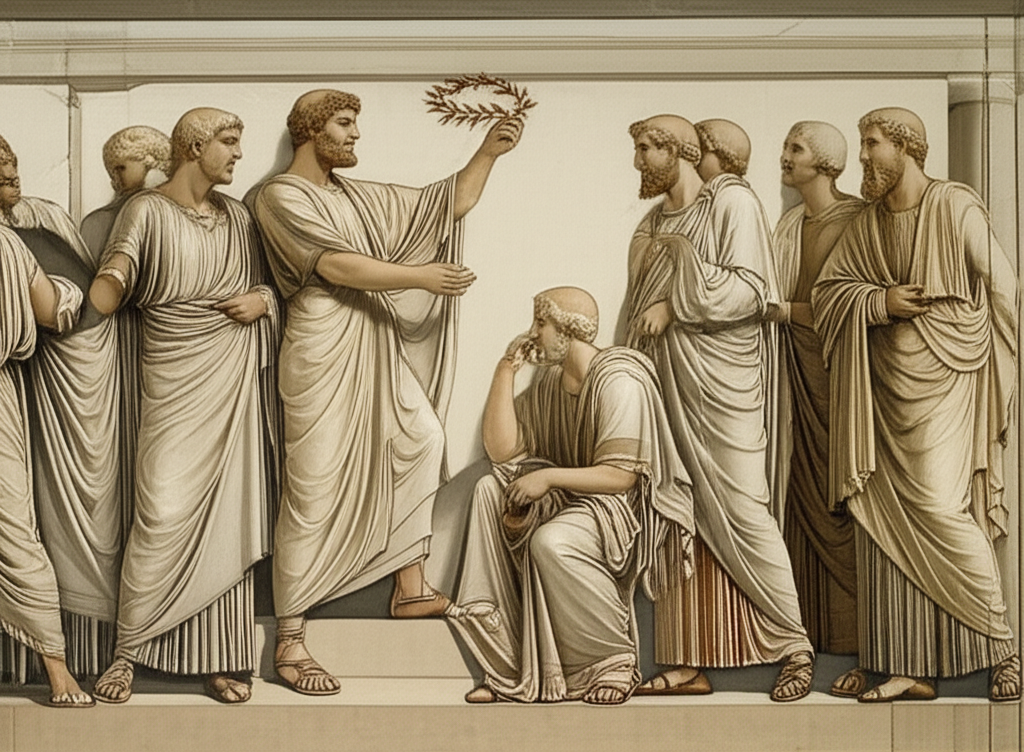
Virtue and Vice: The Moral Compass of Honor
The aristocratic code of honor was a strict moral framework, sharply delineating between virtue and vice. To act virtuously was to gain honor; to succumb to vice was to invite shame and disgrace, the antithesis of honor.
Key Virtues Associated with Aristocratic Honor
The Great Books frequently highlight specific virtues as essential for the honorable aristocrat:
- Courage (Andreia): Especially in battle or in defending one's community. This was paramount, as cowardice was deeply dishonorable.
- Justice (Dikaiosyne): Upholding laws and fairness, especially in their role as leaders or judges.
- Wisdom (Sophia/Phronesis): The ability to make sound judgments, particularly in governance and ethical dilemmas.
- Temperance (Sophrosyne): Self-control, moderation, and avoiding excessive indulgence.
- Magnanimity (Megalopsychia): Aristotle's "great-souled man," characterized by a proper sense of self-worth, generosity, and disdain for petty concerns.
- Integrity: Adherence to one's word and principles, even at great personal cost.
Conversely, vices like cowardice, treachery, impiety, and greed were seen as deeply dishonorable, leading to social ostracism and the loss of reputation. The fear of shame often served as a powerful motivator for virtuous conduct.
Custom and Convention: The Social Fabric of Honor
The aristocratic view of honor was not an abstract ideal but was deeply embedded in the custom and convention of a given society. These unwritten rules, traditions, and expectations dictated how honor was earned, maintained, and lost.
- Social Expectations: Specific behaviors were expected of the noble class. These included hospitality, patronage, eloquent speech, and participation in public life. Failure to meet these expectations could diminish one's standing.
- Rituals and Ceremonies: Public rituals, such as athletic games, debates, or military parades, provided arenas for demonstrating virtue and earning public acclaim. Awards, titles, and public acclamations were formalized ways of bestowing honor.
- Reputation (Kudos/Timē): Reputation was everything. A good name, passed down through generations, was a precious inheritance. Slander or insult was not merely a personal affront but an attack on one's honor and, by extension, on the honor of one's family and lineage. Duels or other forms of challenge were often mechanisms for restoring or defending honor.
- Lineage and Heritage: While honor was earned through individual action, it was also inherited. To be born into a noble family meant inheriting a legacy of honor, which one was then obligated to uphold and enhance. Disgrace brought shame upon the entire lineage.
The Enduring Legacy
The aristocratic view of honor, while tied to specific social structures, offers profound insights into the human desire for recognition, the societal enforcement of moral codes, and the intricate relationship between individual character and public perception. Philosophers from Plato and Aristotle to Cicero explored these dynamics, recognizing that for an aristocracy to truly rule by being "the best," its members must embody the highest ideals of honor, grounded in virtue and upheld by custom and convention. This legacy continues to inform our understanding of leadership, moral responsibility, and the complex nature of reputation in any society that values excellence.
YouTube Video Suggestions:
-
📹 Related Video: ARISTOTLE ON: The Nicomachean Ethics
Video by: The School of Life
💡 Want different videos? Search YouTube for: "Aristotle Nicomachean Ethics Honor Virtue"
2. ## 📹 Related Video: PLATO ON: The Allegory of the Cave
Video by: The School of Life
💡 Want different videos? Search YouTube for: "Plato Republic Aristocracy Justice Honor"