

The Cultivation of Excellence: Exploring the Aristocratic View of Education
The aristocratic view of education, deeply rooted in classical philosophy, posits that its primary purpose is not vocational training but the cultivation of moral character, intellectual virtue, and civic leadership. Emphasizing Honor, adherence to Custom and Convention, and a broad liberal arts curriculum, this educational paradigm sought to forge individuals capable of wise governance and a life lived in accordance with virtue, as illuminated by thinkers from the Great Books of the Western World. It is a vision where learning is intrinsically linked to the development of the whole person, preparing them not just for a profession, but for a life of meaningful contribution and moral rectitude.
Introduction: Beyond Mere Instruction
When we speak of Aristocracy, we often conjure images of inherited privilege and power. However, at its philosophical core, the term (from Greek aristokratia) refers to "the rule of the best." This ideal of "the best" was not merely about birthright, but about the cultivation of excellence—moral, intellectual, and physical. Consequently, the Education of these "best" individuals was seen as paramount, a rigorous process designed to imbue them with the virtues necessary for leadership and the responsible exercise of power. This was an education that transcended the practicalities of daily life, aiming instead for the elevation of the human spirit and the refinement of character.
The Philosophical Bedrock: Plato and Aristotle
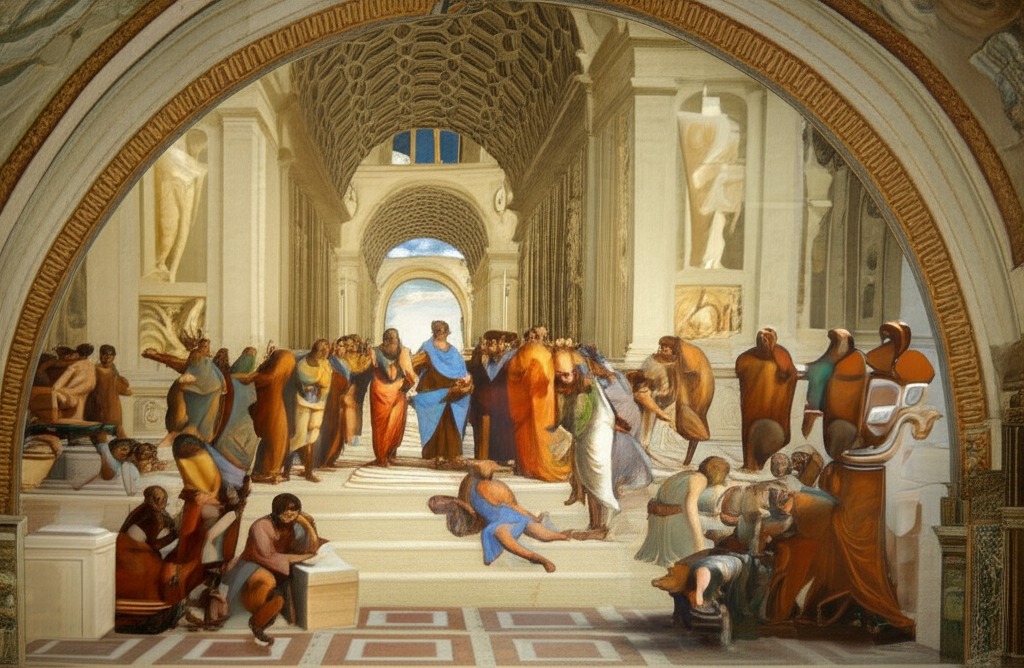
The foundations of the aristocratic view of education are most profoundly articulated in the works of Plato and Aristotle, central figures in the Great Books of the Western World. Their writings reveal a shared conviction that education is the crucible in which the ideal citizen, and indeed the ideal state, is forged.
Education for the Soul, Not Just the Skill
Plato, in his Republic, outlines an elaborate educational system for his guardian class, the philosopher-kings. Their rigorous training, spanning decades, moves from gymnastics and music to mathematics, astronomy, and ultimately, philosophy and dialectic. The goal is not to train them for a specific trade, but to turn their souls towards the Good, to enable them to perceive truth and justice. This is an education of the soul, designed to produce individuals whose reason governs their spirit and appetites, making them fit to rule wisely and justly.
The Pursuit of Arete: Excellence and Virtue
Aristotle, in his Politics and Nicomachean Ethics, reinforces this perspective. For him, the purpose of education is to foster arete, or excellence, leading to eudaimonia, a flourishing life. He argues that citizens must be educated for the specific constitution under which they live. In an ideal state, education would cultivate moral virtues (like courage, temperance, justice) through habituation and intellectual virtues (like wisdom, understanding) through instruction. The liberal arts, for Aristotle, were those studies worthy of a free person, not for their utility in earning a living, but for their role in perfecting the intellect and character.
The Curriculum of Cultivation: A Holistic Approach
The aristocratic educational model was inherently holistic, recognizing that true leadership and virtue required the development of every facet of the human person.
Liberal Arts as Liberation
The curriculum was heavily weighted towards what we now call the liberal arts, understood as subjects that liberate the mind.
- Grammar, Rhetoric, Logic: For clear thought and persuasive communication.
- Mathematics, Astronomy, Music: For developing abstract reasoning and appreciating order and harmony.
- Philosophy: For understanding fundamental truths about existence, knowledge, values, reason, mind, and language.
These disciplines were not vocational; they were designed to cultivate critical thinking, ethical reasoning, and a broad understanding of the world, essential for those expected to govern.
The Discipline of Body and Mind
Physical training (gymnastics) was equally important, not just for health, but for instilling discipline, courage, and resilience. The well-ordered body reflected a well-ordered soul. This balance between physical and intellectual development underscored the belief that a sound mind in a sound body was crucial for the virtuous citizen.
Honor as the Guiding Star
Central to the aristocratic educational ethos was the concept of Honor. For the educated elite, honor was not merely reputation, but an intrinsic sense of worth and a powerful motivator for virtuous action.
The Weight of Reputation and Duty
An individual's honor was deeply intertwined with their adherence to ethical principles and their commitment to civic duty. The fear of dishonor served as a potent check on misconduct, while the pursuit of honor spurred individuals to acts of courage, justice, and wisdom. Education reinforced this by emphasizing historical examples of honorable conduct and the philosophical justifications for virtuous living. To betray one's education was to betray one's honor and, by extension, one's community.
Leading by Example
The educated aristocrat was expected to be a moral exemplar, a beacon of virtue for society. This expectation of leading by example was a direct outcome of their specialized Education, which instilled a profound sense of responsibility. Their actions were not just their own; they reflected on their family, their lineage, and the very ideals of their social standing.
Custom and Convention: The Unseen Teachers
While formal education provided the intellectual framework, Custom and Convention played an equally vital, albeit often unspoken, role in shaping the aristocratic individual. These were the established norms, traditions, and unwritten rules that guided behavior, social interaction, and expectations.
Shaping the Citizen
- Socialization: Education extended beyond the classroom into the daily life of the community, where established customs dictated proper conduct, decorum, and social hierarchy.
- Civic Participation: Conventions dictated the appropriate forms of participation in public life, from debates in the assembly to religious ceremonies.
- Moral Framework: Many moral precepts were embedded in custom, shaping an individual's sense of right and wrong from an early age, complementing the philosophical ethics taught in schools.
These customs provided a stable moral and social environment, ensuring continuity and reinforcing the values that the formal Education sought to impart. They were the practical application of philosophical ideals in everyday life.
The Inheritance of Wisdom
The adherence to Custom and Convention was seen not as blind conformity, but as a respect for the inherited wisdom of past generations. It was believed that these traditions had been refined over time and represented the accumulated knowledge of what constituted a good and stable society. Education, therefore, also involved learning to navigate and uphold these societal structures.
Enduring Echoes in Modern Thought
While the overt Aristocracy of ancient Greece and Rome has largely faded, the philosophical underpinnings of their educational ideals continue to resonate. The emphasis on character formation, critical thinking, and the pursuit of knowledge for its own sake—rather than purely utilitarian ends—remains a powerful counter-narrative to purely vocational or economic models of education. It prompts us to consider what kind of individuals we wish to cultivate and what purpose education truly serves in a flourishing society.
Conclusion: A Legacy of Virtue
The aristocratic view of education, as presented in the Great Books of the Western World, offers a profound vision of human development. It is an Education dedicated to the cultivation of excellence, guided by Honor, and deeply embedded in Custom and Convention. Far from being merely a system for preserving privilege, it represents a philosophical commitment to nurturing individuals capable of wisdom, justice, and courageous leadership—a legacy that continues to challenge and inspire our understanding of what it means to be truly educated.
**## 📹 Related Video: PLATO ON: The Allegory of the Cave
Video by: The School of Life
💡 Want different videos? Search YouTube for: ""Plato's Republic Education" or "Aristotle on Virtue and Education""**