

The Aesthetics of Quantity and Form: Unraveling the Architecture of Beauty
Summary: The perception of Beauty is not merely subjective fancy; it is deeply rooted in the objective interplay of Quantity and Form. This article explores how philosophers, from ancient Greeks to Enlightenment thinkers, have grappled with the idea that the harmonious arrangement of parts (Form) and their appropriate measure (Quantity) are fundamental to our aesthetic experience, revealing the underlying principles that govern what we find pleasing, sublime, or simply beautiful.
Introduction: The Enduring Question of Beauty's Structure
For centuries, thinkers have pondered the elusive nature of Beauty. Is it truly in the eye of the beholder, or are there universal principles that guide our aesthetic judgments? Drawing from the profound insights preserved within the Great Books of the Western World, we find a persistent thread: the notion that Beauty is inextricably linked to discernible structures. Specifically, this exploration delves into the profound relationship between Quantity – the measure, extent, or number of elements – and Form – the arrangement, shape, and organization of those elements. It is within their delicate, often mathematically precise, interplay that the true Aesthetics of our world are revealed.
The Ancient Roots: Proportion, Harmony, and Ideal Forms
The philosophical journey into Aesthetics often begins with the Greeks, whose meticulous inquiries laid the groundwork for understanding Beauty as something more than mere sensation.
Plato's Ideal Forms and Mathematical Precision
Plato, with his theory of Forms, suggested that true Beauty resides in an ideal, non-physical realm, and that the beautiful objects we perceive in our world are but imperfect reflections of these perfect archetypes. For Plato, these ideal Forms possessed inherent mathematical properties. A beautiful object, therefore, participates in this ideal Form through its Form and Quantity – its proportions, symmetry, and internal coherence. The Beauty of a perfect circle or an equilateral triangle, for instance, is not arbitrary but derived from its inherent mathematical Form and balanced Quantity.
Aristotle on Magnitude and Arrangement
Aristotle, in his Poetics, directly addresses the conditions for Beauty in artistic creations. He posited that for something to be beautiful, it must have a proper magnitudos (quantity or size) and taxis (arrangement or form).
He articulated this with remarkable clarity:
"To be beautiful, a living creature, and every whole made up of parts, must not only present a certain order in its arrangement of parts, but also be of a certain definite magnitude. Beauty is a matter of size and order..."
This statement underscores the critical necessity of both elements:
- Quantity: The object must be of a size that can be apprehended as a whole – neither too small to be seen distinctly nor too large to be grasped in a single perception.
- Form: The parts must be arranged in a coherent, orderly fashion, contributing to a unified whole.
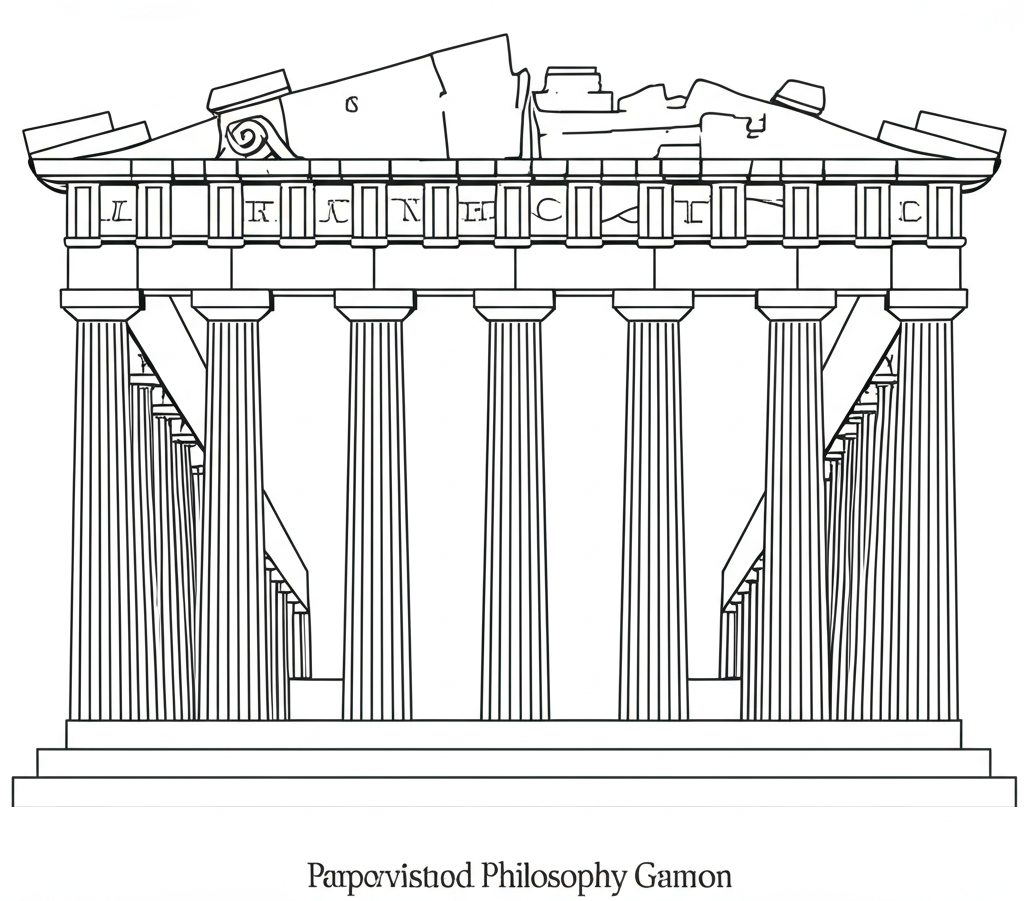
Quantity: The Dimension of Aesthetic Impact
Quantity, in an aesthetic context, is more than just measurement; it's about the scale, multiplicity, and extent that evoke particular responses.
- Scale and the Sublime: Edmund Burke, in his A Philosophical Enquiry into the Origin of Our Ideas of the Sublime and Beautiful, explored how immense Quantity – vastness, towering heights, boundless expanses – can transcend mere Beauty to evoke the sublime. Here, Quantity overwhelms, producing awe and even a delightful terror. Think of a colossal mountain range or the infinite night sky; their sheer Quantity of space and elements is central to their aesthetic power.
- Multiplicity and Intricacy: Conversely, an abundance of fine detail, an intricate network of small parts, can create a different kind of Beauty. The Quantity of individual elements, meticulously arranged, contributes to a rich and engaging aesthetic experience, as seen in a Baroque painting or a complex fractal pattern.
- The "Just Right" Quantity: Aristotle's point about appropriate magnitude remains crucial. A melody can be too short to develop its theme or too long to sustain interest. A building can be too small to convey grandeur or too vast to feel human-scaled. The Beauty often lies in the Goldilocks zone – the Quantity that feels perfectly balanced for its intended Form.
Form: The Architect of Perception and Meaning
While Quantity provides the raw material or scale, Form is the organizing principle, the structure that allows us to perceive, understand, and appreciate.
- Structure and Arrangement: Form dictates how the individual parts (quantities) are assembled. This includes:
- Symmetry: Balanced distribution of elements.
- Rhythm: Repetition and variation of elements over time or space.
- Unity: How disparate elements cohere into a single, meaningful whole.
- Contrast: The juxtaposition of elements to create visual or conceptual interest.
- Kant's Formal Aesthetics: Immanuel Kant, in his Critique of Judgment, emphasized the importance of Form in judgments of Beauty. For Kant, pure aesthetic pleasure arises from the harmonious free play of our cognitive faculties when we apprehend an object's Form, independent of any concept or purpose. The Beauty of a flower, for instance, is appreciated for its intricate Form and delicate proportions, not for its biological function.
- The intelligibility of Form: Without Form, Quantity is mere chaos. A pile of bricks, no matter how numerous, lacks the Beauty of a meticulously constructed wall. It is the Form – the pattern, the design, the arrangement – that transforms raw Quantity into something aesthetically meaningful.
The Inseparable Interplay: Where Quantity Meets Form
The true magic of Aesthetics emerges not from Quantity or Form in isolation, but from their dynamic and often interdependent relationship.
Consider the following examples:
| Aesthetic Domain | Example | Role of Quantity | Role of Form |
|---|---|---|---|
| Architecture | A Gothic Cathedral | Immense scale, countless intricate details, vast space | Soaring arches, ribbed vaults, precise geometric layouts |
| Music | A Symphony | Duration of notes, number of instruments, tempo | Melodic lines, harmonic progressions, thematic structure |
| Poetry | A Sonnet | Number of lines, syllables per line, stanza count | Rhyme scheme, meter, thematic development |
| Visual Arts | A Renaissance Painting | Number of figures, areas of color, depth of field | Composition, perspective, balance, light and shadow |
In each instance, the Quantity provides the raw material, the potential, while the Form provides the structure, the order, and the meaning. A symphony's Beauty isn't just its duration (quantity) or its individual notes (quantities), but how those notes are arranged into themes, movements, and harmonies (form). The grandeur of a cathedral is not just its sheer size (quantity), but how that size is articulated through its architectural Form – the rhythm of its arches, the verticality of its spires.
This profound interdependence demonstrates that Beauty is often a function of fittingness: the right Quantity expressed through the right Form, and vice versa. It is this delicate balance that elevates mere existence to aesthetic significance.
Conclusion: Reflecting on the Architecture of Beauty
The exploration of The Aesthetics of Quantity and Form reveals a fundamental truth about our perception of Beauty: it is not simply an arbitrary response but an engagement with the underlying order of the world. From the mathematical harmonies cherished by Plato to Aristotle's insistence on proper magnitude and arrangement, and Kant's emphasis on formal judgments, the philosophical tradition consistently points to the structural elements that inform our aesthetic experiences.
As Henry Montgomery, I invite you to observe the world around you with a renewed appreciation for this interplay. Notice how the vastness of an ocean (quantity) is given meaning by the curve of the horizon (form), or how the myriad leaves of a tree (quantity) are organized into the distinctive shape of its canopy (form). In understanding the relationship between Quantity and Form, we gain a deeper insight into the enduring principles that govern Beauty itself, enriching our appreciation for the intricate architecture of existence.
YouTube Video Suggestions:
-
📹 Related Video: PLATO ON: The Allegory of the Cave
Video by: The School of Life
💡 Want different videos? Search YouTube for: "Plato's Theory of Forms and Beauty"
-
📹 Related Video: KANT ON: What is Enlightenment?
Video by: The School of Life
💡 Want different videos? Search YouTube for: "Kant's Aesthetics and the Judgment of Beauty Explained"