

In wrapping up this journey through Plato Re-Imagined, let’s reflect on the essence of Socratic ethics: the pursuit of the ultimate Good. For Socrates, the quest for truth wasn’t just an intellectual exercise—it was a way of life aimed at understanding and aligning with a higher principle. His relentless questioning wasn’t about tearing down ideas but building a path to the Good, which he saw as a moral compass guiding both our actions and our understanding of the world.
This vision is vividly captured in his famous assertion, "The unexamined life is not worth living" (Apology, 38a). This idea challenges us today more than ever, asking us to consider whether we live with intention and strive for integrity. In a world filled with distractions and half-truths, the pursuit of the Good becomes a radical act of self-awareness and commitment. How often do we pause to question whether our choices align with our deeper values?
If the pursuit of wisdom and the Good intrigues you, consider participating in the planksip community at planksip.org. Here, the personification of Plato invites readers to explore these enduring questions together, making ancient wisdom a living conversation rather than a dusty relic of the past.
From the Archives of Ancient Greece: Featuring Dr. Michael Sugrue
This week, Dr. Michael Sugrue focuses on the core of Socratic ethics in his reflections on Plato’s Republic. Sugrue emphasizes that, for Socrates, philosophy was about the relentless pursuit of the Good, a principle that guided every action and decision. Sugrue’s interpretation reminds us that Socrates wasn’t merely a critic or skeptic; he was a philosopher committed to living out the highest ideals.
Sugrue uses the metaphor of the "Divided Line" (Republic, 509d-511e) to illustrate how Socrates viewed the journey towards the Good. This metaphor divides human understanding into four levels, ascending from illusion to rational insight, and ultimately to the vision of the Good. Sugrue points out that this isn’t just an abstract philosophical concept—it’s a call to live intentionally and seek clarity in our understanding of what is right.
The practical implications of this are profound. Imagine navigating a complex workplace decision. Rather than taking the easiest route or following popular opinion, the Socratic approach would involve questioning assumptions, seeking out principles that lead to justice, and acting with integrity. This type of engagement is at the heart of planksip, where members challenge themselves and each other to think deeply about the values they live by.
Insights from the Dialogues: Quoting Plato
Plato’s Republic gives us a powerful framework for understanding the pursuit of the Good through Socrates’ philosophical dialogues. One of the key passages that illustrates this is the "philosopher’s love of the Good," found in Republic 504b-509b. Here, Socrates emphasizes that true lovers of wisdom are not satisfied with mere knowledge—they desire to align their lives with a higher, objective Good.
Take, for example, the role of a judge. A wise judge does not only seek to understand the facts of the case but to render a judgment that aligns with the deeper principles of justice. This alignment with the Good is not just about fairness; it’s about embodying an ideal that transcends individual circumstances. This idea extends beyond professions—whether you’re a parent, a leader, or a student, the pursuit of the Good demands reflection, empathy, and a commitment to something greater than oneself.
These dialogues aren’t just ancient teachings; they’re blueprints for living well. The community at planksip engages with these ideas not as abstract theories but as practical principles for navigating the complexities of modern life. If you’re eager to dive deeper into these teachings, we invite you to join the discussion and contribute your own reflections.
Chance and Fate: Exploring Ancient Games
In ancient Greece, games of chance were not merely recreational—they were symbolic rituals reflecting life’s uncertainties and the role of fate. Knucklebones, one of the earliest known games, required skill but also involved an element of unpredictability. This blend of agency and fate echoed the philosophical ideas of Socrates, who taught that while we can control our intentions and actions, the outcomes often lie beyond our grasp.
Consider how this metaphor applies to modern life. Think of a business owner launching a new venture. They can strategize, plan, and make informed decisions, but market conditions, customer preferences, and unforeseen events introduce a level of uncertainty that cannot be completely eliminated. The key is to act with wisdom, understanding that not everything is under our control—a concept Socrates would deeply resonate with.
Explore the Mystical World of Astraguli: Ancient Games of Chance with Cultural Significance.
The members of planksip frequently draw connections between ancient rituals and contemporary challenges, exploring how philosophical wisdom can guide our responses to uncertainty. By reflecting on the games of chance played by the Greeks, we gain insights into the delicate balance between intention and outcome in our own lives. Join us in exploring these ancient metaphors and consider how they resonate with your own experiences.
Virtues Revisited: Practical Lessons for Today
This week’s virtue is Wisdom. For Socrates, wisdom was not merely the accumulation of knowledge but a deeper understanding of one’s own ignorance and a commitment to seeking the Good. It was the guiding principle behind every action and moral decision—a principle that, when applied, leads to a life of integrity and purpose.
Think of a leader faced with a critical decision in a moment of crisis. A wise leader doesn’t rush to action based on superficial information or popular opinion; instead, they reflect on what serves the greater Good. They consider the long-term implications and potential consequences, aligning their choices with principles of justice, courage, and temperance. This is the essence of Socratic wisdom: the ability to discern the right course of action, even when it’s not the easiest or most obvious.
In today’s world, where the rush to judgment and the pressure to conform are ever-present, the value of wisdom cannot be overstated. At planksip, we revisit these ancient virtues not as relics of the past but as practical guides for modern life. By engaging in reflective discussions and challenging our assumptions, we strive to cultivate wisdom in our daily choices.
Engage with Us: Reader’s Corner
As we conclude this journey through Plato Re-Imagined, we want to hear from you. How has the exploration of Socratic ethics and the pursuit of the Good influenced your understanding of life? What new questions or perspectives have emerged for you through engaging with these teachings?
We invite you to share your thoughts at planksip.org, where a living community of readers and thinkers continues to explore these timeless questions. By joining the conversation, you contribute to the ongoing legacy of philosophical inquiry—a legacy that, like Plato’s dialogues, challenges us to live thoughtfully and intentionally.
Closing Reflection: Socrates’ Enduring Legacy
Socrates’ philosophy wasn’t about winning arguments or achieving intellectual dominance—it was about aligning one’s life with the ultimate Good. His teachings remind us that philosophy isn’t confined to the classroom or the written word; it’s a way of living, a commitment to pursuing truth, justice, and wisdom in every aspect of life.
As we wrap up this final week, let’s remember that the search for the Good is a lifelong journey. It’s not about perfection, but about striving to live with intention, humility, and courage. Socrates’ words still resonate today: "To know the Good is to do the Good." Let that be the guiding principle in your own life as you continue to explore the richness of these ancient teachings.
We hope you’ve enjoyed this journey with Plato Re-Imagined. Join us at planksip to continue the conversation, explore new ideas, and connect with others who share a passion for wisdom and the pursuit of the Good.
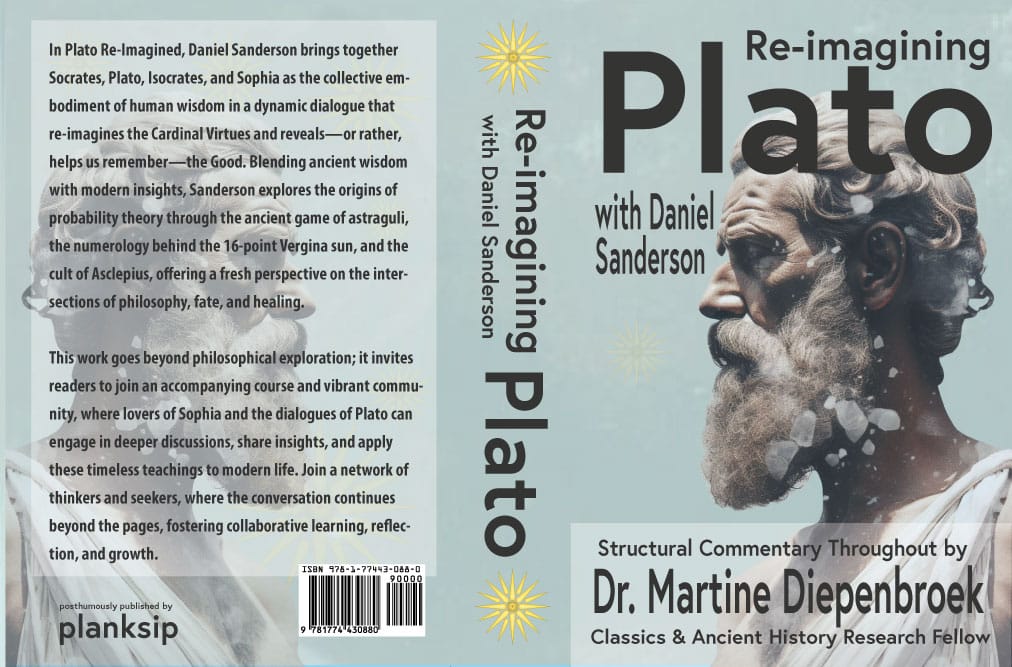
Plato Re-Imagined
This course offers 32 comprehensive lectures exploring most of Plato's dialogues. These lectures guide students toward a consilient understanding of the divine—a concept that harmonizes knowledge across disciplines and resonates with secular and religious leaders. As a bonus, Lecture #33 focuses on consilience, demonstrating how different fields of knowledge can converge to form a unified understanding.


