

Prophecy and the Knowledge of the Future: A Philosophical Inquiry
The human fascination with the future is as ancient as consciousness itself. From the cryptic pronouncements of oracles to the fervent declarations of prophets, humanity has consistently sought glimpses beyond the veil of the present. This article delves into the profound philosophical implications of prophecy and its audacious claim to knowledge of what is yet to come, exploring how different traditions grapple with the nature of time, fate, and divine intervention. We will examine the tension between foreknowledge and free will, the role of religion in shaping our understanding of prophecy, and the enduring questions it poses to our very concept of knowing.
The Allure of Foreknowledge: A Summary
Prophecy, understood as the divinely inspired or supernaturally informed prediction of future events, stands as a persistent challenge to our conventional understanding of time and causality. It compels us to confront whether the future is predetermined, whether true knowledge of it is attainable, and what such knowledge would imply for human agency and moral responsibility. Across diverse religious and philosophical traditions, the concept of prophecy has profoundly shaped worldviews, revealing a deep-seated human yearning for certainty in an uncertain world.
Unveiling the Enigma of Prophecy
What exactly constitutes prophecy? Is it merely an educated guess, a profound intuition, or a genuine insight into events yet to unfold? Historically, prophecy has been framed as a communication from a higher power or an extraordinary faculty possessed by select individuals. The Old Testament, a cornerstone of the Great Books of the Western World, is replete with accounts of prophets like Moses, Isaiah, and Jeremiah, whose pronouncements were understood as direct messages from God, often serving as warnings, promises, or revelations of divine will. These narratives establish prophecy not just as prediction, but as a crucial element of divine-human interaction and the unfolding of sacred history.
- Prophecy as Divine Utterance: In many religious contexts, prophecy is inextricably linked to revelation, suggesting a source of knowledge beyond human empirical observation or rational deduction.
- The Challenge to Linear Time: If the future can be known, does this not imply a non-linear understanding of time, where all moments potentially coexist or are accessible to a higher consciousness? This question profoundly impacts our perception of past, present, and future as distinct entities.
Ancient Voices on Future Knowledge
Philosophers and theologians throughout history have grappled with the implications of prophecy.
1. Greek Oracles and Socratic Wisdom:
Ancient Greece saw the prominence of oracles, particularly the Oracle of Delphi, whose cryptic pronouncements influenced kings and commoners alike. Plato, in works like Phaedrus, discusses divine madness and inspiration, suggesting a state where human reason is surpassed by a higher form of insight. Socrates, famously guided by his daimonion (a divine sign or inner voice), exemplifies a different kind of prophetic guidance – not necessarily predicting specific events, but indicating what not to do, thereby subtly shaping the future through moral discernment.
2. Aristotle and the Contingency of Future Truths:
Aristotle, in On Interpretation, delves into the logical problems of statements about future contingent events. He famously pondered whether the statement "There will be a sea-battle tomorrow" is true or false now. If it is true now, then the sea-battle is fated to occur, implying a deterministic universe. If it is neither true nor false, then the future remains open, preserving contingency and human freedom. This philosophical dilemma highlights the profound tension between foreknowledge and free will, a central theme in debates surrounding prophecy.
3. Augustine on Divine Foreknowledge and Free Will:
Centuries later, Augustine of Hippo, a pivotal figure in the Great Books, meticulously explored this problem in City of God. He argued that God's perfect foreknowledge does not negate human free will. For Augustine, God knows what we will freely choose, but does not cause our choices. This subtle distinction attempts to reconcile divine omniscience with human moral responsibility, a cornerstone of Christian theology and its understanding of prophecy.
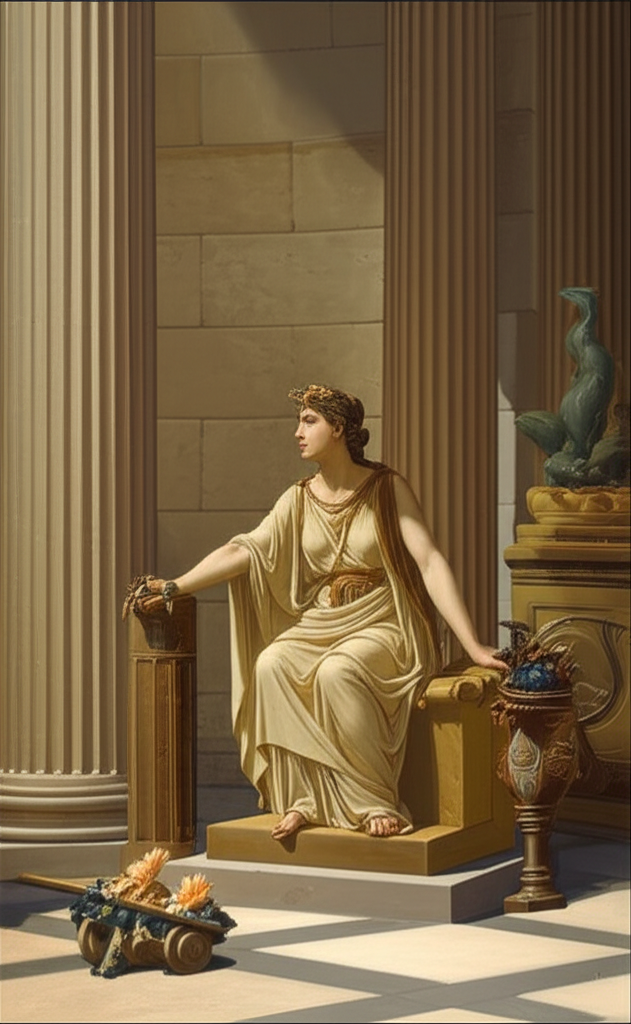 seated on a tripod, inhaling vapors from a chasm, with a supplicant figure kneeling before her, while attendants transcribe her obscure pronouncements on scrolls. The scene is set within an ancient Greek temple ruin under a dramatic sky, emphasizing both the mystical and the historical weight of prophecy.)
The Philosophical Crossroads: Determinism vs. Freedom
The existence of genuine prophecy forces us to confront fundamental questions about the nature of reality:
| Aspect of Prophecy | Philosophical Implication | Related Concepts |
|---|---|---|
| Foreknowledge | Implies a predetermined future, where events are fixed. | Determinism, Fatalism, Divine Omniscience |
| Divine Source | Suggests a universe governed by a higher power or plan. | Theism, Providence, Teleology |
| Human Reception | Raises questions about human capacity for extraordinary knowledge and intuition. | Revelation, Inspiration, Intuition, Mysticism |
| Impact on Action | If the future is known, does it diminish the significance of present choices? | Free Will, Moral Responsibility, Agency |
If the future is truly knowable through prophecy, does it render our striving meaningless? The very act of seeking knowledge typically implies an open future, where understanding empowers us to act more effectively. Yet, if the future is already written, what purpose does this pursuit serve? This paradox underscores the deep philosophical unease that prophecy can engender.
The Enduring Quest for Certainty
Despite the logical quandaries, the human desire for certainty about the future remains potent. In times of crisis, uncertainty, or profound personal decisions, the allure of prophecy—whether from ancient texts, modern psychics, or personal omens—persists. This yearning speaks to a fundamental human need for meaning, control, and reassurance in the face of the unknown. Prophecy, regardless of its verifiable accuracy, offers a narrative, a potential roadmap, or at least a framework for understanding one's place within a larger, unfolding story. It provides a lens through which to interpret events, often imbuing them with deeper religious or cosmic significance.
Conclusion: A Future Unfolding
Prophecy and the knowledge of the future present a fascinating and enduring philosophical challenge. It pushes the boundaries of our understanding of time, causality, and the very nature of knowledge. While religious traditions often embrace prophecy as a testament to divine power and a guide for human conduct, philosophy continuously dissects its implications for free will, determinism, and the logical coherence of a knowable future. As we navigate our own unfolding lives, the questions posed by prophecy remain relevant, inviting us to ponder not just what the future holds, but what it means to truly know it, and how such knowledge shapes our present existence.
📹 Related Video: What is Philosophy?
Video by: The School of Life
💡 Want different videos? Search YouTube for: ""free will vs determinism philosophy explained""
📹 Related Video: What is Philosophy?
Video by: The School of Life
💡 Want different videos? Search YouTube for: ""philosophy of time A-series B-series""