

Prophecy and the Knowledge of the Future
The Enduring Enigma of What's to Come
Summary: The human fascination with the future is as old as consciousness itself. This article delves into the profound philosophical questions surrounding prophecy and its implications for our understanding of time, religion, and the very nature of knowledge. Drawing on the rich intellectual heritage of the Great Books of the Western World, we explore how ancient seers, religious texts, and philosophical inquiries have grappled with the possibility of foreknowledge, the tension between divine foresight and human free will, and the epistemological challenges of verifying claims about events yet to unfold. From the oracles of Delphi to the theological debates of medieval scholars, the quest to comprehend the future remains a cornerstone of our intellectual and spiritual journey.
Introduction: Peering Beyond the Veil
From the earliest campfire stories to the most complex theological treatises, humanity has consistently sought to understand, predict, and perhaps even control the future. This deep-seated desire manifests most profoundly in the concept of prophecy—a form of foreknowledge often attributed to divine inspiration or transcendent insight. Unlike mere prediction, which relies on empirical data and logical inference, prophecy often carries the weight of revelation, challenging our conventional understanding of time and the limits of human knowledge.
Our journey through this intricate subject will navigate the philosophical landscape shaped by millennia of thought. We will examine how prophecy has been defined, its relationship with religious belief, and the fundamental questions it poses about destiny, free will, and the very structure of reality. The Great Books offer a magnificent tapestry of perspectives, from the tragic inevitability of fate in Greek drama to the complex theological arguments for divine omniscience and human responsibility.
1. The Lure of Foresight: Defining Prophecy
To grasp the philosophical weight of prophecy, we must first distinguish it from its mundane cousins.
Prophecy vs. Prediction: A Crucial Distinction
While both prophecy and prediction aim to reveal future events, their methodologies and sources differ dramatically.
- Prediction typically relies on observable patterns, scientific laws, logical deduction, or statistical probability. A meteorologist predicts weather; an economist forecasts market trends. These are grounded in empirical observation and reasoned inference.
- Prophecy, conversely, traditionally transcends such empirical bounds. It implies a direct apprehension of future events, often through a non-rational, spiritual, or divine channel. It's less about calculating probabilities and more about receiving revelation. Think of the pronouncements of ancient oracles or biblical prophets; their authority derives not from their analytical prowess but from their perceived connection to a higher source of knowledge.
The Divine Connection: Prophecy and Religion
Historically, prophecy is almost inextricably linked to religion. Across diverse cultures and spiritual traditions, prophets have served as intermediaries between the divine and humanity.
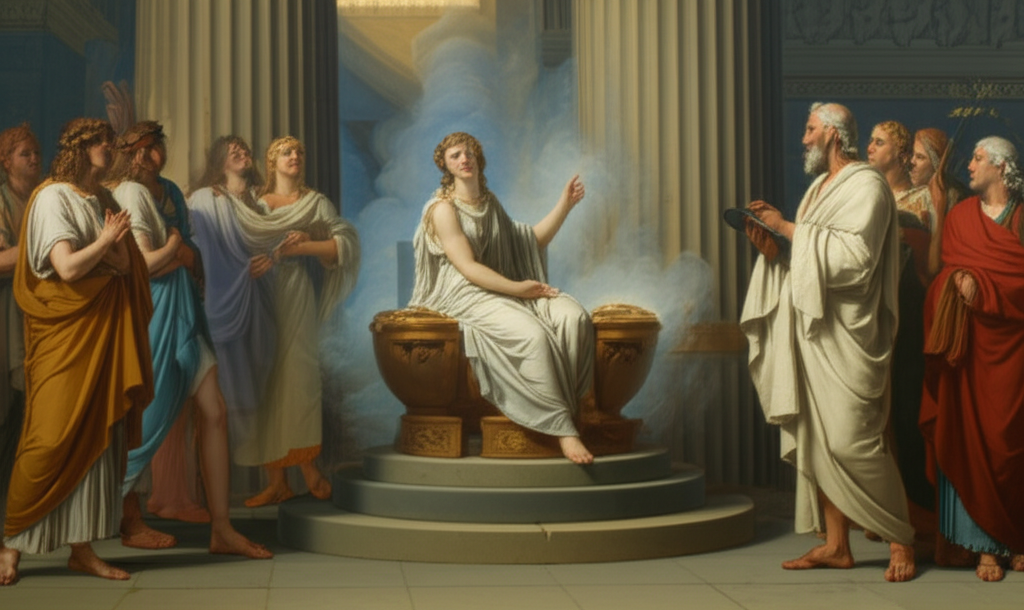
- In ancient Greece, the Oracle of Delphi spoke for Apollo, offering cryptic pronouncements that shaped political and personal destinies.
- In the Abrahamic religions (Judaism, Christianity, Islam), prophets like Moses, Isaiah, and Muhammad delivered messages believed to be directly from God, often foretelling events, issuing warnings, or revealing divine will.
This religious dimension imbues prophecy with immense authority and moral weight, transforming it from a mere statement about the future into a profound expression of divine governance and purpose. The knowledge conveyed through prophecy is thus not merely factual but often deeply ethical and spiritual.
2. Prophecy, Time, and Determinism
The existence of prophecy immediately thrusts us into profound questions about the nature of time and the perennial debate between free will and determinism.
Linear vs. Cyclical Time: Ancient Perspectives
Different conceptions of time have shaped how prophecy is understood:
- Cyclical Time: Many ancient cultures, including some Greek philosophies and Eastern traditions, viewed time as a repeating cycle. In such a framework, prophecy might reveal patterns that are destined to recur, or the unfolding of an inevitable cosmic rhythm. This often aligns with a sense of fate or destiny, where individual actions are part of a larger, predetermined narrative. The tragedies of Sophocles, for instance, often explore characters caught in the inexorable grip of prophesied doom.
- Linear Time: The Abrahamic religions largely embrace a linear view of time, with a definitive beginning, a progression of events, and an ultimate end. In this context, prophecy becomes crucial, marking significant points along this linear path—the coming of a Messiah, the end times, or specific historical interventions by God. This perspective often emphasizes unique, unrepeatable events, making the knowledge of them particularly significant.
Free Will and Foreknowledge: A Philosophical Conundrum
Perhaps the most vexing philosophical challenge posed by prophecy is its relationship to free will. If the future is genuinely known, either by a divine being or through a prophet, does that mean the future is predetermined? And if so, what becomes of human agency and moral responsibility?
Philosophers like Boethius, in his Consolation of Philosophy, grappled extensively with this paradox. He argued that divine foreknowledge does not cause future events, nor does it negate free will. Instead, God's eternal present allows Him to see all time simultaneously, much like an observer on a high peak sees all travelers on a road at once, without compelling their movements. This perspective attempts to reconcile divine omniscience with human freedom, asserting that God's knowledge of a future free choice does not make that choice less free. Augustine also explored this, emphasizing that God's knowledge is of what will happen, not what must happen due to divine causation.
3. The Epistemology of Prophetic Knowledge
How is prophetic knowledge acquired, and perhaps more importantly, how can it be validated? These are questions that probe the very limits of epistemology.
How is Prophetic Knowledge Acquired?
The purported sources of prophetic insight are diverse:
- Divine Inspiration: The most common explanation, suggesting a direct transmission of information from a deity to a chosen individual. This often involves visions, dreams, or auditory revelations.
- Mystical Experience: Some traditions link prophecy to altered states of consciousness, ecstatic trance, or profound spiritual enlightenment, where the boundaries of ordinary time and perception dissolve.
- Natural Insight: A less common, but sometimes debated, view suggests that certain individuals possess an extraordinary intuitive capacity or a heightened sensitivity to subtle patterns that allow them to glimpse future possibilities.
Verifying the Unverifiable: The Challenge of Validation
The inherent difficulty in verifying prophetic claims lies in their nature: they pertain to the future.
- Post-hoc Verification: The most common method is to wait for the predicted event to occur. If it does, the prophet's credibility is enhanced. If it doesn't, their claim is undermined. However, this is often complicated by vague language, symbolic interpretations, or the potential for self-fulfilling prophecies.
- Subjectivity: Prophetic experiences are often deeply personal and subjective, making objective external validation exceedingly difficult.
- Faith vs. Evidence: For believers, the truth of a prophecy might rest on faith in its divine source, rather than empirical proof. This creates a tension with rational inquiry, which demands evidence.
Faith and Reason: The Enduring Tension
The philosophical tradition, particularly since the Enlightenment, has often viewed prophecy with skepticism. Thinkers like David Hume, whose empiricist philosophy emphasized sensory experience and inductive reasoning, would question the very possibility of knowledge derived from non-empirical, supernatural sources. For Hume, miracles and prophecies, by definition, violate the known laws of nature, and thus require an extraordinary level of evidence that is rarely, if ever, met.
Conversely, for many religious traditions, prophecy is a cornerstone of faith, offering proof of divine intervention and a roadmap for humanity. The tension between accepting prophetic statements on faith and seeking rational justification for them has been a fertile ground for philosophical and theological debate for centuries.
4. Prophecy in the Tapestry of Religion and Philosophy
Prophecy has manifested in countless forms throughout history, shaping cultures and intellectual discourse.
Ancient Oracles and Seers
The ancient world was replete with figures believed to possess prophetic abilities.
- The Oracle of Delphi: Perhaps the most famous, whose priestess, the Pythia, delivered prophecies that influenced major political and military decisions in the Greek world. Her pronouncements were often ambiguous, requiring interpretation, which itself became a form of knowledge management.
- Roman Augurs and Haruspices: These religious officials interpreted signs (bird flight, entrails of sacrificed animals) to divine the will of the gods and predict future events, thereby guiding public policy.
Abrahamic Traditions: The Core of Revelation
In Judaism, Christianity, and Islam, prophecy is not merely a phenomenon but a fundamental mode of divine revelation.
- Judaism: The Hebrew Bible is filled with prophets who delivered God's messages, often concerning the fate of Israel, ethical admonitions, and messianic expectations.
- Christianity: Jesus is seen as the fulfillment of Old Testament prophecies, and the New Testament includes prophetic books (e.g., Revelation) concerning the end times.
- Islam: Muhammad is considered the final prophet, whose revelations form the Quran, providing guidance for all aspects of life and foretelling aspects of the future.
In these traditions, the knowledge conveyed by prophets is considered foundational truth, guiding belief and practice, and shaping their respective understandings of time and destiny.
Philosophical Skepticism: The Enlightenment Critique
The rise of rationalism and empiricism during the Enlightenment brought a rigorous critique to prophetic claims. Philosophers like Baruch Spinoza and David Hume questioned the validity of miracles and prophecies, arguing that they undermine a consistent, law-governed universe.
- Spinoza saw prophecy as a form of imagination, shaped by the prophet's own cultural context, rather than a direct, unmediated communication from God.
- Hume argued that the evidence required to believe in a violation of natural laws (a miracle or prophecy) would have to be so overwhelming as to be practically impossible to obtain. This skepticism shifted the burden of proof firmly onto those who claimed prophetic knowledge.
5. Modern Reinterpretations and Enduring Questions
Even in a secular age, the human desire to glimpse the future persists, albeit in new forms.
Psychological Perspectives: Intuition and the Subconscious
Modern psychology offers alternative interpretations for what might have been historically labeled prophecy.
- Intuition: Some suggest that prophetic insights are a heightened form of intuition, where the subconscious mind processes vast amounts of information and discerns patterns that consciously elude us, leading to accurate 'guesses' about future trends.
- Archetypal Patterns: Carl Jung's concept of the collective unconscious and archetypes might suggest that certain narrative patterns or symbolic insights appear across cultures, reflecting deeper, universal human experiences that can sometimes seem predictive.
The Future of Foresight: Technology, AI, and New 'Oracles'
In the 21st century, the quest for foresight has largely shifted from divine revelation to technological innovation.
- Big Data and Predictive Analytics: Algorithms now analyze vast datasets to predict consumer behavior, disease outbreaks, and even election outcomes. While not 'prophecy' in the traditional sense, this represents a new, data-driven approach to gaining knowledge about future probabilities.
- Artificial Intelligence: The development of advanced AI raises questions about whether machines could one day achieve a form of 'foresight' that rivals or surpasses human intuition, potentially becoming the new 'oracles' of our age.
The Unknowable Future: The Limits of Knowledge
Despite our advancements, the ultimate unknowability of the future remains a profound philosophical truth. The very concept of time itself—its arrow, its nature, its relationship to causality—continues to puzzle physicists and philosophers alike. Even if we can predict probabilities, the truly unique, contingent events, especially those shaped by human free will, may always remain beyond the grasp of complete knowledge. The philosophical journey into prophecy reminds us of the inherent limits of our understanding and the enduring mystery of existence.
Conclusion: The Enduring Quest for Certainty
The philosophical inquiry into prophecy and the knowledge of the future is a testament to humanity's unending quest for certainty in an uncertain world. From the ancient reverence for oracles to the modern reliance on algorithms, our desire to pierce the veil of time remains undiminished. This exploration reveals the deep interplay between prophecy, time, religion, and knowledge, highlighting how these concepts have shaped our understanding of destiny, freedom, and the very nature of reality. While the methods and interpretations may evolve, the fundamental questions posed by prophecy—can the future be known, and if so, what does that mean for us?—continue to resonate, inviting perpetual philosophical reflection.
📹 Related Video: What is Philosophy?
Video by: The School of Life
💡 Want different videos? Search YouTube for: ""Free Will and Determinism Philosophy" or "Boethius Consolation of Philosophy Explained""