

Prophecy and the Enigma of Future Knowledge
Summary: The concept of Prophecy, the foretelling of future events, stands as one of humanity's most enduring and perplexing phenomena. From ancient oracles to modern philosophical debates, prophecy challenges our fundamental understanding of Time, the nature of Knowledge, and the very fabric of Religion. This article delves into the philosophical questions surrounding prophecy, examining how thinkers throughout Western history have grappled with its implications for free will, causality, and the limits of human cognition, drawing extensively from the rich tapestry of ideas found within the Great Books of the Western World.
The Allure of Foresight: A Philosophical Inquiry
Since the dawn of civilization, humanity has harbored a profound fascination with the future. Will the crops flourish? Will the war be won? Is there a divine plan unfolding? This yearning for foresight often manifests in the belief in Prophecy – a special Knowledge of what is to come, typically attributed to divine revelation or extraordinary insight. But what does it mean to know the future? And what are the philosophical ramifications of such Knowledge?
The very existence of prophecy, whether real or imagined, forces us to confront deep questions about the nature of reality itself. Does the future already exist, merely waiting to be unveiled? Or is it a realm of pure potential, shaped by our choices and unforeseen circumstances? These are not merely theological questions; they lie at the heart of metaphysics, epistemology, and the philosophy of Time.
Prophecy, Religion, and Divine Knowledge
Historically, Prophecy is inextricably linked with Religion. From the Hebrew prophets of the Old Testament to the oracles of Delphi, and the revelations in the Quran, religious traditions across the globe have posited that certain individuals can receive direct Knowledge from a divine source, transcending ordinary human perception.
Key Aspects of Religious Prophecy:
- Divine Revelation: Prophets are often seen as conduits for God's will or Knowledge, providing guidance, warnings, or promises. This implies a divine being with complete foreKnowledge of all events, past, present, and future.
- Moral Imperative: Many prophecies carry ethical weight, calling for repentance, justice, or adherence to divine law.
- Fulfillment as Validation: The fulfillment of a prophecy often serves as a powerful validation of its divine origin, reinforcing faith and the authority of religious texts.
Philosophers within the Great Books tradition, such as St. Augustine in Confessions and St. Thomas Aquinas in Summa Theologica, extensively explored the concept of divine foreKnowledge. For them, God exists outside of Time, perceiving all moments simultaneously. This divine perspective allows for perfect Knowledge of the future without necessarily negating human free will – a complex theological and philosophical conundrum. Aquinas, for instance, argued that God's Knowledge of future contingents is not causal but rather observational, akin to someone watching an event unfold in the present, even if that event is "future" from our temporal perspective.
Time's Enigma: How Can the Future Be Known?
The greatest philosophical challenge posed by Prophecy lies in its relationship to Time. Our everyday experience of Time is linear: it flows from a fixed past, through a fleeting present, into an open and uncertain future. If Prophecy is possible, it suggests a different, perhaps more complex, reality of Time.
Philosophical Perspectives on Time and Prophecy:
- Presentism vs. Eternalism:
- Presentism holds that only the present moment is real. The past is gone, the future does not yet exist. From this view, Prophecy would be impossible, as there is nothing "there" to know.
- Eternalism (or the "Block Universe" theory) posits that all moments in Time – past, present, and future – are equally real. If this is true, then the future does exist, and in principle, could be known by a sufficiently powerful intellect. This view aligns more readily with the concept of divine omniscience.
- Causality and Determinism: If the future is known, does that imply it is predetermined? If so, what becomes of free will? Philosophers like Aristotle, in texts such as On Interpretation, grappled with the problem of future contingents – statements about future events that are neither necessarily true nor necessarily false. He famously discussed the "sea-battle problem," questioning whether a statement about a future sea-battle is true or false now, and what that implies for its inevitability.
- The Subjectivity of Time: Thinkers like Immanuel Kant, in his Critique of Pure Reason, argued that Time is not an external reality but an intuitive form of our perception. If Time is a construct of the mind, then the "future" as an objective entity to be known becomes even more elusive.
Table 1: Philosophical Challenges of Prophecy and Time
| Philosophical Concept | Relation to Prophecy | Key Questions Raised |
|---|---|---|
| Determinism | Implies a fixed future, potentially making prophecy a mere "reading" of what is already set. | Does prophecy negate free will? Is human choice an illusion? |
| Causality | Challenges the linear cause-and-effect model if effects can be known before their causes. | Can future events influence the present? (Retrocausality) |
| Time's Nature | Suggests Time may not be strictly linear or that certain entities exist outside of it. | Is Time an objective reality or a human construct? |
| Epistemology | Raises questions about the source, reliability, and certainty of prophetic Knowledge. | How can we verify prophetic claims? What constitutes "knowing" the future? |
The Epistemology of Prediction: What Kind of Knowledge is This?
Beyond the metaphysical questions of Time, Prophecy also presents profound epistemological challenges. What kind of Knowledge is prophetic Knowledge? Is it rational, empirical, intuitive, or something else entirely?
- Rational vs. Empirical: Unlike scientific predictions, which are based on observable data and logical inference, Prophecy often claims to transcend these methods. It is not derived through reason or sensory experience in the conventional sense.
- Intuition and Revelation: Many philosophical traditions acknowledge forms of Knowledge beyond the purely rational. For Plato, in dialogues like Meno, true Knowledge is distinct from mere true belief. Could prophetic insight be a form of Knowledge accessed through a different faculty, perhaps akin to Platonic recollection or a direct apprehension of Forms?
- The Problem of Verification: How can we verify a prophetic claim before the event occurs? And even after, how do we distinguish genuine Prophecy from lucky guesses, self-fulfilling prophecies, or retrospective interpretation? The Knowledge offered by prophecy is inherently difficult to scrutinize with standard epistemological tools.
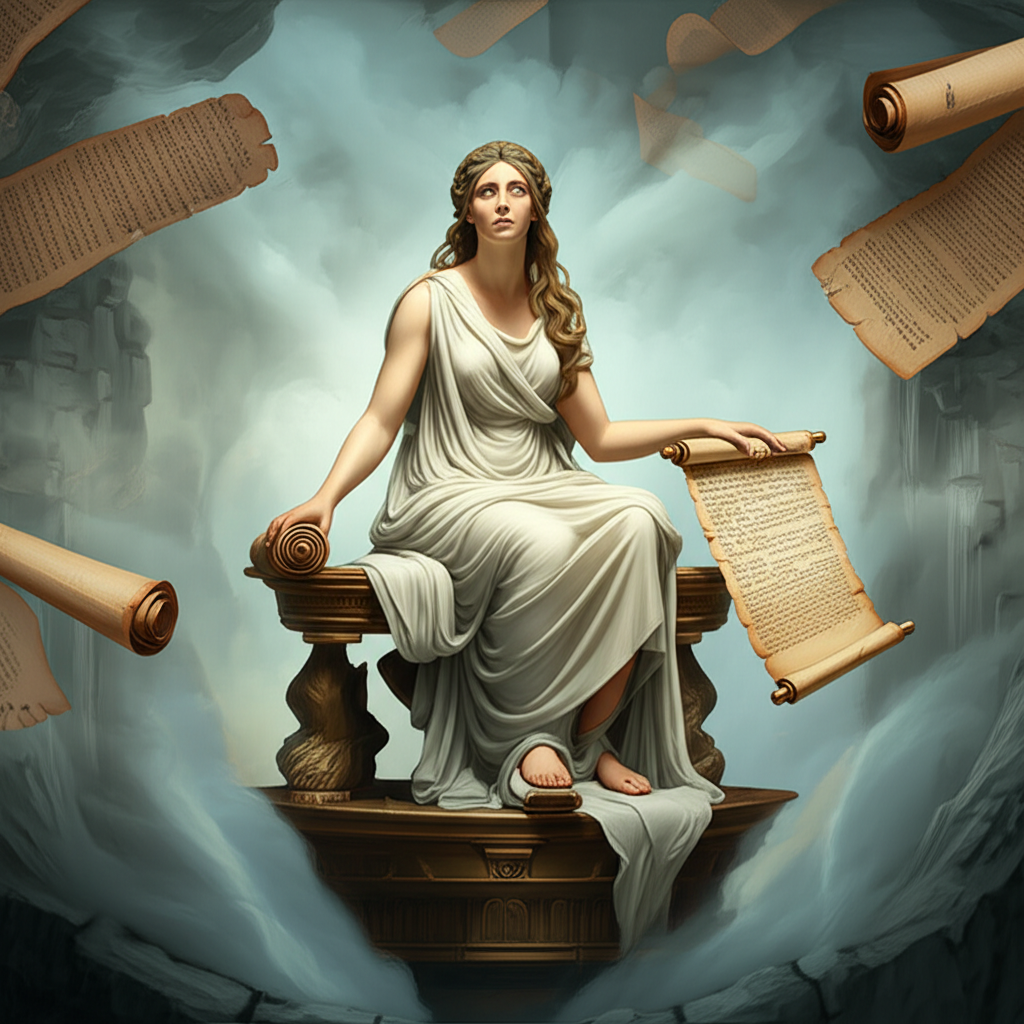
Prophecy in the Great Books: A Recurring Motif
Throughout the Great Books of the Western World, the theme of Prophecy emerges repeatedly, not just as a religious concept, but as a lens through which to explore human destiny, morality, and the limits of Knowledge.
- Sophocles' Oedipus Rex: The tragic inevitability of Oedipus's fate, foretold by the oracle, highlights the tension between free will and destiny. Despite his efforts to escape the prophecy, his actions inadvertently lead to its fulfillment, forcing us to question whether Knowledge of the future merely reveals what is already set.
- The Bible (Old and New Testaments): Central to the Judeo-Christian tradition, the prophetic books offer visions of the future, divine commands, and messianic expectations. These texts have shaped Western thought on history, salvation, and the role of divine intervention in human affairs.
- Dante Alighieri's The Divine Comedy: Dante frequently encounters souls in Hell, Purgatory, and Paradise who possess foreKnowledge of future events, often related to his own life or the political landscape of Florence. This artistic use of prophecy underscores the medieval understanding of a divinely ordered cosmos where future events are known to those with higher insight.
- Machiavelli's The Prince: While not dealing with divine prophecy, Machiavelli touches on a secular form of prediction – the ability of a wise ruler to foresee political trends and act decisively. This highlights a more pragmatic, human-centered approach to "knowing" the future through sagacity and experience, rather than divine revelation.
These diverse examples demonstrate that the philosophical questions surrounding Prophecy are not confined to a single era or discipline. They are fundamental to understanding the human condition, our relationship to the divine, and our ceaseless quest for Knowledge in a world where Time relentlessly marches on.
Conclusion: The Enduring Question
The concept of Prophecy remains a powerful and provocative subject for philosophical inquiry. It compels us to re-examine our assumptions about Time, the nature of Knowledge, the role of Religion, and the extent of human freedom. Whether viewed as divine insight, a psychological phenomenon, or a mere literary device, Prophecy continues to challenge the boundaries of our understanding, inviting us to ponder the elusive enigma of the future and our place within its unfolding narrative.
📹 Related Video: What is Philosophy?
Video by: The School of Life
💡 Want different videos? Search YouTube for: "Philosophy of Time - Determinism vs. Free Will"
📹 Related Video: What is Philosophy?
Video by: The School of Life
💡 Want different videos? Search YouTube for: "Ancient Greek Oracles and Prophecy - History and Philosophy"