

Prophecy and the Knowledge of the Future
The human fascination with the future is as old as civilization itself, manifesting most profoundly in the concept of prophecy. This article delves into the intricate relationship between prophecy and our understanding of knowledge concerning events yet to unfold. We will explore how different philosophical and religious traditions have grappled with the possibility of foreknowledge, examining the implications for human agency, the nature of time, and the very definition of what it means to truly "know." From ancient oracles to theological doctrines of divine omniscience, the idea that the future can be known has challenged our most fundamental assumptions about reality and our place within it.
The Enduring Allure of Foreknowledge
Since antiquity, the desire to peer beyond the veil of the present has driven individuals and societies to seek out prophecy. Whether through omens, dreams, or divinely inspired pronouncements, the belief that certain individuals or texts could reveal future events has profoundly shaped human history, politics, and religion. This enduring allure stems from a deeply human need for certainty, control, and meaning in an often unpredictable world.
Prophecy, in its various forms, offers a glimpse into a potential future, providing comfort, warning, or justification. But what does it mean for the future to be knowable? And what are the philosophical ramifications of such knowledge? These questions have occupied thinkers for millennia, from the pre-Socratics to contemporary philosophers of time.
Prophecy, Religion, and the Fabric of Time
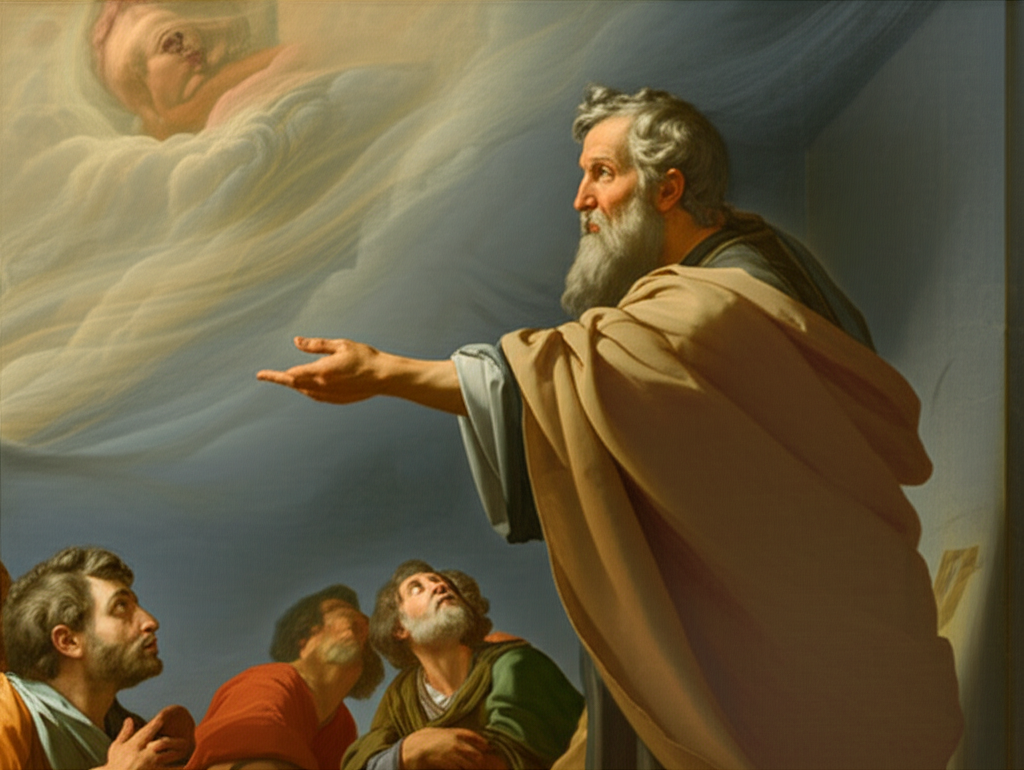
Across the tapestry of human civilization, prophecy has been inextricably linked with religion. From the Delphic Oracle in ancient Greece, consulted by kings and commoners alike, to the prophetic books of the Abrahamic faiths, divine revelation has often been presented as the primary conduit for future knowledge.
Consider the profound discussions within the Great Books of the Western World. Plato, in his dialogues, often explores the nature of ideal forms and true knowledge, hinting at a realm beyond mere sensory perception where ultimate truths reside, though his focus isn't on predicting specific events. Aristotle, on the other hand, with his emphasis on empirical observation and logical deduction, viewed the future as largely contingent, a product of causes and effects that are not fully determined in advance. For Aristotle, knowledge of the future would be a knowledge of what will happen, not necessarily what must happen.
The advent of monotheistic religions introduced a new dimension: the concept of an omniscient God. If God knows all, then He must know the future. This raises a fundamental philosophical dilemma:
The Paradox of Divine Foreknowledge and Free Will
- If God knows the future, is the future already determined? If every event, including every human choice, is known to God before it occurs, does this negate human free will?
- If human beings possess free will, how can God's foreknowledge be absolute? If our choices are truly free, then even an omniscient being could not "know" them until they are made, as they are not predetermined.
Philosophers like Augustine and Aquinas grappled extensively with this tension. Augustine, in The City of God, argued that God's foreknowledge does not cause events, but merely sees them. God exists outside of time as we experience it, perceiving all moments simultaneously. Therefore, His knowledge of our future choices is not a causal force, but an eternal present. Aquinas, building on Aristotle, posited that God’s knowledge is not contingent on time in the human sense; He knows all things in their eternal truth, without imposing necessity on human actions.
The Epistemology of Prophecy: What Can We Truly Know?
Beyond the theological, the very possibility of prophecy challenges our understanding of knowledge. How can one "know" something that has not yet occurred?
- Empirical Knowledge: Typically, knowledge is grounded in experience, observation, or logical inference from existing data. The future, by definition, is not yet experienced.
- Rational Knowledge: We can predict future events based on scientific laws (e.g., planetary movements), but these are extrapolations based on present conditions and known causal chains, not revelations of specific, contingent human actions.
This leads to a crucial distinction:
Types of Future Knowledge
- Predictive Knowledge (Scientific/Probabilistic): Based on understanding natural laws, statistical probabilities, and observed patterns. For example, knowing the sun will rise tomorrow or that a thrown object will follow a parabolic trajectory. This is not prophecy in the mystical sense.
- Deductive Knowledge (Logical Necessity): Knowing that if A is true, and A implies B, then B must be true. Again, this is a logical consequence, not a revelation of a contingent future event.
- Prophetic Knowledge (Revelatory/Mystical): The direct apprehension of future events, often attributed to divine inspiration, supernatural insight, or a unique connection to the fabric of time. This is where the philosophical challenges are most acute.
For prophecy to be true knowledge, it must be accurate, verifiable (eventually), and somehow grounded in reality. Yet, the very act of knowing the future could, in some philosophical frameworks, alter it. The "self-fulfilling" or "self-defeating" prophecy highlights this paradox: if you know a future event, your actions might either ensure its occurrence or prevent it.
📹 Related Video: What is Philosophy?
Video by: The School of Life
💡 Want different videos? Search YouTube for: ""Free Will and Determinism Philosophy""
📹 Related Video: PLATO ON: The Allegory of the Cave
Video by: The School of Life
💡 Want different videos? Search YouTube for: ""Augustine on Time and Eternity Explained""
Time, Contingency, and the Limits of Knowledge
The concept of time itself becomes a central player in the discussion of prophecy. Is time a linear progression of discrete moments, or is it a more fluid, perhaps even cyclical, phenomenon? If time is truly linear and the future is genuinely open and contingent, then knowledge of specific future events would seem impossible without breaking the rules of causality.
However, if time is merely a human construct for experiencing a reality that is fundamentally static or eternal (as some physicists and philosophers suggest, like the "block universe" theory), then the future could, in principle, be "there" to be known, much like a landscape exists whether or not we have traversed it. This perspective, however, often comes at the cost of genuine free will, reducing our experience of choice to an illusion.
Philosophers from the Great Books have consistently struggled with time. From the Physics of Aristotle, which defines time in relation to motion, to the profound meditations of Augustine in his Confessions, where he famously asks, "What then is time? If no one asks me, I know; if I wish to explain it to one who asks, I know not," the nature of time remains one of philosophy's most elusive puzzles. Our ability to "know" the future hinges entirely on our understanding of this fundamental dimension of existence.
Conclusion: The Enduring Philosophical Riddle
The concept of prophecy and the knowledge of the future remains one of philosophy's most compelling and persistent riddles. It forces us to confront fundamental questions about the nature of time, the extent of human freedom, the limits of our knowledge, and the very essence of reality. While modern scientific thought largely dismisses literal prophecy as a means of gaining concrete future knowledge, the philosophical questions it raises endure.
Whether viewed as divine revelation, psychological intuition, or a grand illusion, prophecy continues to serve as a powerful lens through which we examine our relationship with the unknown, our yearning for certainty, and our ongoing quest to understand the complex interplay between what is, what was, and what will be. The Great Books of the Western World offer a rich dialogue on these timeless themes, reminding us that the human mind's capacity for inquiry into the future is as boundless as the future itself.