

Poetry as a Form of Imitation: A Philosophical Inquiry
Summary: From the classical philosophical perspectives foundational to the Great Books of the Western World, poetry has long been understood as a profound art form intrinsically linked to the concept of imitation, or mimesis. This article delves into how poets, far from merely copying reality, engage their Memory and Imagination to re-present, interpret, and shape experience, giving it a unique Form. We will explore the ancient debates surrounding this mimetic function and its enduring significance in understanding the essence of poetic creation.
The Ancient Roots of Poetic Mimesis
The notion that poetry is a form of imitation is not a modern construct but a concept deeply embedded in the origins of Western thought. Philosophers such as Plato and Aristotle, whose works are cornerstones of the Great Books, extensively debated the nature and implications of mimesis (μίμησις), or imitation, particularly in relation to the arts.
Plato, in his Republic, famously viewed poetry with a degree of suspicion. For him, the true reality resided in the eternal, unchanging Forms. Physical objects were mere imitations of these Forms, and art, including poetry, was an imitation of these physical objects. This rendered poetry "thrice removed from the truth," a shadowy representation of a shadow. Plato worried that poetry, by appealing to emotions and sensory experience rather than reason, could potentially mislead citizens and corrupt the ideal state.
Aristotle, however, presented a more nuanced and ultimately more sympathetic view in his Poetics. He contended that imitation is a fundamental human instinct, natural to us from childhood, and a primary means of learning. Through imitation, we derive pleasure and gain understanding. For Aristotle, the poet does not merely copy what is, but rather imitates "things as they might be or ought to be." This distinction elevates poetry from a mere reflection to a creative act that can reveal universal truths through particular instances.
Poetry as a Reflection and Re-creation: The Mimetic Art
When we speak of poetry as imitation, we are not suggesting a simplistic, photographic reproduction of reality. Rather, it is a complex process of selection, arrangement, and interpretation. The poet observes the world – human actions, emotions, characters, natural phenomena, philosophical ideas – and then re-presents these observations in a crafted, artistic manner.
Consider the various ways poetry imitates:
- Imitation of Action: Epic poetry, tragedy, and comedy all imitate human actions, plotting sequences of events that reveal character and consequence. Homer's Iliad, for instance, imitates the wrath of Achilles and its devastating effects.
- Imitation of Character: Poets create personae, developing characters with distinct traits, motivations, and voices. These characters, though fictional, imitate aspects of human nature.
- Imitation of Emotion: Lyric poetry often seeks to evoke or represent specific feelings – love, loss, joy, despair – through vivid imagery, rhythm, and sound.
- Imitation of Thought: Philosophical poetry can imitate debates, ideas, and arguments, giving them poetic expression and exploring their implications.
The art of poetry lies in this transformative act. It takes raw experience and refines it, giving it a new structure and meaning.
The Crucial Role of Memory and Imagination
The poet's ability to imitate is deeply reliant on their Memory and Imagination. These two faculties are not merely passive receptors but active shapers of poetic creation.
-
Memory: Poets draw extensively from their own lived experiences, observations, and accumulated knowledge. This includes personal memories, historical accounts, myths, legends, and the vast repository of cultural narratives. Memory provides the raw material, the catalogue of human experience and the world's phenomena, that the poet can then manipulate. A poet recalling a specific landscape, a poignant conversation, or a historical event uses memory as a wellspring for their craft. The classical poets, drawing upon the collective memory of their societies, retold familiar tales in new ways, preserving and reinterpreting cultural heritage.
-
Imagination: This is where the poet transcends mere recall. Imagination allows the poet to:
- Combine and Juxtapose: To bring together disparate elements from memory to create novel images or scenarios.
- Transform and Re-envision: To alter, exaggerate, or distill reality, presenting it not just as it was, but as it could be or should be.
- Empathize and Project: To step into the shoes of others, imitating their thoughts and feelings, giving voice to experiences beyond their own direct memory.
The interplay between Memory and Imagination ensures that poetic imitation is not a sterile copy but a vibrant re-creation. It is the imaginative faculty that allows the poet to give the imitated content a distinctive Form.
Crafting Reality: The Significance of Form
The concept of Form is paramount in understanding poetry as imitation. While the poet imitates content (actions, emotions, ideas), the way this content is presented – its structure, rhythm, language, and rhetorical devices – constitutes its form. It is the unique form that elevates mere imitation to art.
Aristotle highlighted that the poet is an imitator not of things, but of actions and character, and that the plot (the arrangement of incidents) is the soul of tragedy. This emphasis on plot underscores the importance of Form in shaping the imitated content.
Consider the various formal elements that contribute to poetic imitation:
- Structure: Sonnets, haikus, free verse – each form dictates certain constraints and possibilities, shaping how reality is presented.
- Rhythm and Meter: These elements imitate the cadences of speech, the beat of a heart, or the flow of nature, adding an emotional and sensory layer to the imitation.
- Imagery and Metaphor: Poets use these tools to create vivid mental pictures, drawing parallels between dissimilar things, thereby imitating reality in a symbolic or suggestive manner.
- Language and Diction: The choice of words, their sounds, and their connotations all contribute to the overall effect, imitating the nuances of human expression.
The poet, through the conscious application of Form, takes the raw material gleaned from Memory and Imagination and molds it into something new – a coherent, aesthetically pleasing, and often profoundly insightful representation of reality. This is why poetry is not merely a reflection, but a making (from the Greek poiesis).
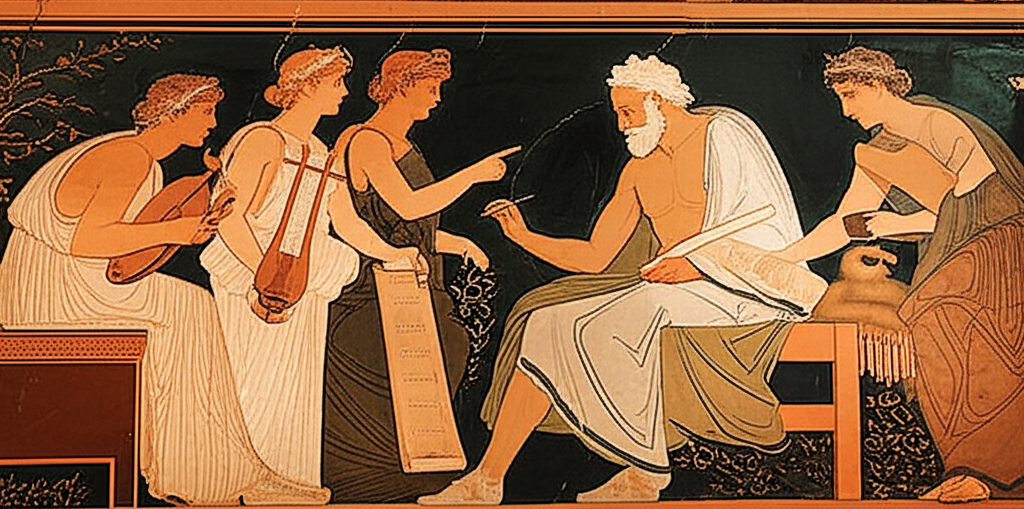
The Enduring Philosophical Implications
The classical understanding of poetry as a Form of imitation continues to resonate in contemporary philosophical discussions about art. The debates initiated by Plato and Aristotle regarding poetry's relationship to truth, morality, and human understanding remain pertinent.
Plato's concerns remind us of the immense power of art to sway emotions and shape perceptions, demanding a critical engagement with its content. Aristotle's defense, however, highlights poetry's unique capacity to offer catharsis, to educate, and to provide profound insights into the human condition by presenting universal truths through particular stories.
Ultimately, the study of poetic imitation, as illuminated by the Great Books of the Western World, reveals that poetry is far more than a simple mirror held up to nature. It is a dynamic process where Memory and Imagination converge, where raw experience is transformed by Form, and where humanity's innate drive to understand and represent its world finds its most eloquent and enduring expression.
YouTube: "Plato Mimesis Art Republic"
YouTube: "Aristotle Poetics Imitation Catharsis"
📹 Related Video: What is Philosophy?
Video by: The School of Life
💡 Want different videos? Search YouTube for: "Poetry as a Form of Imitation philosophy"