

For millennia, thinkers have grappled with the essence of Art, and perhaps no concept is as foundational to understanding Poetry as that of imitation, or mimesis. Drawing deeply from the wellsprings of the Great Books of the Western World, we find that poetry, in its myriad Forms, functions not merely as a reflection of reality but as a profound act of creative re-presentation. It engages our Memory and Imagination to construct worlds, emotions, and narratives that, while derived from observation, transcend mere copying to offer unique insights into the human condition.
The Ancient Echoes of Imitation: Plato and Aristotle on Poetic Mimesis
The idea of Poetry as a Form of imitation finds its most articulate origins in the philosophies of Plato and Aristotle. For Plato, poetry, like all Art, was often viewed with suspicion. In The Republic, he posits that art imitates the sensible world, which itself is an imitation of the eternal Forms. Thus, poetry becomes an "imitation of an imitation," twice removed from ultimate truth, potentially misleading and appealing to the irrational parts of the soul.
Aristotle, however, offers a more sympathetic and nuanced perspective in his Poetics. He argues that imitation is not only natural to humans from childhood but also a fundamental means of learning and experiencing pleasure. For Aristotle, poetic imitation does not merely copy what is, but presents what might be – the probable or necessary. It aims at universal truths through particular instances, refining and ordering experience. This distinction is crucial: poetry imitates not the raw, chaotic surface of life, but its underlying Form and potential.
Poetry and the Mirror of Reality: Beyond Mere Reflection
When we speak of Poetry as imitation, we are not suggesting a photographic reproduction. Rather, it is an active, interpretative process. The poet, through their Memory and Imagination, observes the world, recalls experiences, and then re-structures them into a new Form. This re-structuring involves selection, emphasis, and arrangement, allowing the poet to distill essence, evoke emotion, and illuminate truths that might remain obscured in everyday experience.
The poetic mirror, therefore, is not flat but faceted, refracting reality through the lens of human consciousness. It captures not just the visible surface but the invisible currents of thought, feeling, and aspiration. This is where the Art of poetry truly lies: in its capacity to transform observed reality into something both familiar and profoundly new.
The Diverse Forms of Poetic Imitation
Poetic imitation manifests in various Forms, each engaging with reality in its own distinct way. Whether narrating epic deeds or exploring internal states, the underlying principle of mimesis remains constant.
| Poetic Form | Primary Mode of Imitation | Focus | Example |
|---|---|---|---|
| Narrative | Imitation of actions, events, and characters (e.g., epic) | Stories, plots, heroic deeds, the unfolding of events in time | Homer's Iliad |
| Dramatic | Imitation of actions through direct representation | Characters interacting, dialogue, conflict, staging of human events | Sophocles' Oedipus Rex |
| Lyric | Imitation of emotions, thoughts, and internal states | Subjective experience, personal feelings, reflections, sensory details | Sappho's fragments, Shakespeare's sonnets |
| Didactic | Imitation of knowledge or principles | Instruction, moral lessons, philosophical ideas presented poetically | Lucretius's De Rerum Natura |
Each Form employs specific techniques to achieve its imitative goal, from the meter and epithets of epic to the imagery and metaphor of lyric verse. The choice of Form itself is an imitative act, shaping how reality is perceived and processed by the audience.
The Interplay of Memory and Imagination in Poetic Creation
At the heart of Poetry as imitation lies the dynamic interplay of Memory and Imagination. The poet draws upon a vast reservoir of Memory: personal experiences, historical accounts, cultural narratives, sensory details – the entire tapestry of what has been seen, heard, felt, and thought. This raw material is then processed and transformed by Imagination.
- Memory: Provides the data – the colors, sounds, emotions, and events of life. It anchors the poem in a recognizable reality.
- Imagination: Acts as the architect, re-arranging, combining, inventing, and projecting. It allows the poet to fill in gaps, envision possibilities, create new connections, and ultimately give Form to an experience that may never have existed exactly as presented.
Through this alchemical process, the poet does not simply recall; they re-create. They don't just see; they envision. This creative imitation allows poetry to explore potential realities, to articulate unspoken feelings, and to give voice to the collective human experience.
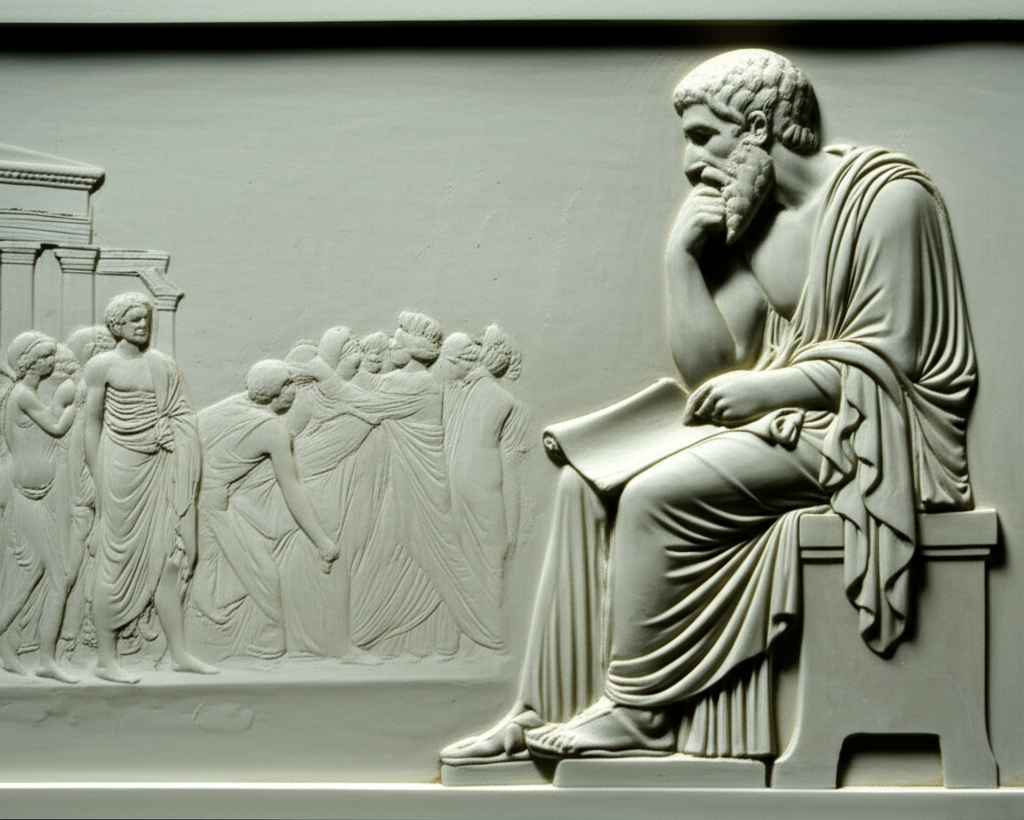
The Enduring Form of Poetic Truth
Ultimately, Poetry as a Form of imitation is not about deception but illumination. It is an Art that, through its careful crafting of language and structure, allows us to see ourselves and our world with fresh eyes. By imitating human actions, passions, and thoughts, poetry provides a unique avenue for understanding, empathy, and insight. It is a testament to the human capacity to not only observe reality but to re-imagine it, giving it new Form and meaning that resonate across generations. This enduring power of poetic imitation, rooted in our fundamental desire to understand and express, solidifies its place as a cornerstone of human culture and philosophical inquiry.
📹 Related Video: PLATO ON: The Allegory of the Cave
Video by: The School of Life
💡 Want different videos? Search YouTube for: "Plato and Aristotle on Mimesis"
📹 Related Video: What is Philosophy?
Video by: The School of Life
💡 Want different videos? Search YouTube for: "The Philosophy of Poetry and Imagination"