

Beyond the Shadows: Unpacking Plato's Enduring Theory of Forms
Plato's Theory of Forms is arguably one of the most profound and influential philosophical concepts ever conceived, a cornerstone of Western thought that continues to challenge and inspire. In essence, it posits that beyond the imperfect, changing world we perceive with our senses, there exists a realm of perfect, eternal, and unchanging essences – the Forms. These Forms are the true reality, the blueprints for everything we experience, from the beauty of a sunset to the concept of justice. Our physical world, according to Plato, is merely an imperfect reflection, a fleeting shadow of this higher, intelligible realm. This theory doesn't just explain what is real; it fundamentally reshapes our understanding of knowledge, morality, and even the ideal structure of society, as extensively explored in his seminal work, The Republic.
The Dual Reality: Sensible vs. Intelligible
Plato, building on the ideas of his predecessors like Heraclitus (everything is in flux) and Parmenides (being is unchanging), sought to reconcile the apparent contradiction between change and permanence. His solution was a radical dualism, dividing reality into two distinct realms:
- The Sensible World: This is the world we inhabit, the one perceived through our five senses. It is characterized by change, impermanence, imperfection, and multiplicity. Objects in this world are constantly coming into being and passing away; they are mere copies or imitations. A beautiful person, a just act – these are fleeting examples.
- The Intelligible World (The Realm of Forms): This is the true reality, accessible only through intellect and reason, not sensory experience. It is the realm of perfect, eternal, unchanging, and universal Forms. Here reside the ideal 'Beautiful Itself,' 'Justice Itself,' 'Equality Itself,' and so on. These Forms are the ultimate causes and explanations for everything in the sensible world.
What Exactly Are These "Forms"?
Think of the Forms as perfect, non-physical archetypes or ideals. They are not merely concepts in our minds, but objectively existing entities. Consider a circle you draw – it's imperfect, but you understand the concept of a perfect circle. That perfect circle, the ideal, is what Plato would call the Form of the Circle.
Here are some key characteristics of the Forms:
- Eternal: They have no beginning and no end.
- Unchanging: They are immutable, never altering their nature.
- Immaterial: They are not physical objects and have no spatial or temporal location.
- Perfect: They embody the ultimate standard of their kind.
- Universal: They are singular essences that many particular things in the sensible world "participate in" or "imitate."
- Accessible by Reason: True knowledge of the Forms is gained through philosophical contemplation and intellectual insight, not sensory experience.
At the pinnacle of all Forms, Plato places The Form of the Good. This supreme Form is like the sun in the intelligible realm, illuminating all other Forms and making them knowable. It is the source of all being, truth, and value, guiding the philosopher towards ultimate wisdom and understanding.
The Allegory of the Cave: A Visual Metaphor
Perhaps the most famous illustration of the Theory of Forms comes from Plato's The Republic – the Allegory of the Cave. Imagine prisoners chained in a cave since birth, facing a blank wall. Behind them, a fire burns, and people carry objects past the fire, casting shadows on the wall. The prisoners, knowing nothing else, believe these shadows are reality.
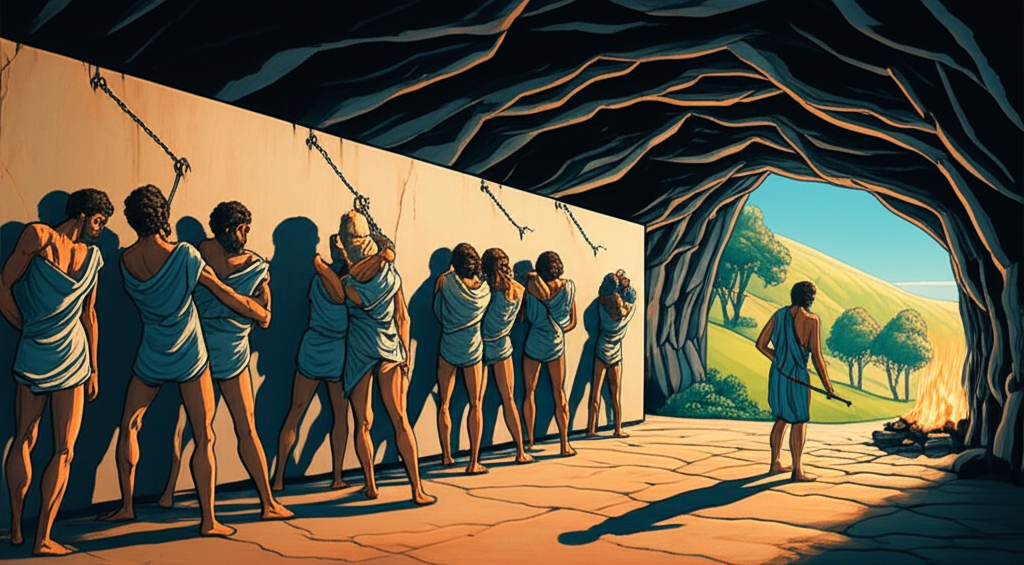
Now, imagine one prisoner is freed and forced to turn towards the fire, then dragged out of the cave into the blinding sunlight. Initially, the light hurts his eyes, and he struggles to see the real objects, preferring the familiar shadows. But gradually, his eyes adjust, and he sees the world as it truly is – the sun, the trees, the colors. If he were to return to the cave to tell his fellow prisoners, they would mock him, believing his journey had ruined his sight and that the shadows were still the only reality.
This allegory is a powerful metaphor for Plato's theory:
- The Cave: Represents the sensible world, the realm of appearances.
- The Prisoners: Symbolize humanity, trapped by sensory perception and ignorance.
- The Shadows: Are the imperfect, fleeting objects of the sensible world, mistaken for reality.
- The Chains: Represent the biases, prejudices, and sensory attachments that bind us.
- The Escape: Symbolizes the arduous philosophical journey towards true knowledge.
- The Outside World: Is the intelligible realm of the Forms, illuminated by the Form of the Good (the Sun).
- The Philosopher's Return: Represents the duty of the enlightened to guide others, even if they are met with resistance and ridicule.
Implications for Knowledge, Ethics, and Society
Plato's Theory of Forms has profound implications across various philosophical domains:
- Epistemology (Theory of Knowledge): True knowledge (episteme) is not derived from the senses, which only provide opinions (doxa) about the changing world. Instead, it comes from rational contemplation of the unchanging Forms. Our souls, having pre-existed in the realm of Forms, merely "recollect" this knowledge.
- Metaphysics (Theory of Reality): It establishes a dualistic reality, prioritizing the non-physical, eternal realm over the physical, temporal one.
- Ethics and Politics: For Plato, moral concepts like Justice, Courage, and Piety are not arbitrary human conventions but derive from objective, perfect Forms. In The Republic, he argues that an ideal society must be structured according to the Forms of Justice and the Good. This leads directly to his advocacy for philosopher-kings – rulers who have ascended from the shadows of opinion to grasp the Forms, particularly the Form of the Good.
Here's where the keyword Democracy comes into play. Plato was deeply skeptical of democracy, particularly the Athenian democracy of his time, which he believed led to the conviction and execution of his mentor, Socrates. He saw democracy as a system where leadership is based on popular opinion, rhetoric, and the ability to sway the masses, rather than on true knowledge and wisdom. For Plato:
- Democracy prioritizes opinion over truth: Citizens, like the prisoners in the cave, are guided by shadows and fleeting desires, not by an understanding of the unchanging Forms of Justice and Good.
- It can lead to mob rule: Without the guiding hand of those who understand the Forms, society can descend into chaos, driven by individual appetites and factional interests.
- The ideal state requires true knowledge: Only those who have undergone rigorous philosophical training and apprehended the Forms are fit to govern, as they alone can legislate and rule in accordance with objective truth and virtue.
In essence, Plato argued that a just and stable society could only be achieved if it were led by individuals whose souls were oriented towards the eternal Forms, rather than the fleeting opinions and desires that often characterize democratic processes.
An Enduring Legacy
While the Theory of Forms has faced its share of criticisms – notably from Aristotle, who questioned the separation of Forms from the physical world – its influence is undeniable. It laid the groundwork for much of Western metaphysics, epistemology, and political philosophy. It spurred millennia of debate about the nature of reality, the source of knowledge, and the ideals that should guide human conduct. Plato's vision of a higher reality, accessible through reason, continues to challenge us to look "beyond the shadows" and strive for a deeper understanding of truth and goodness in our ever-changing world.
YouTube Video Suggestions:
-
📹 Related Video: PLATO ON: The Allegory of the Cave
Video by: The School of Life
💡 Want different videos? Search YouTube for: "Plato's Allegory of the Cave explained animation"
-
📹 Related Video: PLATO ON: The Allegory of the Cave
Video by: The School of Life
💡 Want different videos? Search YouTube for: "Plato Theory of Forms explained philosophy"