

Philosophy as the Pursuit of Wisdom: A Timeless Journey
Philosophy, at its very core, is not merely an academic discipline but a profound and enduring quest for Wisdom. It is a love affair with understanding, a relentless interrogation of existence, and a deep dive into the nature of Being. Far from being a dry, abstract exercise, philosophy invites us to live more thoughtfully, to question our assumptions, and to seek a deeper, more meaningful engagement with the world around us. This pursuit distinguishes itself from the accumulation of mere Knowledge, aiming instead for insight, discernment, and a comprehensive grasp of what truly matters.
The Genesis of Philosophy: More Than Just Knowing
The very word "philosophy" originates from the ancient Greek philosophia, meaning "love of wisdom." This etymology is not accidental; it encapsulates the fundamental orientation of the discipline. Unlike other fields that might focus on acquiring specific facts or mastering particular skills, philosophy grapples with the broadest and most fundamental questions: What is reality? How do we know what we know? What constitutes a good life? What is justice?
From the earliest thinkers whose works are preserved in the Great Books of the Western World, we see this persistent aspiration. Figures like Thales, Anaximander, and Heraclitus sought to understand the underlying principles of the cosmos, moving beyond mythological explanations to rational inquiry. Their pursuit was not just for knowledge of the world's mechanisms, but for a deeper wisdom about its nature and our place within it.
Wisdom vs. Knowledge: A Crucial Distinction
It's imperative to distinguish between Knowledge and Wisdom. While often conflated, they represent different stages or qualities of understanding:
- Knowledge is the accumulation of facts, information, and skills acquired through experience or education. It answers "what" and "how." One can possess vast knowledge without necessarily being wise. A scholar might know every detail of ancient history, but lack the insight to apply its lessons to contemporary life.
- Wisdom, conversely, is the ability to apply Knowledge effectively, to discern what is true, right, and lasting, and to make sound judgments. It answers "why" and "what for." Wisdom involves understanding the implications, connections, and ultimate value of knowledge. It's about perspective, ethical understanding, and the capacity to navigate life's complexities with prudence and insight.
The philosophical journey is precisely this transition from mere information gathering to profound understanding. It's about synthesizing disparate pieces of knowledge into a coherent worldview that guides action and provides meaning.
The Quest for Being: Understanding Existence
At the heart of philosophical inquiry, especially as explored by the foundational texts in the Great Books, is the question of Being. What does it mean to exist? What is the fundamental nature of reality? This line of questioning, pioneered by Parmenides and explored deeply by Plato and Aristotle, is not an abstract diversion but a direct path to Wisdom.
Understanding Being means grappling with:
- Metaphysics: The study of the fundamental nature of reality, including the relationship between mind and matter, between substance and attribute, and between potentiality and actuality.
- Ontology: A branch of metaphysics concerned with Being itself, exploring concepts such as existence, becoming, reality, and the categories of being.
By questioning the very fabric of existence, philosophy challenges us to look beyond superficial appearances to grasp deeper truths. This pursuit of understanding Being is not just intellectual; it informs our ethical frameworks, our understanding of human nature, and ultimately, our ability to live a wise and fulfilling life. If we misunderstand what we are, and what the world is, how can we hope to live well within it?
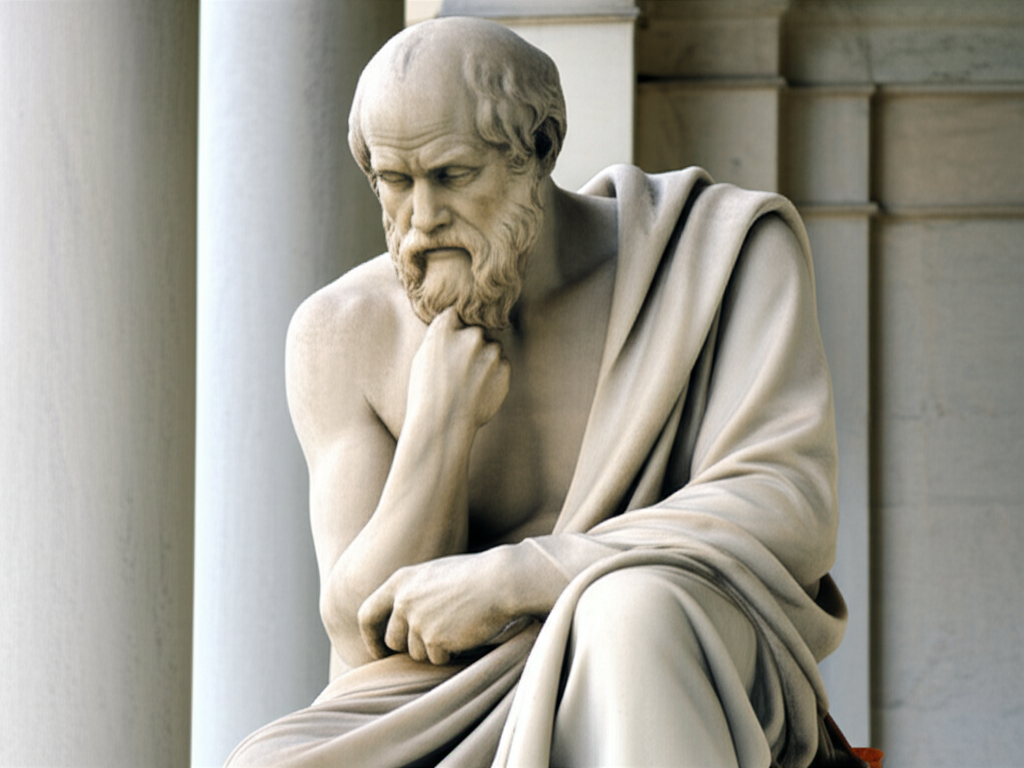
Exemplars of Wisdom's Pursuit: Insights from the Great Books
The history of philosophy, as chronicled in the Great Books of the Western World, is replete with figures who epitomized the pursuit of Wisdom:
- Socrates (c. 470–399 BCE): Perhaps the quintessential philosopher, Socrates famously claimed to know nothing, yet was declared the wisest man by the Oracle of Delphi. His method of relentless questioning (the Socratic method) aimed not at imparting knowledge, but at revealing ignorance and guiding others towards self-knowledge, which he considered the ultimate path to wisdom. His life and death, as depicted by Plato, are a testament to living by philosophical principles.
- Plato (c. 428–348 BCE): Socrates' most famous student, Plato, through his theory of Forms, posited that true Being resides in an immutable realm of perfect Forms, accessible not through the senses, but through reason. For Plato, the ultimate wisdom lay in apprehending these Forms, particularly the Form of the Good, which illuminates all other truths. His allegory of the cave powerfully illustrates the journey from ignorance to enlightenment.
- Aristotle (384–322 BCE): Plato's student, Aristotle, took a more empirical approach while still valuing wisdom. He distinguished between different types of knowledge and wisdom, including phronesis (practical wisdom or prudence), which guides ethical action, and sophia (theoretical wisdom), which is the contemplation of eternal truths. For Aristotle, the highest human activity was the pursuit of theoretical wisdom, which brings true eudaimonia (flourishing).
These figures, among many others, demonstrate that philosophy is not a static body of knowledge but an active, dynamic engagement with fundamental questions, constantly seeking deeper insights into Being, morality, and the human condition.
The Enduring Value of Philosophical Inquiry
In our modern, information-saturated age, the pursuit of Wisdom through philosophy is arguably more crucial than ever. While technology provides unprecedented access to Knowledge, it often falls short in offering guidance on how to use that knowledge ethically, meaningfully, or for the greater good.
Philosophy equips us with:
- Critical Thinking Skills: The ability to analyze arguments, identify fallacies, and evaluate evidence, essential for navigating complex information landscapes.
- Ethical Frameworks: Tools for contemplating moral dilemmas, understanding different perspectives, and making responsible choices.
- Self-Awareness: A deeper understanding of our own beliefs, biases, and motivations, leading to greater personal integrity.
- Perspective: The capacity to see issues from multiple angles, fostering empathy and intellectual humility.
- Meaning-Making: The means to construct a coherent worldview that provides purpose and direction in life.
The journey of philosophy is an ongoing dialogue with the greatest minds across history, a continuous process of questioning, reflecting, and refining our understanding of ourselves and the universe. It is the disciplined and passionate pursuit of Wisdom, a pursuit that enriches not just the intellect, but the very fabric of our Being.
YouTube: "What is Philosophy and Wisdom"
YouTube: "Ancient Greek Philosophy Explained"
📹 Related Video: What is Philosophy?
Video by: The School of Life
💡 Want different videos? Search YouTube for: "Philosophy as the Pursuit of Wisdom philosophy"