

Oppositional Forces in Nature: The Enduring Principle of Change
Summary: The Unseen Harmony of Strife
At the heart of existence, from the grandest cosmic movements to the most subtle biological processes, lies the fundamental principle of opposition. Far from being mere conflict, these oppositional forces in nature are the very engine of change, stability, and progress. Ancient philosophers, observing the world around them, recognized that the tension between contraries is not a flaw but an essential characteristic, a dynamic equilibrium that perpetually shapes and reshapes all things. This article explores how this profound insight, rooted in the Great Books of the Western World, reveals itself as a pervasive and indispensable law of the natural order.
The Genesis of Dynamic Tension
For millennia, humanity has grappled with the apparent paradox of a world defined by both harmony and strife. How can order emerge from chaos, or stability from constant change? The answer, as profound thinkers like Heraclitus of Ephesus understood, lies in the inherent opposition that underpins all reality. He famously declared, "War is the father of all and king of all," not celebrating conflict for its own sake, but recognizing that the clash of contraries is the creative force, the principle by which all things come into being and pass away.
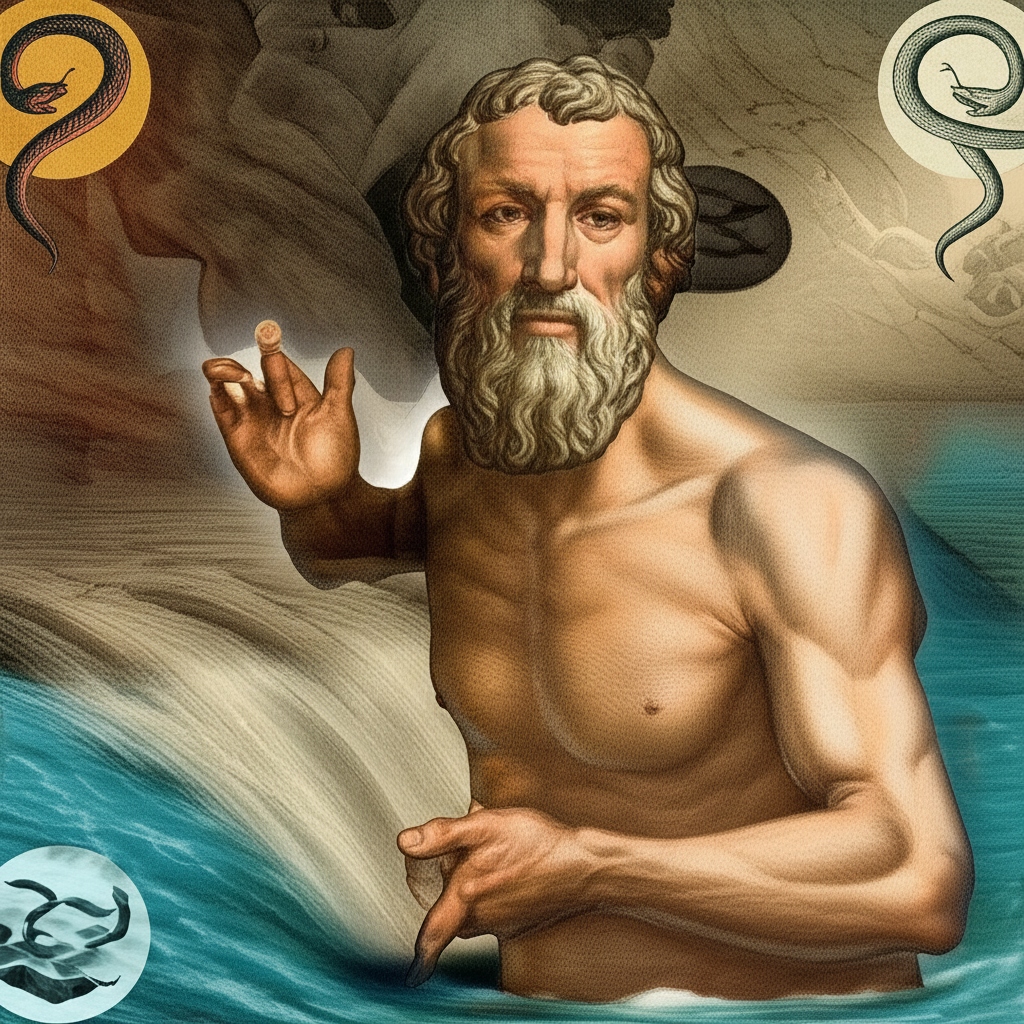
Heraclitus and the River of Change
Heraclitus’s famous aphorism about never stepping into the same river twice encapsulates the essence of change driven by opposition. The river remains, yet its waters are ever new. This is not mere randomness but an ordered flux, governed by a hidden principle—the Logos—which orchestrates the constant interplay of opposing forces.
- Hot and Cold: The very distinction creates temperature.
- Day and Night: Defines the cycle of time.
- Life and Death: The ultimate opposition that drives evolution and renewal.
This continuous opposition prevents stagnation, ensuring a vibrant, ever-evolving nature.
From Natural Cycles to Philosophical Dialectic
The observation of oppositional forces in nature profoundly influenced subsequent philosophical thought, moving beyond mere physical phenomena to the very structure of reasoning and societal organization.
Table: Manifestations of Opposition
| Domain | Opposing Forces | Outcome/Principle |
|---|---|---|
| Physical Nature | Gravity vs. Expansion | Formation of celestial bodies, cosmic balance |
| Biological Nature | Predator vs. Prey | Regulation of populations, natural selection |
| Human Thought | Thesis vs. Antithesis | Dialectical progress towards synthesis (Plato) |
| Ethics/Morality | Good vs. Evil | Defining virtues, moral choices |
| Political Theory | Freedom vs. Order | Development of laws, governance structures |
Plato, in his Dialogues, frequently employed a dialectical method, a form of intellectual opposition where ideas are tested and refined through questioning and counter-argument. This rigorous process, born from the clash of differing perspectives, aims to uncover a deeper truth, a more profound understanding of the Forms. The principle here is that truth is not static but emerges from the dynamic tension of intellectual change.
Aristotle, too, recognized the importance of balance, often viewing virtue as a mean between two extremes of excess and deficiency. This Aristotelian "golden mean" is not an absence of opposition but a harmonic resolution of opposing tendencies, a state achieved by understanding and navigating these forces.
The Principle of Dynamic Equilibrium
What appears as conflict is, in many cases, the very mechanism that maintains equilibrium. Consider the ecosystem: the opposition between a predator and its prey seems brutal, yet it is a vital principle for the health of both populations and the overall biodiversity of nature. Without predators, prey populations can explode, leading to overgrazing and environmental degradation. Without prey, predators cannot survive. Their opposition creates a delicate, self-regulating balance.
This dynamic equilibrium is not a static state but a constant dance of forces, a perpetual change that ensures resilience and adaptability. It is the wisdom embedded in nature, demonstrating that stability is often found not in the absence of opposition but in its well-regulated interplay.
Understanding the Principle
- Opposition as a Catalyst: It drives evolution, innovation, and growth.
- Nature's Self-Correction: Imbalances created by one force are often corrected by its opposite.
- Change as Inevitable: Embracing opposition means accepting the constant flux of existence.
Embracing the Inevitable: A Philosophical Stance
The profound insight derived from observing oppositional forces in nature is that struggle is not an aberration but a fundamental principle of life. To resist this principle is to resist reality itself. Instead, understanding and engaging with opposition allows for growth, resilience, and a deeper appreciation for the intricate tapestry of existence. From the smallest atom to the grandest galaxy, the constant push and pull of oppositional forces orchestrate the magnificent symphony of change that defines our universe. It is a testament to the enduring wisdom found within the pages of the Great Books, reminding us that to comprehend nature is to comprehend the ceaseless dance of contraries.
📹 Related Video: What is Philosophy?
Video by: The School of Life
💡 Want different videos? Search YouTube for: "Heraclitus Philosophy of Change and Flux"
📹 Related Video: PLATO ON: The Allegory of the Cave
Video by: The School of Life
💡 Want different videos? Search YouTube for: "Dialectic Explained - Plato and Hegel"