

The Dynamic Dance: Oppositional Forces as the Engine of Nature
The universe, in its intricate tapestry, is not a static tableau but a vibrant, ever-unfolding drama. At the heart of this ceaseless activity lies a fundamental Principle: the interplay of oppositional forces. Far from mere conflict, this dynamic tension is the very engine of Nature, driving all Change and evolution, from the cosmic scale to the minutiae of biological processes. This article explores how these inherent antagonisms are not only ubiquitous but essential, forming the bedrock upon which reality constructs itself, a concept deeply rooted in the philosophical traditions preserved within the Great Books of the Western World.
I. The Inevitable Embrace of Opposites
From the earliest philosophical inquiries, thinkers have grappled with the pervasive presence of opposition. It is not simply about good versus evil, or right versus wrong, but a more profound, inherent duality that defines existence itself. Every phenomenon seems to be predicated on its counterpoint, establishing a relational framework that gives meaning and structure to the world.
- Light and Darkness: One cannot exist without the other, each defining the boundary and essence of its counterpart.
- Hot and Cold: Temperature is a spectrum, but its poles are experienced as distinct and opposing.
- Life and Death: The ultimate biological opposition, where one state gives way to the other, ensuring renewal and the continuation of species.
- Expansion and Contraction: Found in celestial bodies, economic cycles, and even the breath of living organisms.
These aren't mere contrasts; they are interdependent forces locked in a perpetual, creative struggle.
II. The Heraclitean Flux: Change as a Principle of Nature
The ancient Greek philosopher Heraclitus, whose fragments echo through the Great Books, famously declared that "everything flows" (panta rhei). For him, Change was the only constant, and this ceaseless transformation was fueled by the strife of oppositional forces. He posited that "war is the father of all things," not advocating for literal conflict, but for the generative tension that arises when opposites meet.
This Principle suggests that stability is an illusion, a temporary equilibrium achieved through the dynamic balance of opposing pressures. Without the push and pull, the world would stagnate, unable to evolve or even exist. Consider the atom: held together by the attractive force of the nucleus and the repulsive forces between electrons, a delicate balance that defines its very structure and reactivity. This microscopic dance of opposition is a fundamental aspect of Nature.
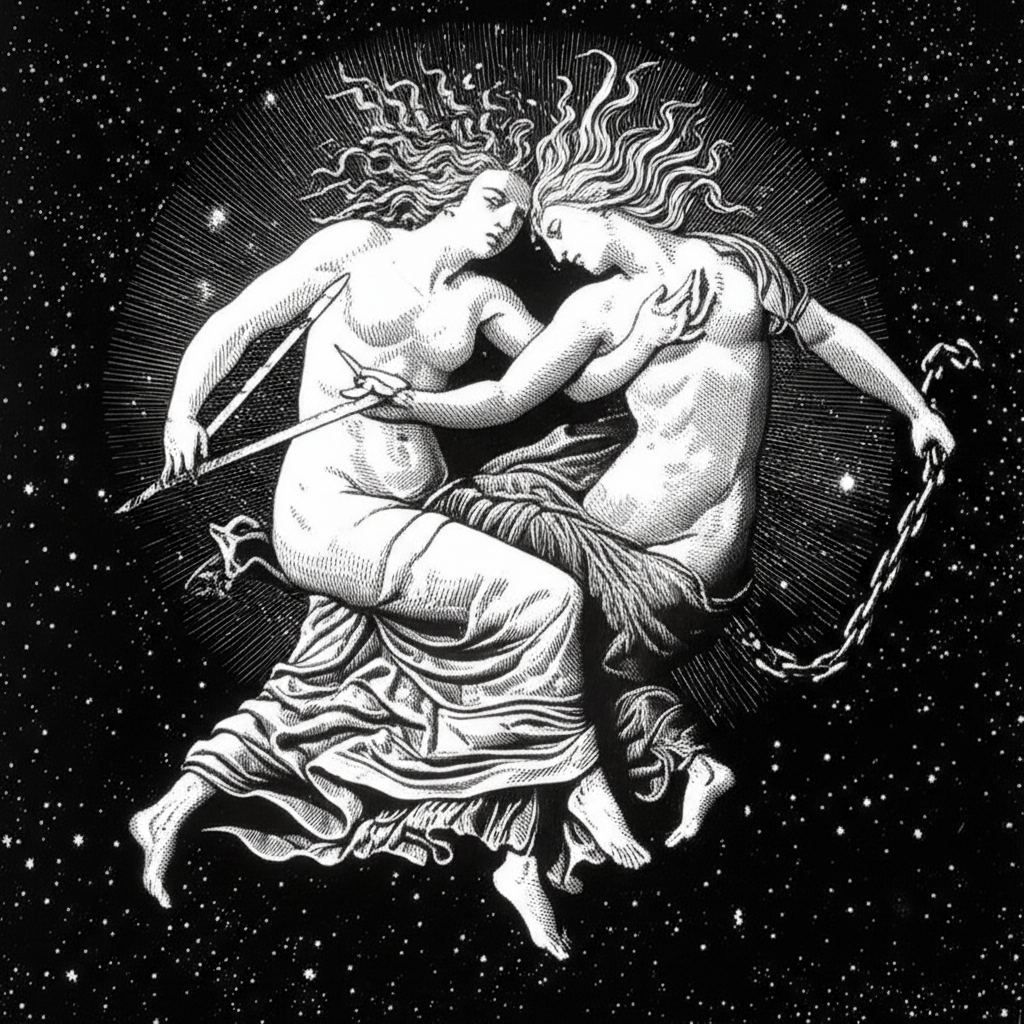
III. Dialectics and the Synthesis of Opposites
The concept of opposition as a driver of Change extends beyond the physical realm into the very fabric of thought and societal development. The dialectical method, prominently featured in the works of Plato and later refined by Hegel, posits a thesis, an antithesis, and a synthesis. This process, essentially a philosophical wrestling match between oppositional forces, leads to a higher understanding or a new state of being.
| Thesis (Initial Idea) | Antithesis (Opposing Idea) | Synthesis (New Understanding/State) |
|---|---|---|
| Order | Chaos | Dynamic Equilibrium |
| Stasis | Movement | Evolution |
| Individual | Community | Society |
| Potentiality | Actuality | Realization |
This table illustrates how the clash of oppositional forces doesn't necessarily result in destruction, but often in a transformative outcome – a new Principle emerging from the conflict. In Nature, this can be seen in ecological succession, where pioneer species (thesis) are challenged by environmental changes and competing organisms (antithesis), leading to a climax community (synthesis).
IV. The Enduring Principle of Opposition
The pervasive presence of oppositional forces is an undeniable Principle that underpins all existence. It is the rhythmic breath of the cosmos, the silent hum of atoms, and the vibrant pulse of life. To understand Nature is to appreciate this inherent duality, not as a flaw or a problem to be overcome, but as the very mechanism through which Change is enacted, leading to ever-greater complexity and novelty. The wisdom gleaned from the Great Books teaches us that true understanding comes not from eradicating opposition, but from comprehending its generative power.
YouTube: "Heraclitus Flux and Change Philosophy"
YouTube: "Dialectical Process Explained"
📹 Related Video: What is Philosophy?
Video by: The School of Life
💡 Want different videos? Search YouTube for: "Oppositional Forces in Nature philosophy"