

The world as we know it is not merely a collection of static entities, but a vibrant, ever-changing dance of opposing forces. From the grand cosmic ballet to the smallest biological process, opposition is not merely incidental; it is the fundamental principle that animates all of nature and drives incessant change. This article explores how these inherent tensions shape our reality, drawing insights from the enduring wisdom contained within the Great Books of the Western World.
The Heraclitean Fire: Opposition as the Genesis of Being
Long before the scientific method sought to categorize the universe, ancient Greek thinkers pondered the very essence of existence. Among them, Heraclitus of Ephesus stood out, proclaiming that "war is the father of all things." This wasn't a call to literal conflict, but a profound observation on the inherent opposition that structures reality. His fragments, preserved through the ages and studied diligently within the Great Books of the Western World, reveal a universe perpetually in flux, where harmony arises not from the absence of conflict, but from the dynamic tension between opposites. For Heraclitus, the constant strife between hot and cold, wet and dry, light and dark, is not destructive chaos, but the very engine of cosmic order and continuous change.
Manifestations of Opposition Across Nature
The principle of opposition is not an abstract philosophical construct but a palpable reality woven into the fabric of nature. Consider the myriad ways this fundamental tension unfolds:
- Physical Forces: The universe is governed by attractive and repulsive forces – gravity pulling matter together, while electromagnetic forces push like charges apart. This delicate balance allows for the formation of stars, planets, and the very atoms that comprise us.
- Biological Systems: Life itself is a constant interplay of anabolic (building up) and catabolic (breaking down) processes. Predator and prey, symbiosis and competition, life and death – these are all oppositional forces that drive evolution and maintain ecological balance.
- Thermodynamics: The flow of energy from hot to cold, the expansion and contraction of matter, are fundamental processes that dictate the behavior of everything from weather patterns to geological shifts.
- Geological Dynamics: Erosion carves away land, while tectonic uplift creates mountains. The destructive power of volcanoes is often followed by the fertile grounds they leave behind, showcasing change born from intense opposition.
- Cosmic Phenomena: The birth of stars from collapsing nebulae and their eventual demise in supernovae or black holes represent cycles of creation and destruction, driven by gravitational opposition to internal pressure.
The Engine of Change: From Tension to Transformation
It is through this ceaseless interplay of opposition that change becomes not just possible, but inevitable. Without the tension, the push and pull, the world would stagnate into a static, lifeless tableau. Heraclitus's famous river analogy – one cannot step into the same river twice – encapsulates this perfectly. The river is the same, yet ever-changing, its identity maintained by the constant flow, the opposition of water molecules moving through a fixed channel. This dynamic principle ensures that nothing remains truly static; everything is in a state of becoming.
Philosophical Echoes: The Principle of Becoming
This principle resonates far beyond the pre-Socratics. Plato, in his dialectic, sought truth through the opposition of ideas, refining understanding through thesis and antithesis. Aristotle, too, explored the change from potentiality to actuality, a dynamic process often requiring an opposition or resistance to be overcome. Even in later philosophical traditions, from the Hegelian dialectic of spirit to the very structure of logical argumentation, the power of opposition to drive understanding and evolution remains a cornerstone. The Great Books consistently reveal that progress, both intellectual and natural, often emerges from the crucible of conflicting forces.
The Harmony of Discord
The profound insight is that this opposition is not chaotic, but rather a source of dynamic balance. It is the tension that holds the universe together, much like the strings of a lyre creating music through their taut opposition. This perspective challenges us to view conflict not as an aberration, but as an essential ingredient in the grand design of nature. The constant push and pull, the ebb and flow, create a vibrant, resilient system capable of adaptation and sustained change.
From the ancient musings of Heraclitus to the complex systems of modern science, the concept of oppositional forces stands as a foundational principle for understanding nature and the ceaseless change that defines our existence. It is a reminder that in the grand theatre of the cosmos, harmony often finds its deepest expression in the vibrant dance of discord.
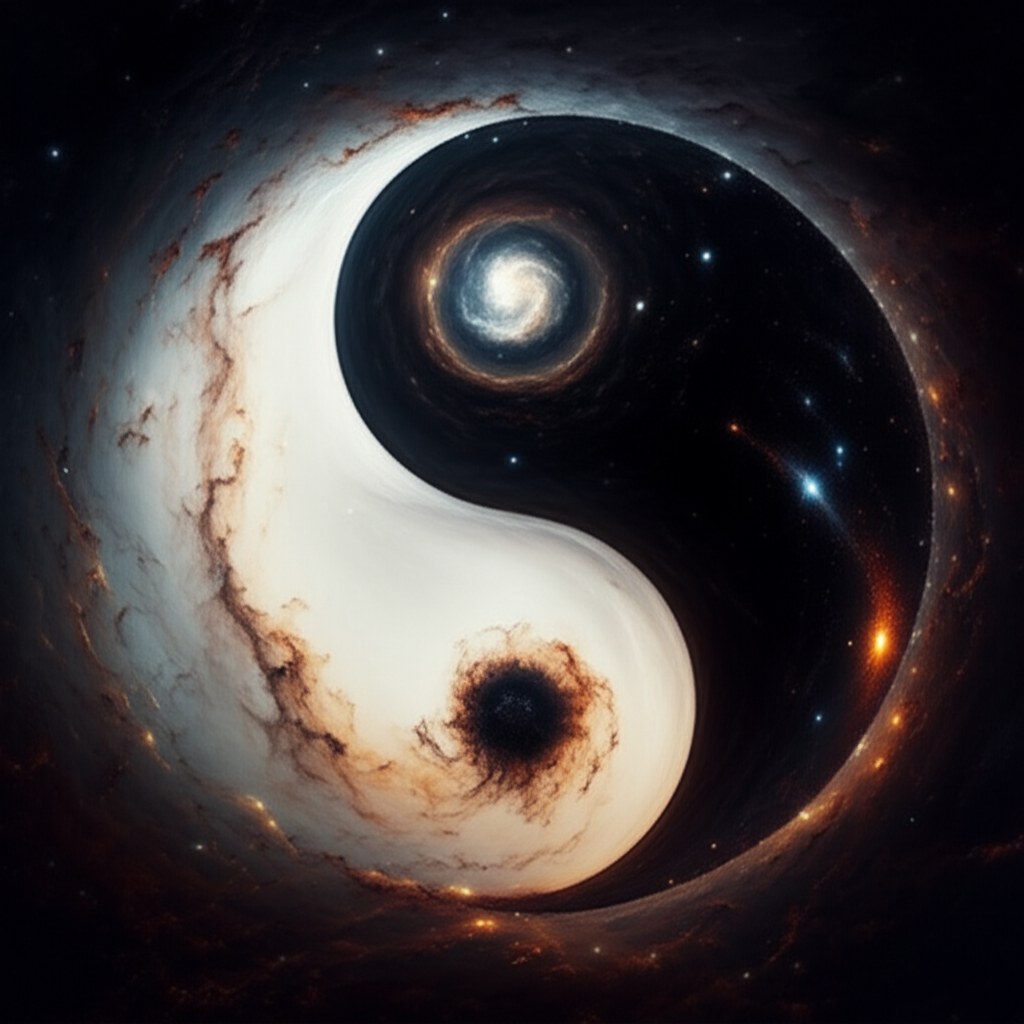 , and the other is a collapsing supernova or black hole (destruction), with a delicate, luminous boundary suggesting constant interaction and transformation.)
📹 Related Video: What is Philosophy?
Video by: The School of Life
💡 Want different videos? Search YouTube for: "Heraclitus philosophy change opposition"
📹 Related Video: What is Philosophy?
Video by: The School of Life
💡 Want different videos? Search YouTube for: "Dialectical thinking nature philosophy"