

Oligarchy and the Concentration of Wealth: A Perennial Philosophical Inquiry
Summary: Oligarchy, the rule by a wealthy few, represents a recurring challenge to just governance throughout history. This article explores how the concentration of wealth inevitably leads to the concentration of power, distorting the government and undermining the common good. Drawing on classical philosophical insights, we examine the mechanisms by which economic dominance translates into political control, creating a self-perpetuating cycle that erodes civic virtue and perpetuates inequality.
The Enduring Specter of Oligarchy in the Body Politic
From the earliest city-states to modern nations, humanity has grappled with the fundamental question of who should govern and for what purpose. Among the various forms of government identified by the ancients, oligarchy stands out as a particularly insidious deviation from the ideal. It is not merely the rule of the few, but specifically the rule of the wealthy few, whose primary aim is the preservation and expansion of their own economic interests. This form of governance, deeply rooted in the concentration of wealth, inevitably leads to a corresponding concentration of power, creating a system where the aspirations of the many are subjugated to the prerogatives of an elite.
Defining the Oligarchic Predicament
The term "oligarchy" itself, derived from Greek roots meaning "rule of the few," gains its critical philosophical weight when paired with the economic imperative. It is the antithesis of a polity striving for justice and the common good, instead prioritizing private gain and class interest.
Philosophical Foundations: Insights from the Great Books
The architects of Western thought meticulously dissected the nature of oligarchy, recognizing its inherent dangers to the stability and morality of the polis.
Plato's Republic: The Descent into Greed
In Plato's Republic, the transition to oligarchy is depicted as a lamentable stage in the degeneration of states. Following the timocratic man, who values honor, comes the oligarchic man, driven solely by the accumulation of wealth. Plato argues that when a society begins to value money above all else, it inevitably selects its rulers based on their property qualifications rather than their wisdom or virtue. This leads to a state divided: "one of the poor, the other of the rich, and these two are ever conspiring against one another." The very foundation of the state becomes unstable, characterized by internal strife and a decline in civic responsibility.
Aristotle's Politics: Property and the Rule of the Few
Aristotle, in his Politics, offers a more empirical and precise definition. He distinguishes oligarchy not merely by the number of rulers, but crucially by their economic status. For Aristotle, an oligarchy is a government where "those who govern are rich" and rule in their own interest, rather than for the common good. He notes that wealth is the defining characteristic, and that such regimes are prone to instability because they exclude the majority from political participation, fostering resentment and rebellion.
Key Characteristics of an Oligarchic State (Aristotle's View):
- Rule by the Wealthy: Rulers are selected based on property qualifications.
- Self-Interest: Policies are enacted to benefit the ruling class.
- Exclusionary: Political participation is limited to a select few.
- Instability: Prone to internal conflict between the rich and the poor.
- Corruption: The pursuit of wealth often supersedes justice and virtue.
The Mechanisms of Wealth Concentration and Political Power
The nexus between concentrated wealth and consolidated power is not accidental; it is built upon a series of interconnected mechanisms that allow economic dominance to translate into political control.
Economic Leverage and Policy Influence
Those who command vast resources possess inherent leverage over the political process. This can manifest in various forms:
- Lobbying: Direct influence on legislators through financial contributions and professional advocacy, shaping laws and regulations to favor specific industries or individual interests.
- Campaign Finance: Funding political campaigns provides access and influence, ensuring that elected officials are often indebted to their largest donors.
- "Revolving Door" Syndrome: The movement of individuals between high-level government positions and lucrative roles in the private sector, blurring the lines between public service and private gain.
Control of Information and Public Discourse
The ability to shape public opinion is a potent tool in maintaining power. Concentrated wealth can influence:
- Media Ownership: Control over major news outlets, publishing houses, and digital platforms allows for the framing of narratives and the suppression of dissenting voices.
- Think Tanks and Academia: Funding research institutions and academic chairs can promote specific ideologies or policy preferences that support the existing economic order.
- Propaganda and Public Relations: Sophisticated campaigns designed to sway public sentiment and legitimize the status quo.
The Legal and Institutional Framework
Oligarchies often solidify their power by subtly (or overtly) manipulating the legal and institutional frameworks of the state. This can involve:
- Tax Policies: Advocating for tax cuts for the wealthy, loopholes, and regressive taxation schemes that shift the burden to the less affluent.
- Deregulation: Removing governmental oversight from industries, allowing powerful entities to operate with fewer constraints, often at the expense of public welfare or environmental protection.
- Judicial Appointments: Influencing the selection of judges who interpret laws in ways favorable to concentrated wealth.
The Vicious Cycle: Wealth Begetting Power, Power Protecting Wealth
The most perilous aspect of oligarchy is its self-perpetuating nature. Concentrated wealth grants the means to capture government institutions, which then enact policies that further concentrate wealth, solidifying the oligarchic grip. This creates a feedback loop that is exceedingly difficult to break.
The Oligarchic Cycle:
- Initial Wealth Accumulation: Through various economic activities, a small group accumulates significant wealth.
- Political Influence: This wealth is then used to influence political processes (lobbying, campaign finance, media control).
- Policy Enactment: Influenced government enacts policies favorable to the wealthy (tax cuts, deregulation, subsidies).
- Further Wealth Concentration: These policies allow the wealthy to accumulate even more wealth, often at the expense of the broader populace.
- Reinforced Power: Increased wealth translates into greater political power and control, strengthening the oligarchy.
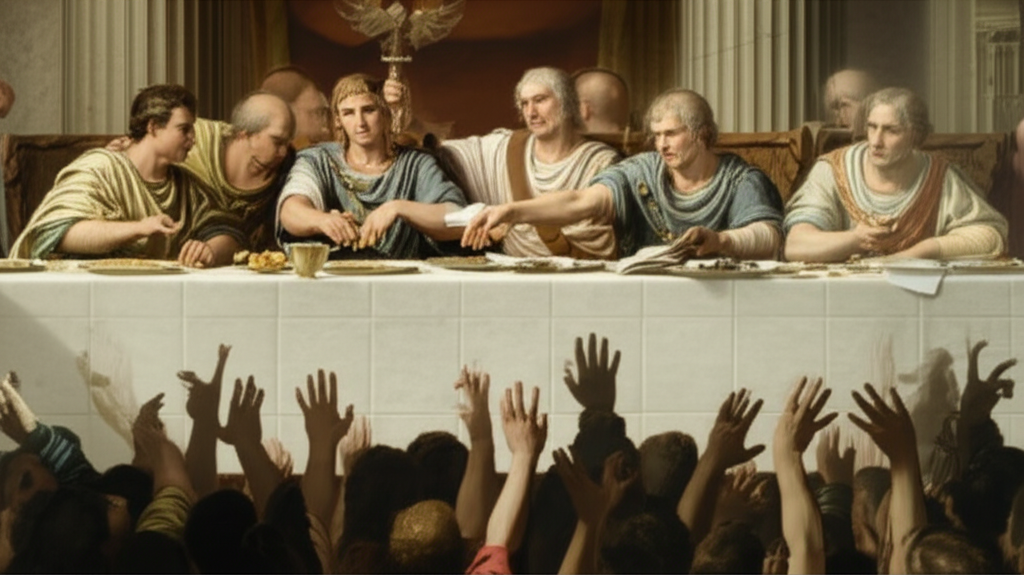 is visible but appears to be leaning precariously, its foundations undermined by the activities at the feast. Light illuminates the wealthy, while the masses remain in gloom, symbolizing the concentration of resources and influence.)
Historical Echoes and Contemporary Concerns
The warnings from the Great Books of the Western World resonate powerfully through history. The decline of the Roman Republic, for instance, is often attributed to the increasing wealth disparities and the political power of a landed aristocracy that eventually undermined republican institutions. The Venetian Republic, while enduring, was a classic oligarchy, where power was tightly held by a few noble families.
In the modern era, while direct rule by the wealthy is often veiled by democratic forms, the philosophical questions remain pertinent. The concerns about the influence of corporate wealth on policy-making, the funding of elections, and the growing gap between the richest and the rest are direct echoes of the ancient philosophers' anxieties about the nature of oligarchy. The fundamental tension between private economic interest and the public good continues to challenge the integrity of government.
The Challenge to the Polis: Erosion of the Common Good
When power is concentrated in the hands of the wealthy, the very notion of the "common good" becomes distorted. Policies are no longer crafted with the broad welfare of all citizens in mind, but rather to serve the narrow interests of the ruling elite. This leads to:
- Increased Inequality: The gap between the rich and the poor widens, leading to social stratification and resentment.
- Erosion of Civic Virtue: When citizens perceive the government as serving only a select few, their faith in democratic institutions wanes, and their willingness to participate in civic life diminishes.
- Social Unrest: Extreme inequality and perceived injustice can breed instability, protests, and even revolution, as predicted by Aristotle.
- Loss of Meritocracy: Opportunities for advancement become less about talent and effort, and more about connections and inherited wealth.
Conclusion: A Perennial Philosophical Problem
The relationship between "Oligarchy and the Concentration of Wealth" is not merely an economic issue; it is a profound philosophical problem that strikes at the heart of political justice and the very purpose of government. The insights from the Great Books of the Western World remind us that unchecked wealth accumulation poses an existential threat to any polity aspiring to be just, stable, and truly representative.
Understanding this dynamic is the first step towards vigilance. As Benjamin Richmond, I contend that a society's commitment to the common good is perpetually tested by the allure of concentrated power derived from concentrated wealth. The philosophical imperative remains to continually examine and reform the structures that allow for such imbalances, ensuring that the government serves the many, not merely the few.
YouTube Video Suggestions:
-
📹 Related Video: PLATO ON: The Allegory of the Cave
Video by: The School of Life
💡 Want different videos? Search YouTube for: "Plato's Republic Oligarchy Explained"
-
📹 Related Video: ARISTOTLE ON: The Nicomachean Ethics
Video by: The School of Life
💡 Want different videos? Search YouTube for: "Aristotle Politics Forms of Government Wealth Power"