

Oligarchy and the Concentration of Wealth: A Philosophical Inquiry
Summary
The enduring philosophical debate surrounding Oligarchy reveals a profound and often perilous connection between the concentration of Wealth and the exercise of Power within a Government. From the ancient Greeks to modern political thought, thinkers have consistently warned that when wealth becomes the primary determinant of political influence, the state inevitably devolves into an oligarchy—a rule by the wealthy few. This system, far from being stable, tends to perpetuate and intensify economic inequality, creating a vicious cycle where concentrated wealth begets concentrated power, and concentrated power serves to further enrich its holders, often at the expense of the broader society and the principles of justice.
The Genesis of Oligarchy: A Timeless Warning
In the grand tapestry of political philosophy, few themes resonate with such persistent urgency as the dangers of Oligarchy. Ancient Greek philosophers, particularly Plato and Aristotle, meticulously dissected the forms of Government, identifying oligarchy not merely as a type of rule, but as a specific pathology arising from an imbalance in the body politic. For Benjamin Richmond, this is not merely an academic exercise; it is a fundamental inquiry into the very health and sustainability of human societies.
Plato, in his Republic, traces the decline of the ideal state through various stages, depicting oligarchy as the successor to timocracy, driven by the insatiable pursuit of Wealth. He describes a society where "riches and the rich are honored, and virtue and the virtuous dishonored." Aristotle, in his Politics, further refines this understanding, defining oligarchy explicitly as the rule of the rich, contrasted with aristocracy (rule of the best) or even democracy (rule of the many). The common thread is clear: when Wealth becomes the singular criterion for Power, the state is already on a perilous path.
Understanding the Oligarchical State
An Oligarchy is characterized not just by the presence of rich people, but by the principle that Wealth itself qualifies one for Power. It is a Government where the laws, institutions, and policies are shaped primarily to protect and enhance the interests of the propertied class.
Key Characteristics of an Oligarchical Government:
- Rule by the Wealthy Few: Political
Poweris concentrated in the hands of a small, affluent elite. - Property Qualification: Citizenship and public office are often tied to property ownership or a certain level of
Wealth. - Prioritization of Economic Interests: Laws and policies are designed to benefit the rich, often at the expense of the poor or middle class.
- Suppression of Dissent: Mechanisms are often in place to limit the political participation and influence of the less affluent.
- Internal Divisions: Oligarchies are frequently unstable due to internal rivalries among the wealthy and resentment from the disenfranchised.
Plato vividly portrays the oligarchic individual as one driven by avarice, whose soul is divided between necessary and unnecessary desires, ultimately dominated by the love of money. This psychological portrait mirrors the state itself, where the pursuit of gold overshadows justice and civic virtue.
The Vicious Cycle: Wealth Begetting Power, Power Begetting Wealth
The most insidious aspect of Oligarchy is its self-perpetuating nature. The concentration of Wealth does not merely lead to Power; once in Power, the oligarchs then employ the machinery of Government to further consolidate and expand their Wealth.
Consider the mechanisms through which this cycle operates:
- Legislative Influence: Oligarchs use their
Powerto enact laws that favor their economic interests. This might include tax breaks for the rich, deregulation that benefits their industries, or policies that suppress wages for laborers. - Control of Institutions: They exert influence over judicial systems, regulatory bodies, and even educational institutions to protect their status and ideologies.
- Monopolies and Cartels: Through legislative and economic
Power, oligarchs can create or sustain monopolies, eliminating competition and ensuring continued high profits. - Resource Allocation: Public resources, such as land, natural resources, or infrastructure projects, are often directed to benefit the wealthy elite rather than the broader public good.
- Financial Systems: The financial architecture of the state—banking, credit, investment—is often structured to serve the interests of those with substantial capital.
Aristotle noted that oligarchies are inherently unstable because they create a vast chasm between the rich and the poor, leading to envy, factionalism, and ultimately, revolution. The very mechanism that sustains them—the extreme concentration of Wealth and Power—also sows the seeds of their destruction.
Philosophical Reflections on Wealth and Power
The Great Books of the Western World offer a profound and consistent critique of the dangers inherent in the unchecked concentration of Wealth and its inevitable link to Power.
| Philosopher | Key Insight on Oligarchy/Wealth Concentration | Relevant Work |
|---|---|---|
| Plato | Oligarchy arises from the honoring of wealth over virtue; leads to a divided state and individual soul. | The Republic |
| Aristotle | Defines oligarchy as rule by the rich; emphasizes its instability due to extreme inequality and factionalism. | Politics |
| John Locke | While advocating for property rights, his framework can be interpreted to show how immense accumulation could lead to unequal political influence if not properly balanced. | Two Treatises of Government |
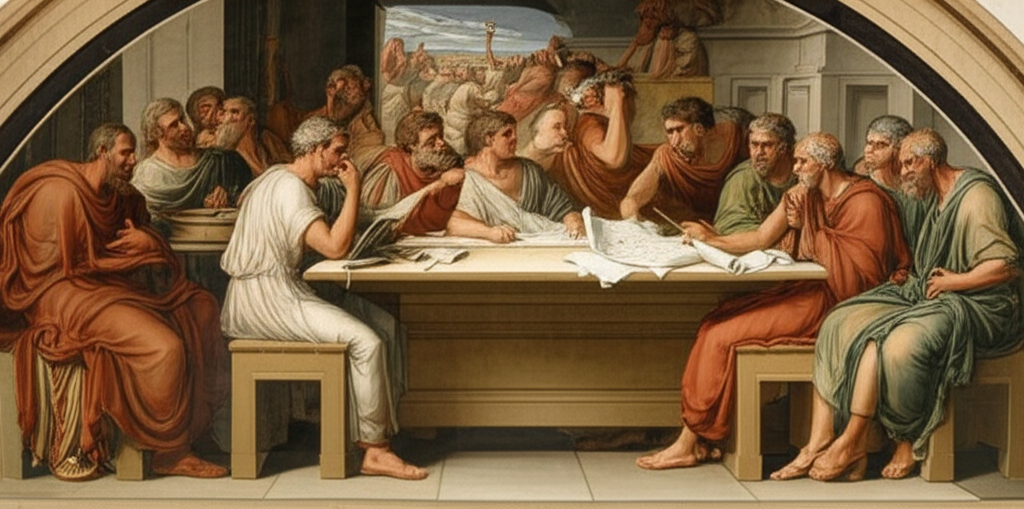
The warnings from these thinkers are not merely historical curiosities; they serve as perennial reminders of the delicate balance required to maintain a just and stable Government. When the pursuit of Wealth becomes the sole engine of a society, and Power is merely its extension, the very foundations of civic life begin to erode.
The Enduring Challenge
The challenge of Oligarchy and the concentration of Wealth remains one of the most pressing philosophical and practical concerns for any society. It forces us to confront fundamental questions about justice, equality, and the purpose of Government. Is a state truly just if its laws are primarily designed to benefit a select few? Can a society thrive when the majority are systematically disempowered by economic disparity?
The insights from the Great Books of the Western World provide a robust framework for understanding these dynamics. They compel us to be vigilant, to scrutinize the structures of Power and Wealth in our own societies, and to strive for a form of Government where Power serves the common good, not merely the coffers of the privileged.
**## 📹 Related Video: PLATO ON: The Allegory of the Cave
Video by: The School of Life
💡 Want different videos? Search YouTube for: ""Plato's Republic Oligarchy Explained - Philosophy Tube" or "Aristotle Politics Oligarchy and Wealth Inequality"."**