

No Kings Part 6
As the “No Kings” protests have made clear, few recent presidents have inspired more visceral debates about leadership and the boundaries of power than Donald Trump. For some, he embodies the kingly threat that has haunted every republic—brazen, unaccountable, trampling norms. For others, he is the very opposite: the disruptive figure bent on returning power to the forgotten and wrenching control away from distant elites. To move beyond caricature, we must examine the record: did Trump, in policy and practice, keep faith with America’s servant-leadership ideal—or did his presidency merely recapitulate the centralizing habits of his predecessors?
Trump’s Rhetoric: “A Republic Restored”?
From the start, Trump’s campaign was a cry against the established order—an attack on political dynasties, bureaucrats, “deep state” actors, and regulatory regimes. His supporters rallied to promises of deregulation, tax cuts, and the return of control to “the people.” He championed religious freedom, warned against global entanglements, and pledged to “drain the swamp.”
The language was revolutionary and restorationist—echoing George Washington’s warnings against political factions, Eisenhower’s distrust of the military-industrial complex, and even the Founders’ suspicion of concentrated power.
But what of the reality?
Rack-and-Stack: Trump’s Presidency against the Kingly Template
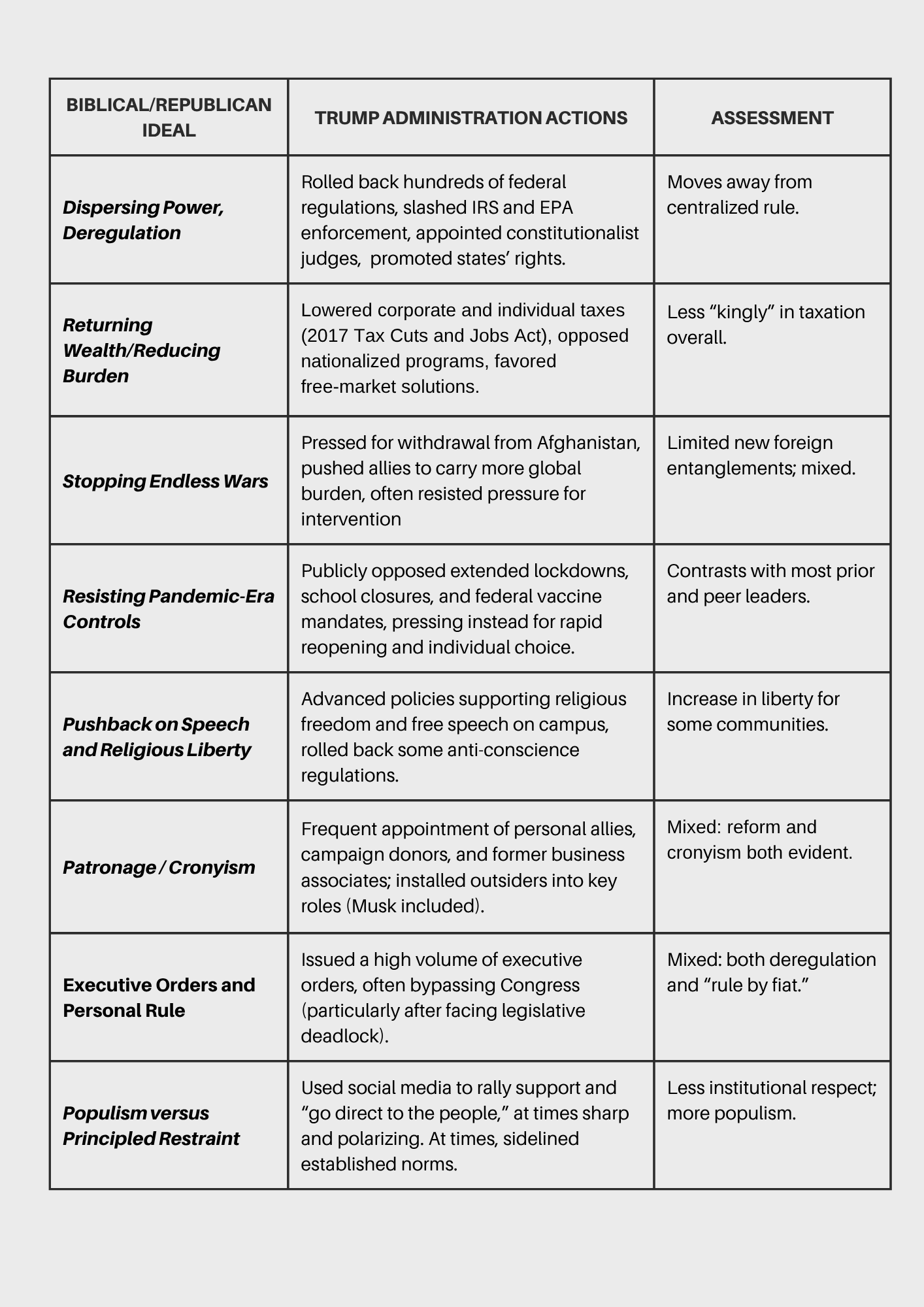
Let’s examine Trump’s record alongside our established kingly criteria:
The Paradox: Dismantling the King’s Palace—With a King’s Pen?
A fair survey of Trump’s conduct reveals contradiction. On the one hand, he clearly attempted to reduce dependency on the federal government, cut taxes and regulations, and push back against mission creep in both foreign and social policy. His culture-war stance, though polarizing, often revolved around the question of what government should not do—what limits should restrain the State for religion, business, and the individual.
“The health of a democratic society may be measured by the quality of functions performed by private citizens.” — Alexis de Tocqueville, Democracy in America
On the other hand, his tactical use of executive orders (especially when blocked by Congress); the centrality of his own persona (and the expectation of fealty from appointees); and his willingness to skirt, at times, constitutional guardrails, all evoked the kingly style he loudly opposed. In the end, the mechanisms of centralized power—built over generations—remained at hand and in play.
Did Trump’s Supporters Want “No King”—Or Their Own?
This is where the American drama turns ironic. Many who cheered Trump’s “return power to the people” message also longed for someone to finally “get things done”—to confront the bureaucracy, silence opponents, or sweep aside gridlock by any means necessary. The “No Kings” protestors saw a would-be strongman; Trump’s base often hoped he would wield power as a liberator, but without noticing how the tools at hand—from executive orders to regulatory decrees—remain inherently kingly, no matter whose name is on the gold letterhead.
Meanwhile, Trump’s critics—whether establishment or radical—frequently demanded more oversight, more regulation, and a return to the comfort of managed outcomes. The result: two sides, both pulling on the levers of power, both terrified of the other’s kingly ambitions.
Theological Irony: The King That Sets You Free?
One reason Trump has been so divisive is that his appeal is less to the customary “left vs. right,” but to the contest between dependency and independence. His vision, as with the biblical Joshua, is unapologetically risky: less government shield, more trust in those closest to the problem—families, local communities, religious institutions. Yet, as with Israel of old, such freedom is daunting. It is easier, amid uncertainty, to demand a king—whether your own, or someone else’s to resist.
The Riddle Remains
So what is Trump—a would-be autocrat, or a flawed Moses smashing old idols while anxiously building new ones? The truth, as always, is less about the man and more about the moment. As long as the apparatus of centralized government remains in place, the temptation to rule by decree and for parties to demand “their king” persists.
Looking to the Unseen Standard
In the coming installment, we look for a resolution. Israel’s story offers a third way: David, the king “after God’s heart,” who succeeded to the extent that he submitted himself and his rule to a higher authority. Today, the real question for America is not whether we’ll have kings, or who gets to hold the pen—but whether any leader, or people, can rediscover the discipline of service, justice, and law that stands above party, power, and personality.
Next up: Part 7—Can there be a righteous king, or do we always fall into the same traps? What does it look like for power to be truly “under authority,” and what would it take—culturally and spiritually—for America to recover this deeper vision?


