

No Kings Part 2
Having emerged from under the shadow of Egypt, Israel was tasked with the challenging work of forging a genuine nation—a people uniquely defined not by their oppressors, but by their covenant with God. With Moses gone, the mantle of leadership fell to Joshua: a soldier, but first a servant; a man not only of courage but of principle.
God’s Pep Talk: “Be Strong and Courageous”
At the very threshold of the Promised Land, God does not hand Joshua a politics of expediency, but offers a clear and bracing charge:
“Be strong and very courageous. Be careful to obey all the law my servant Moses gave you; do not turn from it to the right or to the left, that you may be successful wherever you go... Have I not commanded you? Be strong and courageous. Do not be afraid; do not be discouraged, for the Lord your God will be with you wherever you go.”
—Joshua 1:7, 9
In these lines are two keys: relentless courage, and fidelity to the rule of law—God’s law, not man’s improvisation. The formula is simple, but not easy: Conquer fear; obey completely.
How and Why Did They Fail?
Despite miraculous victories—Jericho’s walls falling, the sun standing still—Israel ultimately left the charge unfinished. The Book of Joshua and, even more vividly, the Book of Judges, recount not only triumphs but treaties made with adversaries out of fear, half-measures granted for the sake of convenience, alliances with peoples and customs forbidden by God.
For example:
- The Gibeonites deceive Israel into making a treaty with them (Joshua 9), and the Israelites—fearing the consequences of breaking their oath—honor it, despite God’s explicit instructions.
- Numerous tribes fail to drive out the inhabitants of their allotted lands, either because of intimidation or a desire for “peace and security.” They compromise, allowing Canaanite practices and idols to persist in their midst.
What emerges is a pattern: obedience weakened by doubt, courage compromised by a desire for quick peace, and a preference for doing “what seems right at the time” over the harder work of singular commitment.
Peace Treaties, Pragmatism, and the Slow Creep of Decay
On its face, these treaties and deals might appear prudent—diplomacy instead of war, coexistence over conquest. But the repeated narrative lesson is blunt: partial faithfulness sows the seeds of eventual collapse. When principle gives way to pragmatism, the very identity of the people is slowly eroded. The Book of Judges draws a tragic line connecting these initial compromises to later chaos.
Are We Reliving the Same story?
In reflecting on these early failures, I can’t help but see the same dynamic at work today. Our own national story—of revolution, of founding ideals, of a “new world” based on law and justice—was, like Joshua’s commission, noble and full of promise. Like the Israelites, America’s founders wrestled with an uncomfortable truth: that free government is sustained not by laws alone, but by the ethical backbone of the people. Washington’s parting advice was clear:
“Of all the dispositions and habits which lead to political prosperity, Religion and morality are indispensable supports... Let us with caution indulge the supposition that morality can be maintained without religion.” —George Washington, Farewell Address, 1796
Alexis de Tocqueville, the great observer of American democracy, pointed to where society’s health is most visible—not in Congress, but in the homes and neighborhoods of ordinary citizens:
“The health of a democratic society may be measured by the quality of functions performed by private citizens.” —Alexis de Tocqueville, Democracy in America
And Madison, ever the realist, balanced hope with warning:
“As there is a degree of depravity in mankind which requires a certain degree of circumspection and distrust; so there are other qualities in human nature which justify a certain portion of esteem and confidence.” —James Madison, The Federalist No. 55
Every time America has settled for expedience over first principles, for comfort over conviction, we have drifted from our foundation. Whether through selective application of justice, unwise alliances, or the negotiation of core values to avoid conflict, the result is the same: a weakening of communal identity, and fertile ground for the next crisis.
The Enduring Lesson: Partial Obedience, Lasting Consequences
So much of Israel’s later disaster was foreshadowed here. The impulse to seek safety by making deals, rather than trusting God and the courage He requires, finds a parallel in our own civic compromises. Laws half-enforced, rights unevenly granted, obligations sidestepped—for the sake of peace or progress—always come back to haunt us. The difficult call is still the same: “Be strong. Be courageous. Do not waver from the standard.”
Racking and Stacking: Then and Now
Let’s summarize the parallels:
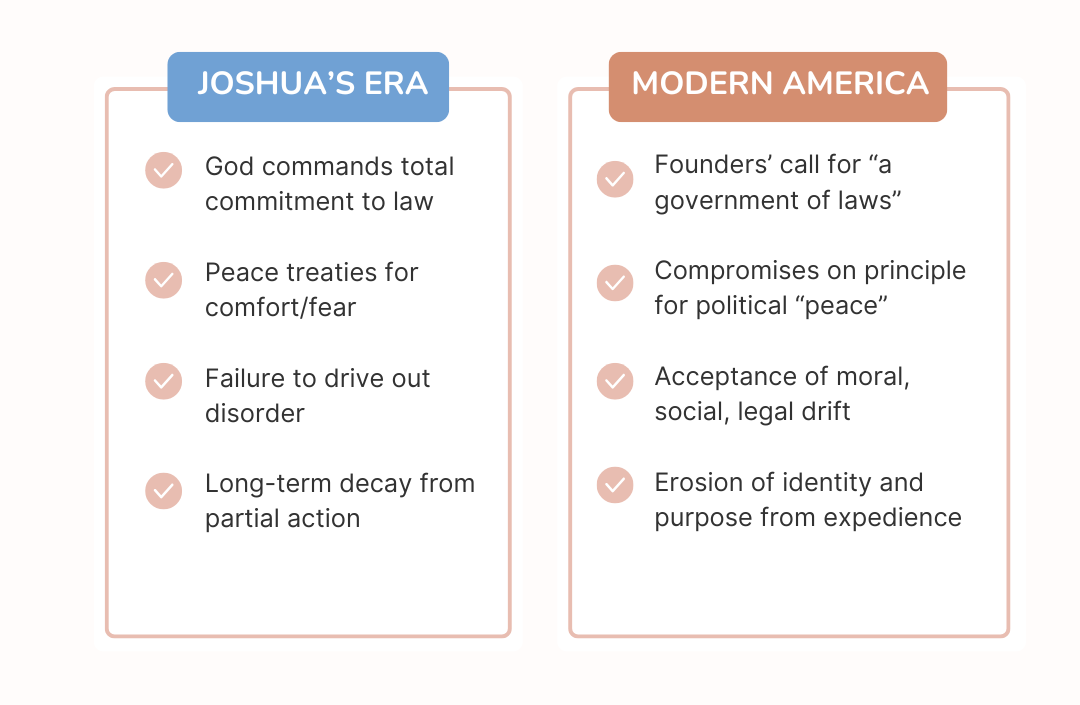
Are we living in greater obedience and courage than those early Israelites—or are we forever one anxious generation away from golden calves of our own?
Seeds Planted for Future Crisis
As we move toward the period of the Judges, remember: Israel’s failure was not simply a failure of strategy, but a failure of heart—a lack of resolve to do what principle demanded, despite the cost. The echo we must hear is this: doing “most” of what is right is not enough. The virtue lies in completeness, in obedience.
Next up, we explore what happens when that resolve weakens—when “everyone did what was right in their own eyes”—and the yearning for a king emerges as both a solution and a new dilemma.
Preview of Upcoming Installments
Again, these are my views, and not the official or unofficial teachings of any religion.
Stay tuned for Part 3, as we delve into the age of the Judges: chaos, decadence, insecurity, and the slow creep from radical freedom to the longing for imposed order. Is a king truly the answer? Or is the real danger the failure to heed the voice that called us out of Egypt—not just to escape bondage, but to forge something lasting and just?


